"Concerns Over Price Pressure on Semiconductor Industry Outside China"
China has reportedly spent more on semiconductor manufacturing equipment in the first half of this year than the combined expenditures of the United States, South Korea, Taiwan, and Japan. This has raised concerns that the semiconductor sector could face an 'overproduction' issue similar to those seen in solar power and electric vehicles.
On the 4th (local time), CNBC cited a report from the Semiconductor Equipment and Materials International (SEMI), stating that China spent $24.73 billion (approximately 32.9824 trillion KRW) on semiconductor manufacturing equipment procurement in the first half of this year.
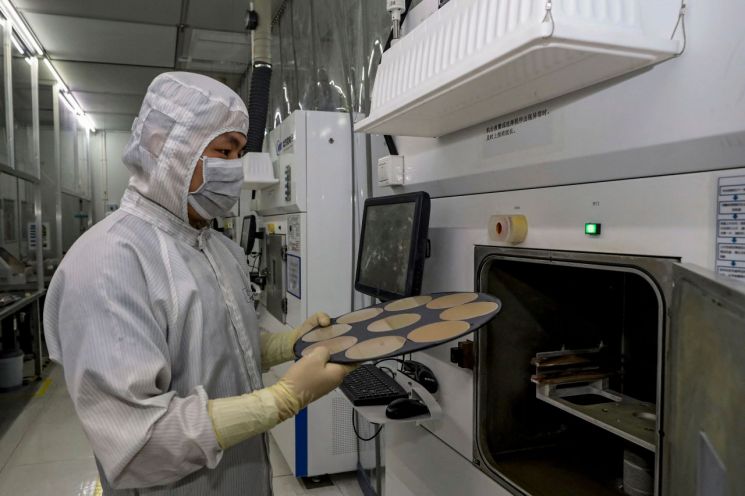
During the same period, North America, South Korea, Taiwan, and Japan collectively spent $23.68 billion (approximately 31.5868 trillion KRW) on procurement. The majority of North America's expenditure came from the United States. China is thus spending more on equipment purchases than the combined major semiconductor manufacturing countries.
CNBC explained, "China's large-scale investment is driven by its goal of 'semiconductor rise' due to potential restrictions on access to core semiconductor technologies caused by Western regulations."
Clark Cheng, SEMI's Senior Director, stated that excessive investment in semiconductor manufacturing equipment could lead to reduced efficiency and utilization in the future, and may also exert price pressure on the semiconductor industry outside China.
In fact, the world is concerned about China's 'overproduction' in sectors such as solar power, steel, and electric vehicles. As China's economy slows due to a real estate market collapse, the Chinese government is aggressively supporting the manufacturing sector with subsidies to stimulate the economy. China accounts for 80% of global solar panel production, but prices have plummeted due to oversupply. The United States, Europe, and Canada have significantly increased tariffs on Chinese electric vehicles.
China is currently focusing on legacy (mature process) semiconductor production used in home appliances and automobiles. Alex Capri, a senior lecturer at the National University of Singapore and a researcher at the Heinrich B?ll Foundation, evaluated that "China is on the right path in producing legacy chips."
Market research firm TrendForce predicted last October that China's share in the legacy semiconductor market of 28nm (1nm = one billionth of a meter) and above would rise from 29% in 2023 to 33% in 2027.
However, Capri noted that China "still has a long way to go" in the advanced semiconductor sector. He stated that U.S. export controls have effectively blocked China's access to extreme ultraviolet (EUV) lithography equipment, a key technology for advanced semiconductor manufacturing. He said, "China is trying to figure out (advanced semiconductor) manufacturing technology, but it is almost impossible."
He regarded Huawei's Mate 60 Pro smartphone as an exceptional case. Last year, Huawei made headlines by releasing the Mate 60 Pro smartphone equipped with a 7nm chip developed in-house and produced by SMIC. Once ranked first in global smartphone shipments, Huawei faltered after being placed on the U.S. sanctions list against China. Unable to access advanced semiconductors, it could not release 5G smartphones, causing its market share to decline rapidly. However, last year it succeeded in semiconductor manufacturing using its own technology. Capri pointed out, "This is a breakthrough for SMIC, but manufacturing 7nm semiconductors without EUV equipment is less efficient and much more costly."
© The Asia Business Daily(www.asiae.co.kr). All rights reserved.

















