"The Public Interest of Protecting the People and Athletes Is Far More Important"
The Constitutional Court has ruled that the legal provision mandating the cancellation of qualifications for sports instructors who have been fined for forced molestation does not violate the Constitution.
According to the legal community on the 5th, the Constitutional Court unanimously upheld the constitutionality of the relevant part of the proviso in Article 12, Paragraph 1 of the National Sports Promotion Act, which stipulates the grounds for cancellation of sports instructors' qualifications, in a case requesting a constitutional review of the law.
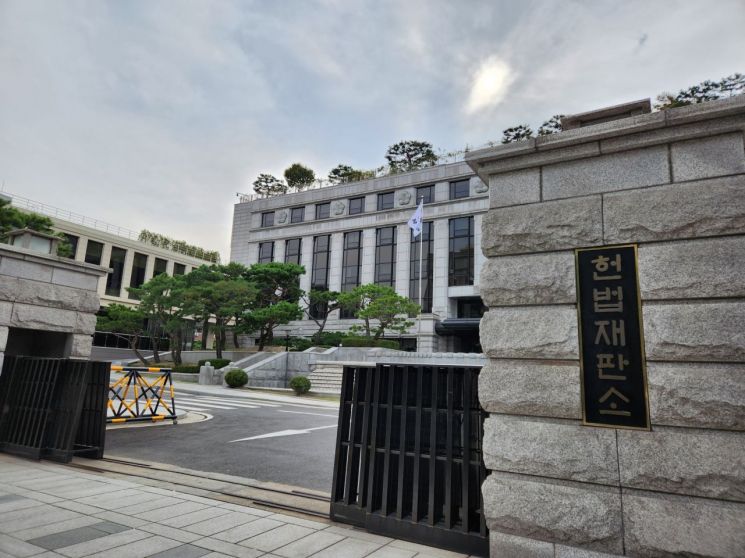
The Constitutional Court stated in its order, "The part of Article 12, Paragraph 1, Proviso 4 of the National Sports Promotion Act concerning 'persons who have committed the crime of forced molestation under Article 298 of the Criminal Act among the sexual violence crimes under Article 11-5, Paragraph 4, Subparagraph (a)' and have been fined with a confirmed penalty does not violate the Constitution."
The reason the Constitutional Court's order is so complex is that this case is not a direct constitutional complaint under Article 68, Paragraph 1 of the Constitutional Court Act but a constitutional review of a law case.
In constitutional review cases, the principle of "prematurity of the trial" applies, meaning only the laws applied in the trial that affect the order or main judgment reason are subject to review by the Constitutional Court. Therefore, only the laws directly applied to the claimant's trial in this case are judged for constitutionality.
On November 9, 2018, Mr. A, who obtained the Level 2 Professional Sports Instructor (Soccer) qualification under the National Sports Promotion Act and worked as a soccer coach at a soccer club, was fined 2 million won by summary order on November 13, 2020, for forcibly molesting Ms. B (female), the planning director of the soccer club where he worked, by touching the back of her neck with his left hand on October 20 of the same year. The summary order was confirmed on November 28 of the same year.
On November 15, 2021, the Minister of Culture, Sports and Tourism canceled Mr. A's sports instructor qualification pursuant to Article 12, Paragraph 1, Proviso and Subparagraph 4 of the National Sports Promotion Act (Cancellation of Sports Instructor Qualifications, etc.).
Article 12, Paragraph 1 of the National Sports Promotion Act states, "The Minister of Culture, Sports and Tourism may cancel or suspend the qualification of a sports instructor for up to five years based on the resolution of the Sports Instructor Qualification Management Committee under Article 12-2 if the sports instructor falls under any of the following subparagraphs. However, if the sports instructor falls under any of subparagraphs 1 to 4, the qualification must be canceled."
In other words, this provision enumerates the grounds for canceling or suspending a sports instructor's qualification: ▲obtaining the qualification by falsehood or other fraudulent means (Subparagraph 1), ▲performing duties during the suspension period (Subparagraph 2), ▲lending the sports instructor certificate to others (Subparagraph 3), and ▲falling under any of the subparagraphs of Article 11-5 (Subparagraph 4). If any of these apply, the qualification must be canceled.
In this case, Subparagraph 4, which stipulates that cases falling under Article 11-5 of the National Sports Promotion Act are grounds for mandatory cancellation, was applied.
Article 11-5 (Disqualification of Sports Instructors) of the National Sports Promotion Act lists cases where a person cannot become a sports instructor, including ▲persons sentenced to imprisonment or higher and within two years of completion or exemption of execution (Subparagraph 2), ▲persons sentenced to probation for imprisonment or higher and still within the probation period (Subparagraph 3), ▲persons who committed crimes listed in each subparagraph of Article 11-5, Paragraph 4, and who have been sentenced to imprisonment or higher or treatment custody and are within 20 years of completion or exemption of execution or within 10 years of a confirmed fine (Subparagraph 4), and ▲sports instructors who committed injury or assault against athletes and are within 10 years of completion or exemption of execution of imprisonment or higher.
Article 11-5, Subparagraph 4 specifies two types of crimes: ▲sexual violence crimes under Article 2 of the Act on Special Cases Concerning the Punishment of Sexual Crimes (Subparagraph (a)) and ▲sexual crimes against children and adolescents under Article 2, Paragraph 2 of the Act on the Protection of Children and Juveniles from Sexual Abuse (Subparagraph (b)).
Article 2 of the Act on Special Cases Concerning the Punishment of Sexual Crimes defines "sexual violence crimes," including public indecency, abduction or enticement for molestation, forced molestation, rape, and robbery rape.
This case involved Mr. A, whose qualification as a sports instructor was canceled after a confirmed fine for forced molestation, so the review was limited to the part of Article 12, Paragraph 1, Proviso 4 of the National Sports Promotion Act concerning persons who committed forced molestation under Article 11-5, Paragraph 4, Subparagraph (a) and were fined.
Mr. A, whose qualification was canceled, filed an administrative appeal, which was dismissed. On June 3, 2022, he filed a lawsuit against the Minister of Culture, Sports and Tourism seeking cancellation of the qualification cancellation. During the trial, he requested a constitutional review of the relevant provisions of Article 12, Paragraph 1, Subparagraph 4 of the National Sports Promotion Act, which were the basis for his qualification cancellation.
The Seoul Administrative Court accepted Mr. A's request for constitutional review of the provisions mandating mandatory cancellation of qualifications for sports instructors fined for forced molestation and referred the case to the Constitutional Court.
Meanwhile, Mr. A also challenged the transitional provision stipulating that even if the sexual violence crime was committed before the law was amended, if the sentence was confirmed after the amended law took effect, the qualification cancellation would apply retroactively, arguing it was unconstitutional retroactive legislation. This request was dismissed. He separately filed a constitutional complaint under Article 68, Paragraph 2 of the Constitutional Court Act regarding this provision, but the Constitutional Court upheld its constitutionality.
The Constitutional Court first acknowledged that the provision restricts the freedom to choose one's occupation but ruled it constitutional as it did not violate the principle of proportionality.
The Court stated, "The provision under review aims to protect public trust in the sports instructor qualification system, protect citizens from potential sexual crimes, and foster a healthy sports environment. The legislative purpose is legitimate, and the means are appropriate."
Furthermore, the Court found that mandating cancellation of qualifications for sports instructors fined for forced molestation does not violate the minimal infringement or balance of interests.
The Court explained, "Forced molestation directly infringes on the victim's sexual self-determination rights, and the blameworthiness of the perpetrator is high. It is difficult to ensure transparency and fairness of the system by arbitrarily canceling qualifications based on individual circumstances or severity of the crime. Therefore, the legislature's decision to mandate cancellation without considering individual case specifics or crime severity is not manifestly unreasonable."
As grounds for this judgment, the Court cited ▲the rapidly increasing public demand for everyday sports activities, necessitating protection of all citizens from potential sexual crimes, and ▲the strict hierarchical structure between sports instructors and athletes in professional sports, where instructors have absolute influence, making it difficult for victims of sexual violence to disclose or effectively respond to the abuse.
The Court also noted, "Outside fields where sports instructor qualifications are mandatorily required by law, such as school sports club instructors, even if the qualification is canceled, individuals can still engage in sports coaching work. Therefore, the restriction on freedom to choose one's occupation is limited."
It added, "The provision under review limits cancellation to cases where a fine was imposed for forced molestation, not any crime resulting in a fine. Therefore, it cannot be said that the minimal infringement requirement is unmet simply because there is no lower limit on the fine."
Finally, regarding the balance of interests, the Court concluded, "Although sports instructors fined for forced molestation suffer the disadvantage of mandatory qualification cancellation, the public interest in protecting citizens and athletes engaged in sports, fostering a healthy sports environment, promoting public health and fitness, and protecting and nurturing athletes is far more significant. Therefore, the provision satisfies the balance of interests."
The Seoul Administrative Court also raised the issue of the constitutionality of the disqualification period of "10 years from the date the fine is confirmed," during its referral for constitutional review.
In response, the Constitutional Court stated, "This case's disposition was based on the provision under review, which sets the grounds for qualification cancellation after a confirmed fine for forced molestation for the applicant who held the sports instructor qualification. The constitutionality of the disqualification period does not affect the legality of this disposition and will not be separately judged."
In other words, whether a sports instructor whose qualification was canceled due to the provision mandating cancellation can reacquire the qualification after several years is not relevant to the legality of the qualification cancellation itself and thus is not subject to review in this constitutional review case.
© The Asia Business Daily(www.asiae.co.kr). All rights reserved.

















