Jeonbuk Iksan 2 Factory with a Maximum Annual Production Capacity of 70 Tons
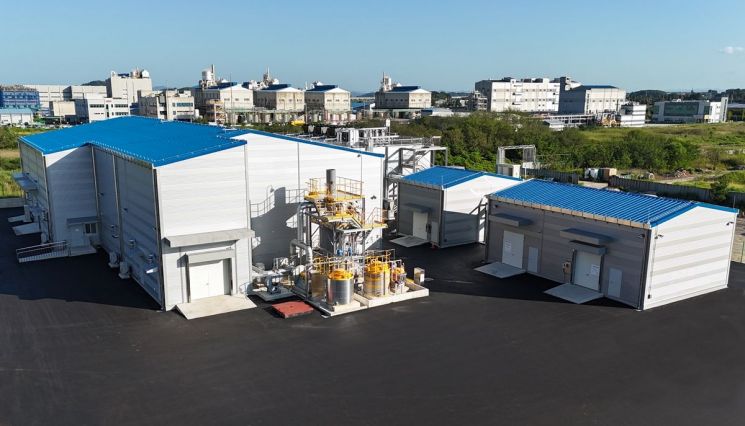 Exterior view of the pilot plant for sulfide-based solid electrolytes completed at Lotte Energy Materials' Iksan Plant 2 in Jeonbuk. Photo by Lotte Energy Materials
Lotte Energy Materials has completed a pilot plant for sulfide-based solid electrolytes.
Lotte Energy Materials announced on the 5th that it has completed a pilot plant for the production of 'sulfide-based solid electrolytes,' a core material for next-generation all-solid-state batteries, by investing 15 billion KRW in its Iksan 2 plant in Jeonbuk. Solid electrolytes are the key material of all-solid-state batteries, known as the 'dream battery.' They replace the conventional gel-type electrolytes with solid-state electrolytes, enhancing battery safety and energy density.
The pilot plant, utilizing a site area of 1,619㎡, has a production capacity of 70 tons of solid electrolyte per year. After obtaining the necessary permits and approvals by the end of this month, it will begin trial operations and plans to produce initial samples by the end of the year.
The sulfide-based solid electrolytes developed by Lotte Energy Materials feature differentiated technological competitiveness, including ▲ high-ion conductivity particle size control technology ▲ moisture stability and high-ion conductivity composition ▲ and various mass production process development capabilities such as dry/wet synthesis.
First, the high-ion conductivity particle size control technology adjusts the size and distribution of solid electrolyte particles, enabling faster and more efficient battery charge and discharge speeds. Next, the moisture stability composition ensures that even when the sulfide-based solid electrolyte is exposed to moisture, its chemical structure and performance are maintained, overcoming drawbacks such as battery performance degradation or shortened lifespan. Additionally, the high-ion conductivity composition facilitates fast and efficient lithium-ion movement within the solid electrolyte, further improving battery charge and discharge speeds.
Finally, the synthesis technology of sulfide-based solid electrolytes significantly impacts battery performance and production costs. With various mass production process development capabilities such as dry and wet synthesis, it enables large-scale battery production and cost reduction.
Lotte Energy Materials plans to provide evaluation samples to domestic and international all-solid-state battery-related companies after completing trial operations and stabilization by the end of this year. If final approval and product supply contracts with customers are secured by 2025, it will begin expanding production facilities to an annual capacity of 1,200 tons in 2026 and start full-scale mass production in 2027. In particular, the company aims to provide a total solution for all-solid-state materials by linking with the 'nickel-plated copper foil,' which it developed first in Korea.
Previously, the customer-tailored nickel-plated copper foil developed by Lotte Energy Materials can adjust the nickel thickness and copper foil strength according to customer requirements. Its strengths include high adhesion to active materials through nickel surface treatment and excellent corrosion resistance that maintains original properties and functions without corrosion or discoloration caused by chemical reactions.
Kim Yeon-seop, CEO of Lotte Energy Materials, said, "We have completed preparations to begin full-scale production of sulfide-based solid electrolytes, which received positive evaluations from customers since the research stage." He added, "Together with nickel-plated copper foil, a next-generation battery anode current collector and all-solid-state battery material, we will advance as a leading material company in the all-solid-state market through customer sales."
© The Asia Business Daily(www.asiae.co.kr). All rights reserved.
![Clutching a Stolen Dior Bag, Saying "I Hate Being Poor but Real"... The Grotesque Con of a "Human Knockoff" [Slate]](https://cwcontent.asiae.co.kr/asiaresize/183/2026021902243444107_1771435474.jpg)
















