Real GNI (Gross National Income) Decreased by 1.4% in Q2
Largest Drop in 2 Years and 9 Months Since Q3 2021
Rising International Oil and Commodity Prices Worsen Wallet Conditions
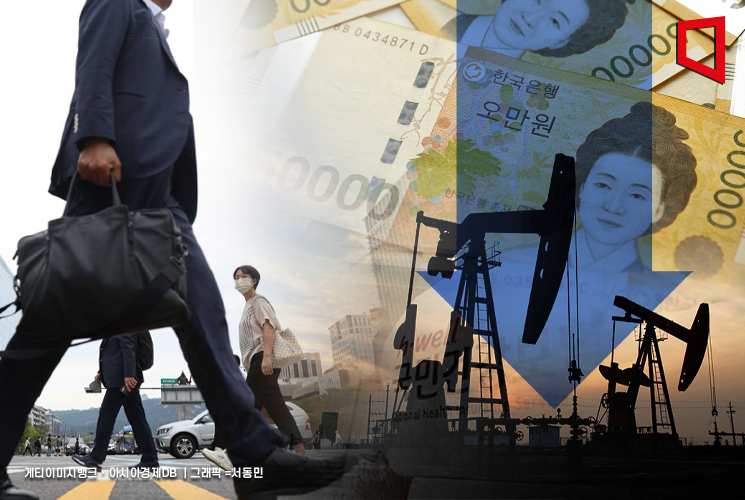
As international oil prices and other commodity prices rose, the income of our citizens significantly decreased in the second quarter. The Korean economy also contracted by 0.2% compared to the first quarter.
Real GNI Falls 1.4% in Q2, Largest Drop in 2 Years and 9 Months
According to the provisional national income data for the second quarter released by the Bank of Korea on the 5th, the real Gross National Income (GNI) in Q2 decreased by 1.4% compared to the previous quarter. This is the largest decline in 2 years and 9 months since Q3 2021, which recorded -1.6%. It is also the first time in a year that real GNI has recorded a negative figure since Q2 last year (-0.9%).
Real GNI is an indicator that reflects the real purchasing power of income earned by our citizens both domestically and abroad. A decrease in real GNI can also be interpreted as a reduction in the economic capacity of the people.
The decline in real GNI was largely influenced by the deterioration in terms of trade, which expanded real trade losses from 11.3 trillion won in the previous quarter to 16.6 trillion won in Q2. The rise in international oil prices and other commodity prices such as natural gas in Q2 increased trade losses.
When real trade losses increase, even if domestic production activities or exports are active, the effect of income growth is minimal, which can eventually lead to reduced consumption and sluggish investment.
A Bank of Korea official explained, "Although semiconductor prices rose in Q2, improving export conditions, the rise in international oil prices worsened import conditions, leading to a deterioration in terms of trade."
Meanwhile, real net primary income from abroad also decreased from 5.9 trillion won in the previous quarter to 4.4 trillion won, further widening the decline. Real net primary income from abroad is the figure obtained by subtracting the income earned by foreigners domestically from the income earned by our citizens abroad.
Q2 Economic Growth Rate -0.2%, Impacted by Weak Domestic Demand
The real Gross Domestic Product (GDP) growth rate of South Korea in the second quarter was recorded at -0.2% compared to the previous quarter. This figure is the same as the preliminary estimate announced on July 25.
The Korean economy experienced positive growth for five consecutive quarters, with 0.4% in Q1 last year, 0.6% in Q2, 0.8% in Q3, 0.5% in Q4, and continuing into Q1 this year. The negative growth observed in Q2 is the first in six quarters since Q4 2022 (-0.5%).
Exports continued to perform well, while domestic demand remained sluggish. Looking at the growth rate by expenditure components in Q2, exports increased by 1.2% quarter-on-quarter, led by automobiles and chemical products. Imports also rose by 1.6%, mainly due to energy products such as crude oil and natural gas, as well as petroleum products.
On the other hand, private consumption, an indicator of domestic demand, decreased by 0.2% quarter-on-quarter due to weak consumption of goods such as clothing and passenger cars. Construction investment also declined by 1.7%, with decreases in both building and civil engineering construction. Facility investment fell by 1.2%, as machinery such as semiconductor manufacturing equipment decreased.
Compared to the earlier preliminary figures, facility investment (up 0.9 percentage points), exports (up 0.3 percentage points), and imports (up 0.4 percentage points) were revised upward, while construction investment (down 0.7 percentage points) and government consumption (down 0.1 percentage points) were revised downward.
Examining the contribution to growth by expenditure components for Q2 GDP, all showed negative figures except for government consumption (0.1 percentage points). Net exports contributed -0.1 percentage points, construction investment -0.3 percentage points, private consumption -0.1 percentage points, and facility investment -0.1 percentage points. This contrasts with Q1, where all areas except facility investment showed positive growth.
By sector, the private sector accounted for -0.2 percentage points, while the government sector was neutral at 0 percentage points, indicating that negative growth was driven by the private sector.
Looking at growth rates by economic activity, the construction sector's weakness was prominent. Construction decreased by 6.0% due to declines in both building and civil engineering construction. Manufacturing increased by 0.8% quarter-on-quarter, led by transportation equipment. The service sector maintained the previous quarter's level, with decreases in information and communication, wholesale and retail, and accommodation and food services, but increases in transportation and real estate.
© The Asia Business Daily(www.asiae.co.kr). All rights reserved.


















