21 Construction Sites Selected This Year
Only 2 Underwent Competition
Trend of Construction Companies Avoiding Competition Becomes More Evident
Competitive bidding is disappearing in the selection process of construction companies for redevelopment and reconstruction projects in Seoul. This year, 90% of maintenance projects that signed construction contracts chose construction companies through private contracts without competition. This is the result of construction companies avoiding competition due to a lack of financial capacity amid a downturn in the construction market. As a trend of not expanding projects recklessly takes hold, it is expected that the private contract trend will continue for the time being.
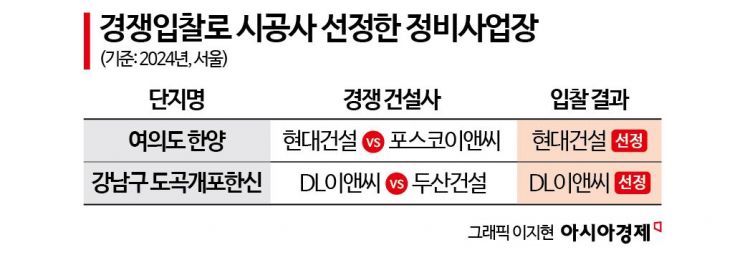
Only 2 Sites with Competitive Bidding for Construction Companies... 19 Projects ‘Entered Without a Fight’
According to the maintenance industry on the 5th, a total of 21 redevelopment and reconstruction projects in Seoul (excluding small-scale projects such as street housing maintenance) selected construction companies this year. Among them, only 2 projects had two or more construction companies participating in bidding and competing. These are the Hanyang Apartment in Yeouido, Yeongdeungpo-gu, which is undergoing reconstruction, and Dogok Gaepo Hanshin in Gangnam-gu. In March this year, Hyundai Engineering & Construction and POSCO E&C competed for the Hanyang Apartment in Yeouido, and after competition, Hyundai E&C won the construction rights. Last month, DL E&C and Doosan Construction competed for Dogok Gaepo Hanshin, with DL E&C gaining the upper hand.
The remaining 19 projects selected construction companies through private contracts. Under current law, competitive bidding is the principle for selecting construction companies in maintenance projects. If no construction company or only one participates in the bidding, the bid is automatically canceled. After two or more cancellations, contracts can be made with the sole bidding construction company. Most projects repeatedly failed in bidding and eventually signed private contracts with construction companies. For construction companies, this means winning construction rights without competition.
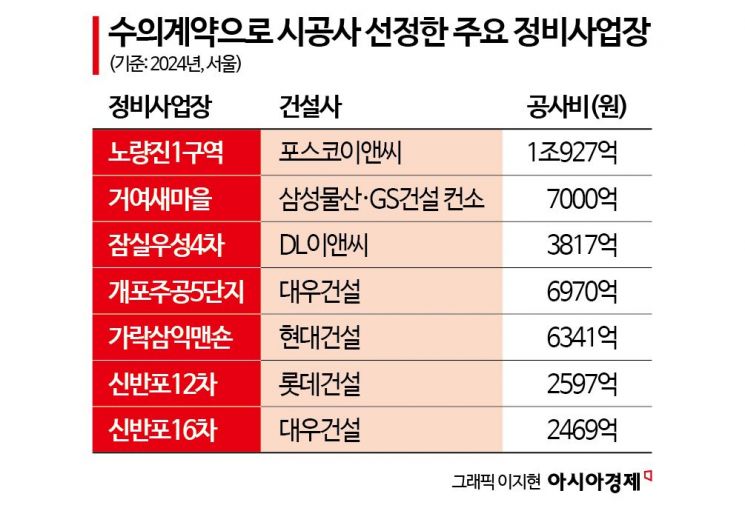
The situation is no different in the Gangnam area, which is considered a prime location. In Jamsil Woosung 4th complex in Songpa-gu, after two failed attempts to select a construction company, the construction cost was raised from 7.6 million KRW to 8.1 million KRW per 3.3㎡, and a contract was signed with DL E&C. Garak Samik Mansion, which will become a large complex with 1,500 households after reconstruction, is also proceeding with the project through a private contract with Hyundai E&C. In Gaepo Jugong 5th complex in Gangnam-gu, only Daewoo Construction participated in both bidding announcements, resulting in cancellations, and eventually Daewoo Construction was appointed as the construction company.
The number of private contract cases may increase further. Machon 3 District in Songpa-gu, which recently failed due to no construction companies participating in the bidding, is pushing to designate GS Engineering & Construction as the preferred private contract negotiation partner. Samhwan Garak is also following the private contract process with GS E&C. Sadang 5 District in Dongjak-gu is likely to have Hyundai Engineering, and Gajaeul 7 District in Seodaemun-gu is expected to have a consortium of Hanwha Construction and GS E&C.
Construction Companies Avoid Competition... Associations Lose Negotiation Power
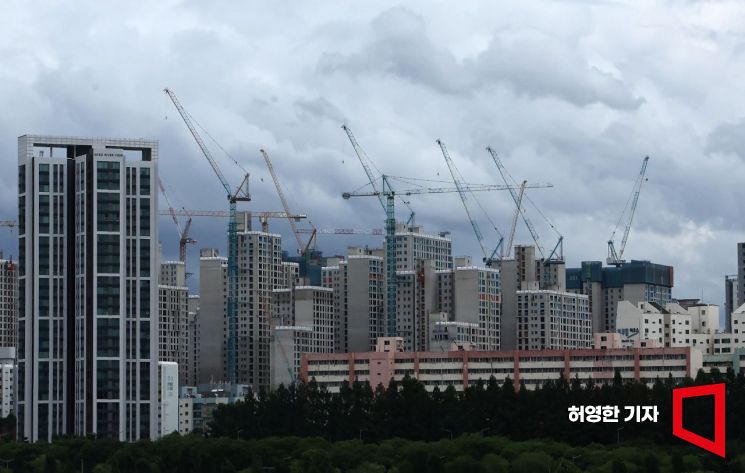 When crossing the Banpo Bridge in Seoul, you can see new apartments, old apartments, and apartments under construction all at once in the Sinbanpo area. The new apartments on the left are Acro Riverview Sinbanpo, the low old apartments on the right are Sinbanpo 2nd Complex, and the apartments under construction in the back are the Maple Xi new construction site. Photo by Huh Younghan younghan@
The tendency of construction companies to avoid competition for construction rights has become more pronounced this year. A maintenance industry official said, "Gaepo-dong was originally a location where 2 to 3 construction companies would naturally compete," adding, "Even in places where competition was expected, many bids have been canceled." In fact, the Sinbanpo 2nd reconstruction project in Jamwon-dong, Seocho-gu, which plans to build more than 2,000 households, was initially expected to see competition between Hyundai E&C and Daewoo Construction, but only Hyundai E&C submitted a letter of intent to bid. Bangbae 7 District and Banpo Samho Garden Mansion 5th complex were also expected to have a ‘two-way battle’ between construction companies, but no one participated in the bidding, resulting in cancellations.
An official from a major construction company said, "Due to the rise in raw material and labor costs, the profitability of projects has declined compared to before," adding, "No matter how good the location is, the need to engage in cutthroat competition while accepting losses has decreased." Another construction company official said, "If one construction company has already invested a lot of effort, there seems to be a mood to avoid competition." When construction rights competition occurs, considerable costs such as promotional expenses arise. If the project rights are not won, these become sunk costs, and with shrinking construction margins, the expenses have become burdensome.
From the association’s perspective, it may become difficult to gain an advantage in negotiations with construction companies when private contracts are made. In competitive situations, construction companies try to offer proposals favorable to association members, such as reducing construction costs, specialized design, and financial support, to win construction rights. A maintenance industry official said, "While deciding on a construction company through private contracts is considered better than delaying the project, there are concerns that the association may be led during the contract process regarding construction costs and future construction progress stages."
Despite these concerns, private contracts are expected to increase as long as the construction market and management conditions do not improve. Song Seung-hyun, CEO of Urban and Economy, said, "Looking at the management conditions of construction companies, debts are increasing and financial capacity is decreasing, creating a tendency to avoid reckless competition," adding, "If even the Gangnam area is being contracted privately, projects on the outskirts of Seoul and in provincial areas may not be able to find construction companies at all." He added, "In prime projects such as Hannam 4 District and Apgujeong Apartments, if the demands of association members do not align with construction companies, competition may fail to materialize."
© The Asia Business Daily(www.asiae.co.kr). All rights reserved.



















