Hankyung Association 'Impact and Implications of System Introduction by Industry' Report
"Efforts to Secure Infrastructure and Improve Power Supply-Demand Balance Needed"
Starting next year, the implementation of the 'Regional Differential Electricity Pricing System' based on the wholesale electricity price (System Marginal Price·SMP) is anticipated, but there are claims that the effect of dispersing large-scale electricity demand across regions may be limited. The electronic and telecommunications sectors are expected to see the largest increase in electricity cost burdens.
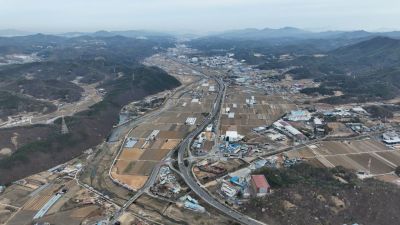 A panoramic view of Idong-eup and Namsa-eup areas in Cheoin-gu, Yongin Special City, where the 'Yongin Advanced System Semiconductor National Industrial Complex' and others are being established.
 [Photo by Yongin Special City]
On the 5th, the Korea Economic Association (KEA) presented a report titled 'Introduction of Regional Differential Electricity Pricing System, Industry-specific Ripple Effects and Implications,' estimating the cost burden by industry within the metropolitan area after the system's implementation and proposing improvements.
Earlier, the Ministry of Trade, Industry and Energy's Energy Committee announced in May and June that the regional differential pricing system would be implemented in phases. The plan is to apply the system to wholesale prices next year and to retail prices starting in 2026. Wholesale prices refer to the price paid by electricity retailers (such as Korea Electric Power Corporation) when purchasing electricity from power generators (such as Korea Hydro & Nuclear Power). Retail prices are the prices paid by end consumers to retailers for electricity usage.
KEA analyzed that after the system's implementation, the total annual electricity cost burden for manufacturing industries in the metropolitan area could increase by up to 1.4 trillion KRW. Since industrial electricity demand has lower price elasticity compared to other contract types such as residential or general use, the industrial sector's burden is expected to be greater. Price elasticity refers to the rate of change in electricity demand relative to changes in electricity prices.
They anticipated that electricity rates would decrease in regions with high local electricity self-sufficiency and increase in regions with low self-sufficiency. A lower electricity self-sufficiency rate means greater reliance on electricity supply from other regions.
According to prior studies by the Korea Electric Research Institute and the Korea Energy Economics Institute, if wholesale electricity prices are differentiated, the wholesale price gap between the metropolitan and non-metropolitan areas is expected to be around 19 to 34 KRW per kilowatt-hour (kWh).
KEA's analysis estimates that after the system's implementation, the total annual electricity cost burden for manufacturing industries in the metropolitan area will increase by between 800 billion KRW (19 KRW per kWh difference) and 1.4 trillion KRW (34 KRW difference).
By industry, the electronic and telecommunications sectors are expected to see the largest increase in electricity costs (up to 600 billion KRW). Based on the standard industrial classification's middle category, the average increase in electricity cost burden for 25 manufacturing industries is estimated at 55 billion KRW.
KEA agrees with the purpose of the system but forecasts that it will be difficult to induce significant changes in corporate location decisions after its introduction.
According to KEA, as of last year, 64.2% of industrial electricity consumption was distributed outside the metropolitan area. Changes in electricity consumption by industry within the metropolitan area over the past three years (2021?2023) were minimal, decreasing by only 0.1 percentage points. Meanwhile, electricity consumption in the electronic and telecommunications sectors within the metropolitan area expanded by 3.4 percentage points during the same period.
The increase in electricity consumption by the electronic and telecommunications sectors in the metropolitan area is due to the construction and expansion of semiconductor factories and data centers, often referred to as 'electricity guzzlers.' The concentration of these facilities in the metropolitan area is because it is easier to secure personnel there. KEA expects that despite rising electricity costs, the concentration of the electronic and telecommunications sectors in the metropolitan area will continue.
Additionally, energy-intensive buildings within the metropolitan area tend to be infrastructure-related or concentrated in a few business sites. For example, energy-intensive buildings in Seoul include department stores, hospitals, and schools. Such infrastructure is difficult to relocate regardless of electricity costs.
KEA suggested that efforts to secure corporate infrastructure considering private demand and incentive systems should precede. When deciding on locations, companies prioritize infrastructure such as facilities, related industry agglomeration, and workforce attraction. The reason companies prefer the metropolitan area is more due to ease of securing personnel and favorable living conditions than concerns about electricity supply costs.
They also emphasized the need to consider measures to improve the balance of electricity supply and demand by local governments within the five-year statutory plan called the 'Comprehensive Plan for the Local Era.' The 'Act on Supporting the Return of Overseas-Expanded Enterprises to Korea' (U-turn Act), implemented since 2013, also highlighted the linkage between corporate location and the 'Comprehensive Plan for the Local Era.'
KEA stated, "To induce large-scale dispersion of electricity demand, it is necessary to prepare corporate infrastructure acquisition efforts and measures to improve electricity supply-demand balance by local governments together with the (Regional Differential Electricity Pricing System)."
© The Asia Business Daily(www.asiae.co.kr). All rights reserved.

















