Gradual Implementation Starting with Large Enterprises
Promoting Secured Loans Instead of Mid-Term Withdrawals
The government will gradually mandate the introduction of retirement pensions in workplaces to ensure stable income in old age. It will also seek ways to increase the retirement pension yield, which is currently at the 2% level.
On the 4th, the government announced a pension reform plan that includes this retirement pension restructuring proposal.
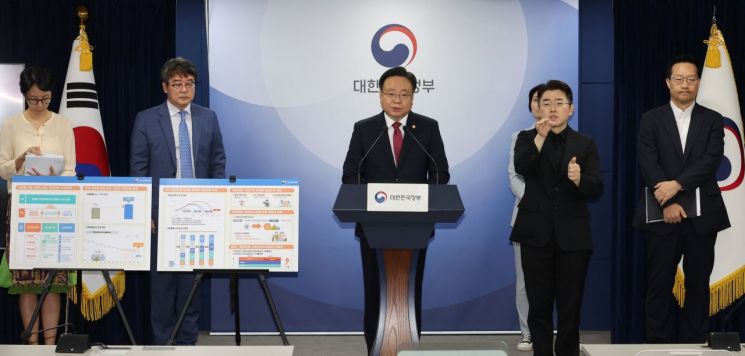 Minister of Health and Welfare Cho Kyu-hong (center) is announcing the pension reform promotion plan on the 4th at the Government Seoul Office in Jongno-gu, Seoul. [Image source=Yonhap News]
Introduced in 2005, the retirement pension has so far played a supplementary role alongside individual pensions within the existing pension system. Going forward, it will become a practical foundation for securing income in old age.
The government will mandate the introduction of retirement pensions across all workplaces. Current regulations require all workplaces with one or more employees to implement either severance pay or retirement pensions. Large-scale workplaces have mainly introduced retirement pensions through labor-management agreements, but the adoption rate remains low among small and medium-sized enterprises (SMEs).
In fact, the adoption rate is 91.9% for workplaces with 300 or more employees, but only 23.7% for those with fewer than 30 employees. Especially for micro and small enterprises, the government has the SME Retirement Pension Fund, a fund-type retirement pension system, but its adoption rate is still relatively low.
The government views the expansion of retirement pensions as necessary to prevent delayed severance pay and reduce income disparities among workers in old age. Accordingly, it will gradually expand the introduction of retirement pensions, starting with large-scale workplaces. In particular, it will continue to provide incentives (20% support on contributions for workers earning less than 130% of the minimum wage) to encourage enrollment in micro workplaces and the SME Retirement Pension Fund, where participation rates are low.
Measures to increase the retirement pension yield, which is currently at the level of deposit interest rates, will also be pursued. The average annual yield of retirement pensions over the past 10 years was 2.07%. The government will review improvements to the default option (automatic management with pre-selected products when the subscriber does not provide investment instructions), introduced last year, and promote robo-advisor discretionary investment services to raise yields. It will also establish a physical transfer system that allows maintaining financial products invested through existing retirement pension accounts while switching to accounts at other financial companies.
Additionally, while strengthening early withdrawal requirements, the government is considering measures to prevent pension assets from being withdrawn prematurely by activating collateral loans. For example, the criteria for early withdrawal, which were previously allowed for reasons such as home purchase, jeonse lease, or nursing care for more than six months, will be tightened to prevent funds from being withdrawn in the middle.
The government explained, "Through improvements to the retirement pension system, we aim to increase the current 10.4% pension-type receipt rate" and "plan to make it function as a stable source of income for old-age living."
© The Asia Business Daily(www.asiae.co.kr). All rights reserved.
![Clutching a Stolen Dior Bag, Saying "I Hate Being Poor but Real"... The Grotesque Con of a "Human Knockoff" [Slate]](https://cwcontent.asiae.co.kr/asiaresize/183/2026021902243444107_1771435474.jpg)
















