2024 Global Economy and Financial Stability Conference
Ralph Ossa, Chief Economist of the World Trade Organization (WTO)
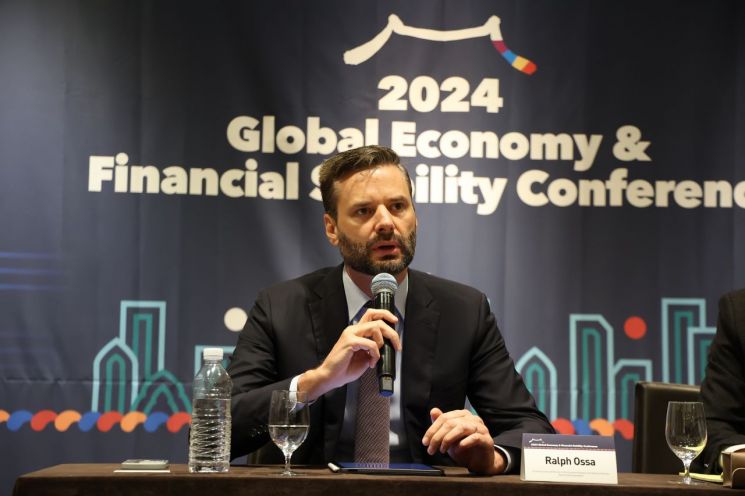 Ralph Ossa, Chief Economist of the World Trade Organization (WTO), is speaking at a press conference for the '2024 Global Economy and Financial Stability' conference held on the morning of the 4th at the Plaza Hotel in Jung-gu, Seoul. (Photo by Bank of Korea, Ministry of Economy and Finance, Korea Development Institute)
As protectionism spreads mainly between the United States and China, South Korea's trade structure is diversifying, with service sector trade nearly doubling before and after COVID-19, indicating various opportunity factors, according to an assessment.
Ralph Ossa, Chief Economist and Director of Economic Research and Statistics at the World Trade Organization (WTO), made these remarks on the 4th at a press conference held at the Plaza Hotel in Jung-gu, Seoul, during the '2024 Global Economy and Financial Stability Conference' jointly hosted by the Ministry of Economy and Finance, the Bank of Korea, the Korea Development Institute (KDI), and the Bretton Woods Reform Committee.
Director Ossa stated, "Since South Korea counts the United States and China as important trade partners, it operates in a trade environment that can be greatly affected, but even in situations like the US-China conflict, there are many opportunities for Korea. Many countries are diversifying their sourcing or procurement not only from China but also including other countries through a 'China+1' strategy, and Korea corresponds to that plus one country."
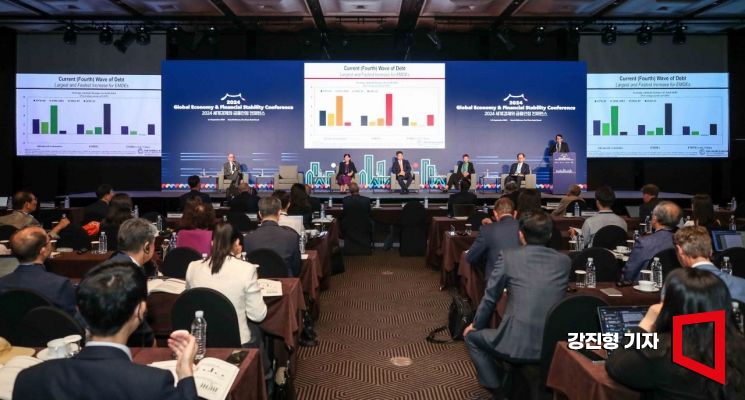 Aihan Kose, Deputy Chief Economist of the World Bank, is giving a presentation at the "2024 Global Economy and Financial Stability Conference" held on the 4th at the Plaza Hotel in Jung-gu, Seoul. Photo by Jinhyung Kang aymsdream@
Director Ossa pointed out the increase in South Korea's service sector trade before and after COVID-19. He said, "A part that many people do not pay attention to is that not only manufacturing but also the service sector's share is growing in Korea's trade. When comparing before and after COVID-19, Korea has nearly doubled the scale of trade in this sector."
He positively evaluated the growth of Korea's service sector, centered on the digital field, from the perspective of economic diversification. However, he emphasized the importance of maintaining a rules-based multilateral order. Director Ossa said, "The reason the global economy was able to recover rapidly after the first lockdown measures during the COVID period was because an open trade order existed. A rules-based multilateral trading system is important from the perspective of economic security."
Director Ossa pointed out that Europe's macroeconomic situation could become a risk factor for the global economy in the future. He said, "We will be able to understand the US economic situation through the labor statistics to be released this week, but a bigger risk factor is Europe's economic situation. When Europe's economic growth rate is updated around October, it may slightly decrease from previous forecasts."
He continued, "A more structural and long-term risk factor is that global trade is becoming fragmented due to geopolitical crises. If the current geopolitical risks persist, real income worldwide could decrease by about 5%. Maintaining a multilateral and rules-based global trade order is essential to enhance economic sustainability and solve poverty."
© The Asia Business Daily(www.asiae.co.kr). All rights reserved.
![Clutching a Stolen Dior Bag, Saying "I Hate Being Poor but Real"... The Grotesque Con of a "Human Knockoff" [Slate]](https://cwcontent.asiae.co.kr/asiaresize/183/2026021902243444107_1771435474.jpg)

















