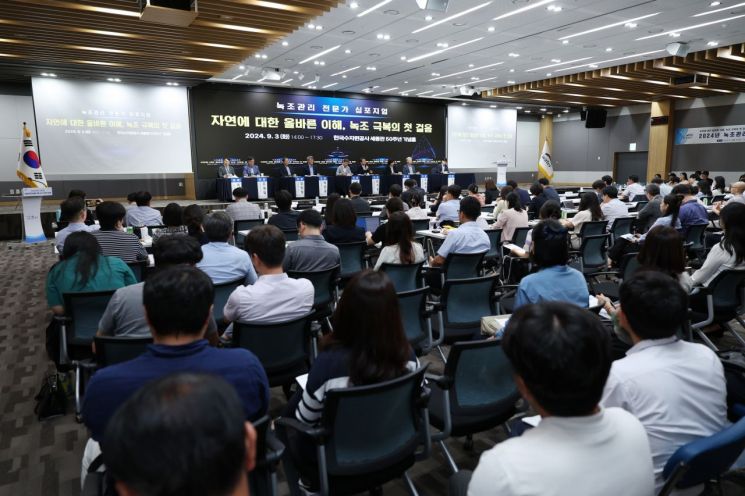
 On the 3rd, attendees are listening to the panel experts' discussion at the 'Algae Control Expert Symposium' held at Korea Water Resources Corporation in Daedeok-gu, Daejeon. Photo by Water Resources Corporation
There has been criticism that scientific evidence is lacking regarding claims that aerosols inhaled due to algal blooms can be fatal to humans.
On the 3rd, Professor Cho Young-chul of the Department of Environmental Engineering at Chungbuk National University participated as a discussant at the 'Algal Bloom Management Expert Symposium' held at the Water Resources Corporation in Daedeok-gu, Daejeon, stating, "Recently, concerns have been raised not only about damage to water sources and public hygiene during algal blooms but also about the possibility of inhaling algal toxins contained in aerosols generated from the blooms," adding, "However, the correlation between inhalation of aerosols containing algal toxins and health effects has not been proven."
Aerosols refer to tiny solid or liquid particles suspended in the air. They typically range in size from 0.001 to 100 μm and can be generated by natural factors such as yellow dust or volcanic ash, as well as artificial sources like automobile emissions and industrial facilities. It is known that inhalation of aerosols can be fatal to the respiratory system.
Environmental groups argue that aerosols containing algal toxins are generated as algal blooms occur. At the end of last year, they shared results analyzing MCs, one of the algal toxins in the air, mainly in the Nakdong River basin, claiming that toxins were detected even indoors in an apartment located 3.7 km away from the river.
Professor Cho explained, "The National Institute of Environmental Research and the Korean Society of Water Environment analyzed aerosol MCs collected from the Daecheong Lake, Geum River, and Nakdong River basins, and no toxins were detected in any of the samples," adding, "The difference is likely due to the different analytical and collection methods used in the two studies." He also pointed out, "There is a possibility of overestimation due to various interfering substances in environmental samples, and partially degraded MCs can also be measured, which is a drawback."
Professor Cho continued, "Recently, in Ohio near Lake Erie, about 8.7 billion KRW in research funding has been invested to conduct a health risk assessment of air exposure on 200 residents and water activity participants around the lake," and argued, "In Korea as well, in-depth research is needed to dispel public concerns about algal bloom occurrences."
© The Asia Business Daily(www.asiae.co.kr). All rights reserved.
![Clutching a Stolen Dior Bag, Saying "I Hate Being Poor but Real"... The Grotesque Con of a "Human Knockoff" [Slate]](https://cwcontent.asiae.co.kr/asiaresize/183/2026021902243444107_1771435474.jpg)
















