3.3% of Adults Experience Difficulties with Basic Reading, Writing, and Arithmetic Skills
It has been revealed that 1.46 million adults in South Korea, accounting for 3.3% of the adult population, are illiterate adults who cannot perform basic reading, writing, or arithmetic, drawing attention to an absurd question posed by a university student.
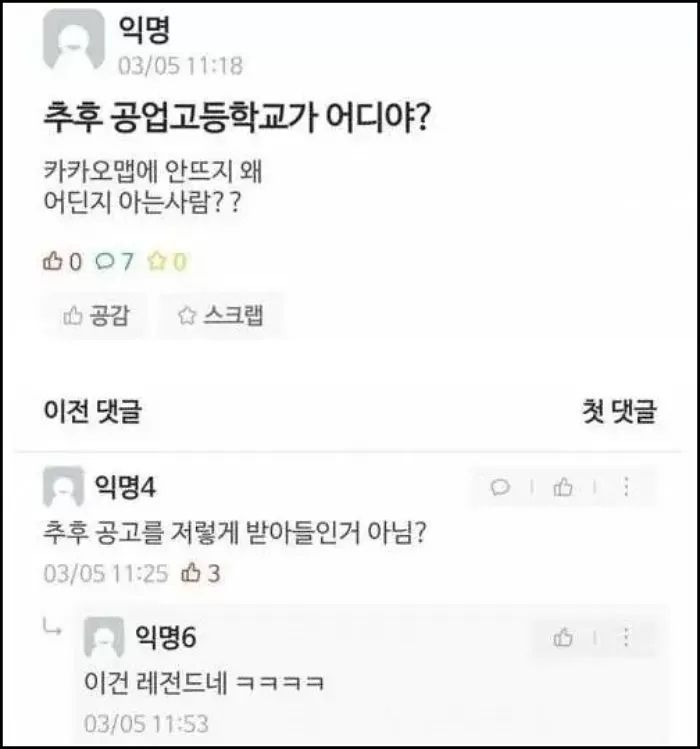
Recently, a post titled "Where is Chuhu Gongye High School?" was uploaded on various online communities, catching the eyes of netizens. The author asked, "Why doesn't it show up on the map? Does anyone know where it is?" In response, one netizen asked, "Could it be that you misunderstood 'Chuhu Gonggo' like that?" It seems they mistakenly interpreted '추후(追後) 공고(公告)', meaning 'announcement to be made later', as the name of a school.

'추후(追後)' means some time after an event has passed. Therefore, '추후 공지' means that the notice will be given later. Also, '공고(公告)' means to widely announce something to the public. If the location field says '추후 공고', it means the location will be announced later. In the end, the author appears to have misunderstood '공고(公告)' as '공고(工高)', an abbreviation for Gongye High School (Technical High School).
As the problem of declining literacy skills worsens, literacy controversies are frequently discussed. In June, a similar anecdote was posted on a community. The author, who identified as a 9-year veteran daycare teacher, wrote a post titled "Parents these days are too dumb," explaining, "Compared to 9 years ago, some parents have become very dumb. When I say 'OOOO is prohibited,' they naturally should understand it means 'OOOO is forbidden,' but they think 'OOO is good' and interpret it as 'Doing OOOO is the best.'
Also, "Some people really ask if 'In case of rain, the location changes to OO' means changing the location to OO in a region called 'rain,'" and "Can they really not know words like intake, feeding, or batch? In the past, no parents contacted me about these things, but recently the proportion has increased quite a bit," the author revealed.
Regarding this, Cheon Kyung-rok, director of the Reading Education Center at Gwangju National University of Education, said on YTN's 'NewsNOW,' "For elementary and middle school students, the best thing is to actively participate in school Korean language classes, and for adults, it is recommended to participate in social programs such as local libraries and reading programs." He added, "For those in their 30s to 50s with high media literacy, I recommend joining online reading communities according to their interests."
Meanwhile, the Ministry of Education announced the results of the '4th Adult Literacy Survey' in August. The adult literacy survey is conducted every three years targeting adults aged 18 and over nationwide. This year's survey was conducted through household visit interviews from September 1 to November 6 of last year.
According to the survey, 3.3% (1.46 million) of adults in South Korea were identified as 'illiterate' adults who have difficulty with basic reading, writing, and arithmetic. Illiterate adults classified as 'Level 1' literacy require learning at the level of 1st to 2nd grade elementary school. Those at 'Level 2', who can perform basic reading, writing, and arithmetic but have insufficient practical use in daily life (requiring learning at the 3rd to 6th grade elementary school level), accounted for 5.2%, or 2.313 million people.
© The Asia Business Daily(www.asiae.co.kr). All rights reserved.
![Clutching a Stolen Dior Bag, Saying "I Hate Being Poor but Real"... The Grotesque Con of a "Human Knockoff" [Slate]](https://cwcontent.asiae.co.kr/asiaresize/183/2026021902243444107_1771435474.jpg)

















