Vice Minister Park Minsu, "Emergency Medical System Not Collapsing"
"Emergency Room Staff Shortage Due to Resident Doctors Leaving"
The government will deploy military doctors and public health doctors to Kangwon National University Hospital, Sejong Chungnam National University Hospital, and Ewha Mokdong Hospital, which are experiencing disruptions in emergency room operations, starting from the 4th. They emphasized that the current partial emergency room gaps are a crisis situation caused by the emergency medical system triggered by the departure of residents in February and that it is "not at the level of emergency medical collapse."
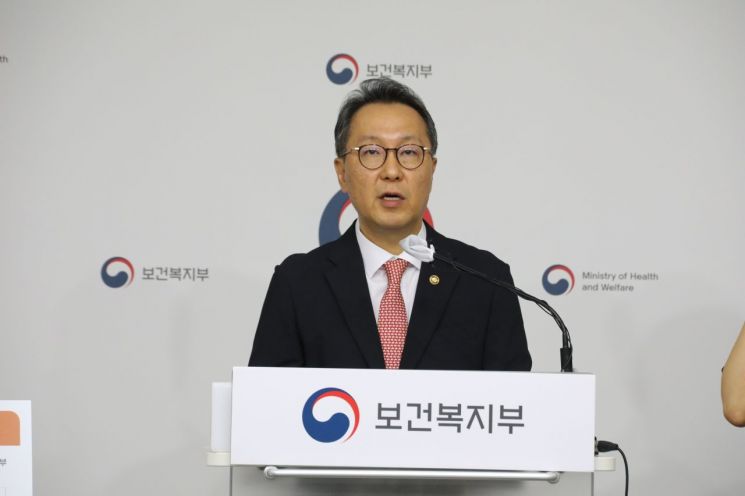
On the 3rd, Park Min-su, the 2nd Vice Minister of the Ministry of Health and Welfare, said at the daily emergency medical briefing, "To ensure that emergency rooms can resume normal operations quickly, we plan to additionally deploy military doctors to Kangwon National University, Sejong Chungnam National University, and Ewha Mokdong Hospitals starting from the 4th," adding, "To prepare for the operational restrictions at Konkuk University Chungju Hospital, we will deploy military doctors to Chungbuk National University Hospital and public health doctors to Chungju Medical Center to minimize disruptions in medical care."
He continued, "Emergency rooms at Konkuk University Chungju, Kangwon National University, and Sejong Chungnam National University Hospitals are operating on reduced hours, and one institution plans to operate on reduced hours soon," and explained, "Ewha Mokdong Hospital limits night-time treatment every Wednesday but will operate normally during the Chuseok holiday."
Vice Minister Park also refuted claims of 'emergency medical collapse,' noting that the average daily number of emergency room visits has recently decreased and the number of emergency medicine specialists has increased.
According to the Ministry of Health and Welfare, before the collective resignation of residents (first week of February), the average daily number of emergency room visits was 17,892, which increased to 19,783 in the third week of August, then decreased to 17,701 in the fourth week of August, and further dropped to 16,423 in the fifth week of August.
In particular, mild and non-emergency patients classified as levels 4-5 under the Korean Triage and Acuity Scale (KTAS) numbered 8,285 during normal times, increased to 8,541 in the third week of August, then decreased to 7,566 in the fourth week of August, and further declined to 6,967 in the fifth week of August.
The government also explained that 406 out of 409 emergency rooms, accounting for 99%, are operating 24 hours a day. As of the previous day (the 2nd), 5,925 emergency medical institution beds were in use, which is 97.6% of the usual 6,069 beds.
Vice Minister Park said, "Currently, some emergency medical institutions are struggling to maintain normal levels of care due to the departure of medical staff and reduced response capacity," but added, "However, we judge that the situation is not to the extent of emergency medical collapse as some have described." He also mentioned, "There are some voices predicting a surge in emergency medical institutions closing down in the future," but added, "During the emergency response week for the Chuseok holiday, we plan to minimize public inconvenience through measures such as operating on-call hospitals and clinics and increasing medical fees."
Regarding criticisms that surgeries and procedures for severe emergency diseases are being restricted in many places, he argued, "Restrictions on treatment for severe emergency diseases are not newly occurring but are long-standing issues caused by a shortage of essential medical personnel." According to the Ministry of Health and Welfare, among the 180 emergency medical centers nationwide, the number capable of performing thoracic aortic surgery is 72 during normal times and 69 as of the 2nd; for infant intussusception and obstruction, 93 during normal times and 83 currently; for infant endoscopy, 15 during normal times and 14 currently; and for obstetric emergency deliveries, 96 during normal times and 91 currently.
© The Asia Business Daily(www.asiae.co.kr). All rights reserved.
![Clutching a Stolen Dior Bag, Saying "I Hate Being Poor but Real"... The Grotesque Con of a "Human Knockoff" [Slate]](https://cwcontent.asiae.co.kr/asiaresize/183/2026021902243444107_1771435474.jpg)
















