The overseas export route for radioactive-labeled pharmaceuticals, which had restrictions on long-distance transportation, has been opened.
The Korea Atomic Energy Research Institute (hereinafter referred to as the Institute) announced on the 3rd that the research team led by Dr. Eunha Cho of the Isotope Research Division developed an "ultra-low temperature transport container" to be used for exporting the radioactive-labeled pharmaceutical "CaremIBG (131I) injection solution," and successfully transported it to three continents: North America (United States), Asia (Japan, India), and Europe (Poland).
Radioactive-labeled pharmaceuticals are medicines used to treat various intractable diseases such as neuroblastoma, created by combining radioactive isotopes with delivery agents within the body.
Currently, although many radioactive-labeled pharmaceuticals are being developed domestically, the only treatment actually used for patients with approval from the Ministry of Food and Drug Safety is the CaremIBG injection solution produced by the Institute.
However, including this injection solution, radioactive-labeled pharmaceuticals must maintain an ultra-low temperature state due to their molecular bonding structure, resulting in a short shelf life (3 days), and thus they have mainly been distributed domestically with restrictions on long-distance transportation. This is the background for the Institute's development of the ultra-low temperature transport container.
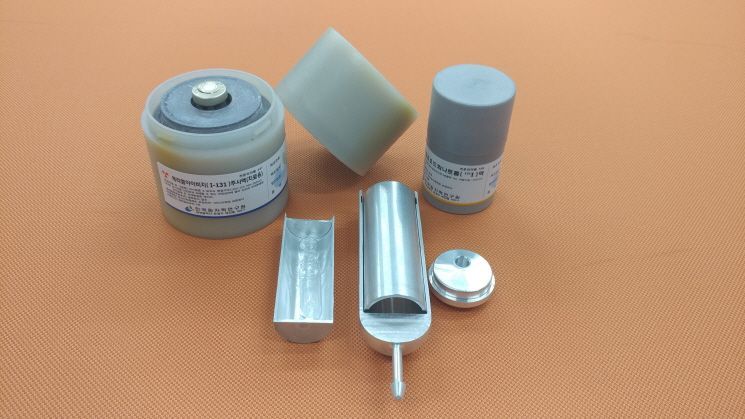 Radiopharmaceutical for treating refractory pediatric cancer (Carimibg Injection). Provided by Korea Atomic Energy Research Institute.
The ultra-low temperature transport container developed by the Institute enhances insulation performance and adds cushioning devices to maintain minus 60°C for up to 6 days, making long-distance transportation and export possible in the future using this container.
Transporting the radioactive-labeled pharmaceutical CaremIBG injection solution requires three conditions: ▲radiation shielding ▲movement control cushioning device ▲ultra-low temperature below minus 60°C.
The radiation from the pharmaceutical must not leak outside, and movements caused by drops or overturning must be controlled. Also, the lower the storage temperature, the more stable the pharmaceutical is. The stability achievable at minus 60°C is over 95%.
The ultra-low temperature transport container developed by the Institute features dimensions of 50 cm in width, length, and height, creating an ultra-low temperature environment and incorporating a design that prepares for minor shocks.
A cylindrical lead container holding the pharmaceutical is surrounded by an insulating box for cooling. Dry ice is placed between the lead container and the box to create an ultra-low temperature environment of minus 60°C, and the outside of the insulating box is wrapped again with shielding material to block radiation. The outside of the shielding material is covered with vacuum insulation to withstand shocks, and the vacuum insulation is further wrapped with an insulating box to enhance the cooling effect.
In manufacturing the ultra-low temperature transport container, the Institute used PP (polypropylene) foam as insulation material instead of PE (polyethylene) foam, which is mainly used in conventional frozen packaging. PP foam has higher heat resistance than PE foam and is sturdy with almost no scratches or damage.
The ultra-low temperature transport container succeeded in transportation tests to the United States, Poland, Japan, and India. According to the internal temperature recorder of the container, it maintained minus 60°C for 6 days with no abnormalities in the contents.
Based on the development of the transport container and the stable overseas transportation results, the Institute plans to pioneer overseas markets for the pediatric cancer treatment injection solution it produces.
Next year, the Institute plans to introduce a mass production process for CaremIBG injection solution to increase production by 2.5 times to meet the treatment demand of domestic neuroblastoma patients and promote exports. They are also exploring the option of separately exporting the transport containers to customers who only require the ultra-low temperature transport container.
Jung Young-wook, director of the Hanaro Quantum Science Research Institute, said, "The successful completion of the long-distance transportation test of the ultra-low temperature transport container has opened the way to export radioactive-labeled pharmaceuticals produced by the Institute," adding, "The Institute will continue technological development to contribute to public health and the advancement of related industries."
© The Asia Business Daily(www.asiae.co.kr). All rights reserved.
![Clutching a Stolen Dior Bag, Saying "I Hate Being Poor but Real"... The Grotesque Con of a "Human Knockoff" [Slate]](https://cwcontent.asiae.co.kr/asiaresize/183/2026021902243444107_1771435474.jpg)
















