Richard Tang Binance CEO Remarks at Press Conference
"User Protection Always Comes First"
Korea, an Irresistibly Attractive Market... Regulations Are Strict
 Richard Tang, CEO of Binance, stated that he will prioritize the victims of 'Gopai' in relation to the sale of shares of the cryptocurrency exchange Gopax. The photo shows, from left, Ryan Kim, co-founder and partner of Hashed, and CEO Richard Tang. Photo by Cha Minyoung
Binance stated regarding the sale of its stake in the domestic virtual asset exchange Gopax that "the top priority in discussions with new investors is the refund of funds to 'GoFi' users."
Richard Tang, CEO of Binance, said at the 'Binance X Hashed Leadership and Compliance Roundtable' held on the morning of the 2nd at the Grand InterContinental Parnas in Gangnam, Seoul, "The initial proposal to acquire Gopax was a measure to protect Gopax users," adding, "We believe user protection always comes first, so we are continuing that journey and aim to negotiate smoothly."
Earlier, while pursuing the acquisition of Gopax, Binance promised 100% compensation for the withdrawal suspension damages (approximately 70 billion KRW at the time) suffered by investors in Gopax's virtual asset deposit service, GoFi. However, the acquisition was stalled as financial authorities did not approve the major shareholder change report. Consequently, Binance is considering reducing its stake from the current 72.6% to the low teens. As part of this, it is reported that Binance is pushing to sell its Gopax stake to Megazone, the parent company of Megazone Cloud.
Steve Young Kim, Director of Business Development for Binance Asia Pacific, said, "When negotiating, we are prioritizing compensation for GoFi users," adding, "Regardless of our shareholding ratio, even if there is some monetary loss, we are placing that as the top priority in negotiations."
Like Binance's acquisition of Gopax, Korean financial authorities are applying strict requirements for foreign virtual asset exchanges entering the domestic market. The Financial Intelligence Unit (FIU) under the Financial Services Commission has demanded stringent entry requirements from Crypto.com, Binance, and others. From the perspective of overseas exchanges, Korea is an attractive country with one of the top two trading volumes worldwide, making it difficult to easily give up on the market.
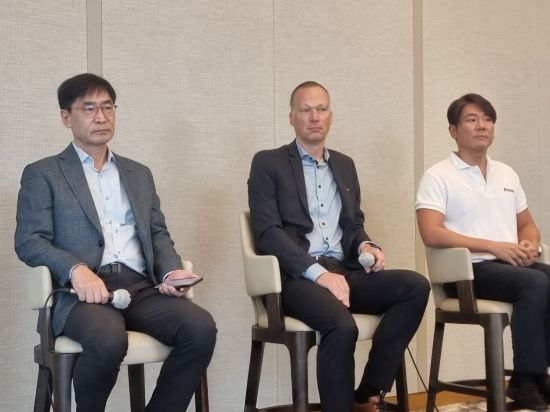 Photo by Park Jong-baek, Lawyer at Bae, Kim & Lee LLC, Nils Andersen Lord, Deputy Director of Financial Crime Compliance, Jin Kang, Head of Legal at Hashed
Richard Tang, CEO, said, "It is up to Korean regulatory agencies to decide what direction is most suitable for Korea," but also pointed out, "The virtual asset sector is very innovative, and if combined with blockchain and artificial intelligence (AI), it will form the foundation of future industries." He emphasized that such investments must be accepted to attract overseas investment.
Currently, Binance operates in 19 countries. Nearby countries include Japan, Singapore, and Hong Kong, with India being the most recent successful market entry. Arab countries like Dubai and Bahrain are also competing to become virtual asset hubs. Richard Tang stressed, "Since 2017, many countries have proclaimed themselves as the 'next virtual asset hub,' and Japan has also announced such a vision."
Richard Tang highlighted, "The number of institutional investors has increased by 36% this year alone, which is very significant," adding, "Family offices are actively investing, and I believe companies will follow suit." BlackRock, led by CEO Larry Fink, is a representative example, with Morgan Stanley and Fidelity also being active institutional investors in virtual assets.
While leaving the judgment of securities classification to individual countries, he also noted the differences between traditional financial assets and virtual assets. He said, "Regulators tend to fit virtual assets into areas they understand best, like horsepower when evaluating car performance," emphasizing, "However, virtual assets have very different characteristics." He explained, "For example, securities exchanges have different settlement times such as T+1 or T+3 and discuss settlement risks, but virtual assets are settled in real-time," pointing out, "The corresponding concepts are mismatched, and the risks are very different."
Regarding recent expectations in the virtual asset industry for the U.S. presidential election, he drew a clear line initially. He said, "Binance does not look at short-term forecasts but takes a long-term view; macroeconomically, there are factors like interest rate cuts," adding, "Many think Trump is virtual asset-friendly, but since each country must set its policy agenda, we focus on building a sustainable platform." In fact, unlike other virtual asset companies, Binance does not make political donations to the Republican side, including former President Donald Trump.
He also emphasized, "Binance wants to act as a 'bridge' for Korean startups, helping good Korean projects expand overseas," adding, "Binance can assist with fundraising and connecting various ecosystems."
Meanwhile, at the event, a panel discussion continued with Nils Andersen Rod, Deputy Head of Compliance at Binance; Jongbaek Park, lawyer at Bae, Kim & Lee LLC; and Jin Kang, Head of Legal at Hashed. The panelists agreed on the need to improve negative perceptions of virtual assets through investor education and professional seminars.
© The Asia Business Daily(www.asiae.co.kr). All rights reserved.
![Clutching a Stolen Dior Bag, Saying "I Hate Being Poor but Real"... The Grotesque Con of a "Human Knockoff" [Slate]](https://cwcontent.asiae.co.kr/asiaresize/183/2026021902243444107_1771435474.jpg)

















