38 Years of History from Construction to Supplying High-Quality Tap Water
Hoeya Dam, Which Has Protected Ulsan Citizens and Industry, Reviewed Twice
Ulsan City is attempting to change the operation of the Hoeya Dam after it was finally included as one of the 14 nationwide candidates for the "Climate Response Dam" announced by the Ministry of Environment on the 30th of last month.
The Hoeya Dam is the only dam owned by Ulsan City and is responsible for supplying tap water to 55% of Ulsan residents.
Since its completion in May 1986, following the expansion of the Ulsan Industrial Complex, it has served for over 40 years as a supplier of industrial water and domestic water to nearby residents.
However, with the increase in industrial population due to the development of industrial facilities and the improvement of living standards, the demand for tap water continues to rise. Additionally, the city is becoming increasingly vulnerable to floods and droughts caused by rapid climate change, making the expansion of water supply facilities necessary.
In response, Ulsan City is exploring solutions in two parts to address safety issues that have arisen during the operation of the Hoeya Dam and to ensure the supply of clean tap water.
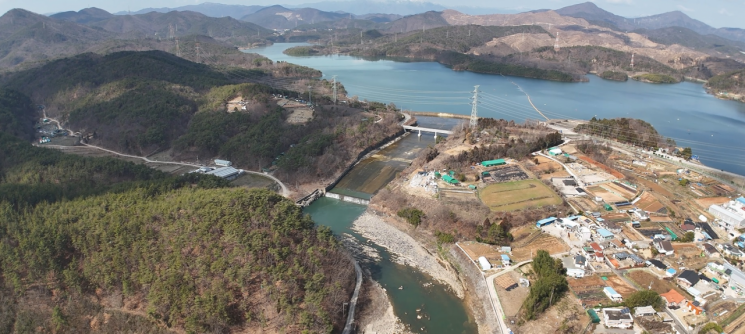
The Hoeya Dam is a central core rockfill dam, standing 36.50 meters high and 424 meters long, with a catchment area of 127 km². When the water stored in the dam exceeds the full water level of 31.8 meters, it is released through the spillway.
Construction of the Hoeya Dam began on December 31, 1982, and was completed on May 14, 1986. A total of 43 billion KRW was invested, funded through a loan from the Asian Development Bank, and compensation for the submerged area of 2.21 km² alone amounted to 9.3 billion KRW.
During Typhoon Chaba in October 2016, heavy rainfall caused the water level to rise, resulting in structural stability issues such as overflow. In response, a reinforcement project costing 2.6 billion KRW was completed in September 2018, securing the dam's structural stability.
The Hoeya Water Purification Plant receives raw water from the Hoeya Dam, purifies it, and sends it to urban areas and reservoirs. The purification capacity is 270,000 m³ per day, and during dry seasons, some raw water is supplied from the Nakdong River.
The purification process involves measuring the amount of raw water pre-treated with ozone, adding chemicals, sedimentation and filtration, post-ozone treatment, and activated carbon adsorption, ultimately supplying clean tap water to households.
The drainage facilities of the Hoeya Dam, which extend from the purification facilities to the water supply system, were the last to be completed among the Hoeya Dam water supply expansion projects due to difficulties in resolving land compensation issues.
The total reservoir capacity is 225,000 m³ per day. The layout of the water pipes and the size and location of the reservoirs were designed considering the economic, topographical, and urban planning factors of Ulsan City's entire water supply system.
Currently, there are 14 reservoirs and 8 pumping stations operating in the Hoeya Dam system.
Establishing a dam that is safe from disasters is essential for the stable supply of tap water.
The upstream area of the Hoeya River, the main inflow source for the Hoeya Dam, is located in Ungsang-eup, Yangsan City, while the downstream area is in Ungchon-myeon, Ulju-gun, Ulsan City.
At the end of 2004, the two administrative bodies clashed over the development of a 528,000 m³ industrial complex in Yongdang-ri, Ungsang-eup, the upstream area of the Hoeya River.
Fortunately, at the beginning of 2005, both regions jointly launched a major cleanup campaign for the Hoeya River, sharing efforts and awareness to protect the water source and actively responding to water quality accidents such as pollution sources in the upstream area.
During the rainy season or heavy rainfall, the water level of the Hoeya Dam rises and overflows naturally through the spillway. This natural overflow leads to the loss of domestic water and causes safety issues such as flooding in downstream areas.
During Typhoon Gladys in 1991 and Typhoon Nakri in 2014, heavy rains created urgent situations where residents in the downstream areas had to evacuate.
In addition, during Typhoon Chaba in 2016, the rapidly increasing water in the dam flowed into the Hoeya River, causing the downstream area to flood and resulting in flood victims. Similarly, during Typhoon Maysak in 2020 and the subsequent Typhoon Haishen, the Hoeya River overflowed, exposing the area to frequent disasters during heavy rainfall.
The Hoeya Dam has experienced multiple overflows due to floods and heavy rains, resulting not only in the loss of dam water but also increasing the inflow into downstream rivers, causing disasters due to river flooding.
When a dam is located upstream of a river, it can receive rainfall flowing into the river. However, since the Hoeya Dam does not have sluice gates, it is impossible to preemptively release water to prepare for floods, making its function insufficient.
Therefore, in October last year, Ulsan City applied to the Ministry of Environment to select the installation of sluice gates as part of the Hoeya Dam remodeling project as a project eligible for national funding.
With the selection of the Hoeya Dam as a candidate site for the Ministry of Environment's Climate Response Dam in July this year, the project to install sluice gates at the Hoeya Dam has moved one step closer to realization.
Ulsan City expects that the future implementation of the Hoeya Dam sluice gate installation project will help prevent disaster risks and enhance safety.
© The Asia Business Daily(www.asiae.co.kr). All rights reserved.


















