Survey on Work-Life Balance of Small Business Owners
Actual Work-Life Balance Scores an Average of 4.97 out of 10 Points
Eight out of ten small business owners consider so-called ‘work-life balance’ important.
The Korea Federation of SMEs announced on the 2nd the results of the ‘2024 Small Business Owners’ Work and Life Balance (Work-Life Balance) Survey,’ conducted from the 1st to the 23rd of last month targeting 1,000 small business owners.
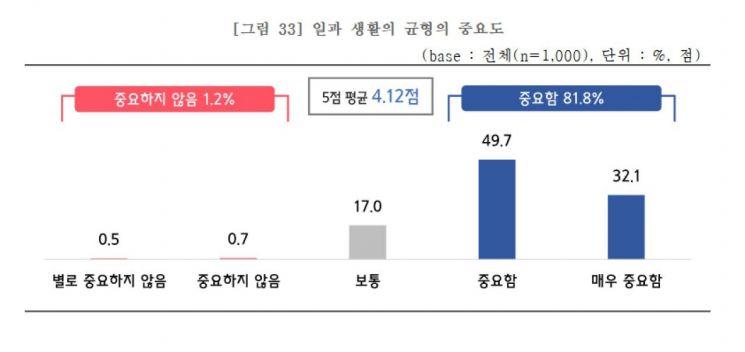
Among small business owners, 81.8% responded that work-life balance is ‘important’ (49.7% important · 32.1% very important). Only 1.2% said it was ‘not important’ (0.5% not very important · 0.7% not important).
The actual balance between working hours and personal life scored an average of 5.58 out of 10, indicating a ‘moderate’ level. Additionally, the proportion of those reporting ‘balanced’ (37.4%) was higher than those reporting ‘unbalanced’ (20.5%). However, the smaller the number of employees, the lower the balance level, and when categorized by sales, the ‘less than 100 million KRW in sales’ group scored the lowest balance at 5.26 points.
As business owners, satisfaction with work averaged 6.52 points, showing a ‘somewhat satisfied’ level. The percentage of those ‘satisfied’ (56.7%) was higher than those ‘dissatisfied’ (9.4%), and satisfaction with work as a business owner was higher among those with more employees or higher sales.
The balance between work and family life scored an average of 5.88 points, indicating a ‘moderate’ level. The balance score between work and family life was lower for those with fewer employees and lower sales. The balance between work and leisure time scored an average of 5.40 points, also at a ‘moderate’ level.
The balance between work and self-development time scored an average of 4.97 points, indicating a ‘somewhat unbalanced’ level, with the proportion of ‘unbalanced’ (27.0%) higher than ‘balanced’ (22.2%).
Among life aspects, small business owners considered ‘health and safety’ (55.6%) the most important. This was followed by ‘financial stability’ (29.3%) and ‘family relationships’ (10.0%).
Small business owners spend an average of 8.4 hours working and 2.8 hours on personal life daily, while they hope for an average of 7.4 hours of work and 3.6 hours of personal life daily.
The most common weekly business days off were ‘Sunday’ (85.4%) and ‘Saturday’ (68.6%), and the most frequent monthly business days off were ‘8 days or more per month’ (62.9%). Additionally, 6 out of 10 small business owners (60.9%) said the current number of business days off is sufficient. However, among those who reported ‘no monthly business days off’ (11.0%) or ‘insufficient business days off’ (17.8%), the proportion of small business owners with fewer employees or lower sales was higher. The main reasons for not having sufficient business days off were ‘profit pressure’ (39.9%) and ‘industry characteristics’ (39.3%).
Regarding this year’s Chuseok holiday, 94.7% of small business owners planned to take business days off, with the planned days off being ‘the 17th’ (92.1%), ‘the 18th’ (88.9%), and ‘the 16th’ (86.3%) in that order.
Choo Moon-gap, head of the Economic Policy Headquarters at the Korea Federation of SMEs, said, “Interest in work-life balance is steadily increasing in Korea as well, but the focus has mainly been on workers’ work-life balance. Small business owners with low sales or few employees face relatively more difficulties in terms of work-life balance, so it is necessary to prepare customized support policies for low-sales and small-scale small business owners.”
© The Asia Business Daily(www.asiae.co.kr). All rights reserved.

















