Announcement of Comprehensive Living Conditions Survey for Construction Workers
Average Age 51.8, Entry Age 39.4
Annual Working Days 217.2... Decreased by 7.1 Days
Average Daily Wage per Worker on Site 183,368 KRW

It was found that one in three construction workers is aged 60 or older. This year, the average daily wage on site increased by only around 1% compared to 2022, and the annual average wage income dropped to the 35 million KRW range. The number of workers experiencing wage arrears or feeling employment insecurity has increased due to the downturn in the construction industry.
The Construction Workers Mutual Aid Association announced the '2024 Comprehensive Living Conditions Survey of Construction Workers' on the 2nd. This report contains the results of examining overall living conditions including employment status, working conditions, and welfare of 1,319 construction workers who have joined the retirement mutual aid system within the past year.
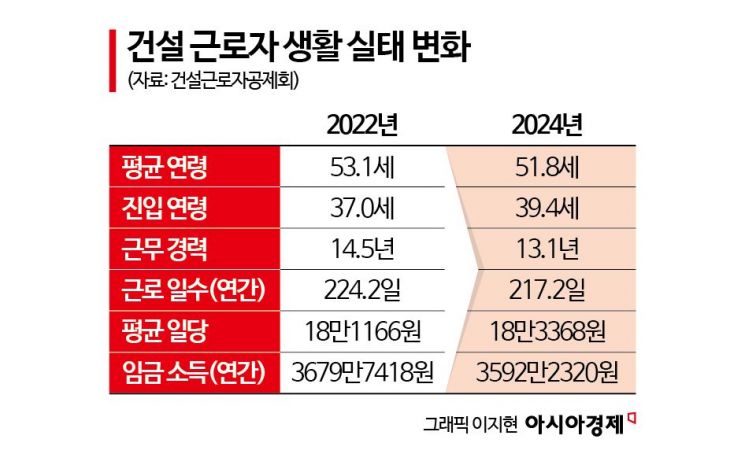
The average age of construction workers this year was 51.8 years, down 1.3 years from 53.1 years in 2022. By age group, those in their 50s accounted for the largest proportion at 34.4%, followed by those aged 60 and above (33.5%), 40s (18.1%), 30s (8.9%), and 20s or younger (5.0%). Unlike the declining proportions of those in their 30s to 50s due to aging trends, the proportion of those aged 60 and above rose by 4.3 percentage points compared to 29.2% in 2022.
The entry age into construction work increased to 39.4 years, up 2.4 years from 37.0 years in 2022. Those aged 20 or younger accounted for the largest share at 30.0%, followed by those in their 40s (23.7%), 50s (19.3%), and 60 and above (7.3%). The proportions of those aged 20 or younger and in their 30s decreased compared to 2022, while those in their 40s, 50s, and 60 and above all increased. In particular, the proportion of those aged 60 and above rose sharply by 3.8 percentage points from 3.5% in 2022.
The average number of working days per year was 217.2 days, down 7.1 days from 224.2 days in 2022. The largest share, 30.0%, answered that they worked between 200 and less than 250 days, followed by 250 to less than 300 days (27.0%), 150 to less than 200 days (15.0%), 300 days or more (14.9%), and less than 150 days (13.1%). The total average work experience at construction sites was 13.1 years, down 1.4 years from 14.5 years in 2022. Those who answered they had worked between 2 and less than 10 years accounted for 41.8%, indicating many had relatively short work periods.
The wage type on site was predominantly daily wage (85.4%). Monthly salary and unit-based payment accounted for 13.7% and 0.9%, respectively. Compared to 2022, the daily wage share increased by 8.9 percentage points, while the monthly salary share decreased by 6.3 percentage points. The average daily wage on site this year was 183,368 KRW, up 1.21% (2,202 KRW) from 181,166 KRW in 2022. However, considering that inflation and the minimum wage have risen at higher rates over the past two years, the perceived daily wage level has actually decreased.
The average annual wage income over the past year was 35,922,320 KRW this year, down 2.38% from 36,797,418 KRW in 2022. Comparing income brackets, the proportion earning less than 20 million KRW rose by 3.9 percentage points to 15.4%, while the proportion earning between 40 and less than 50 million KRW fell by 4.1 percentage points to 21.1%. This indicates an increase in low-wage workers.
Due to the poor construction market, the number of workers who did not receive wages on time increased. When asked if they had experienced delayed wage payments within the past year, 29.5% of respondents answered "yes." This is an increase of 5.0 percentage points from 24.5% in 2022. The proportion who felt anxiety about wage arrears also rose by 5.6 percentage points to 22.5% compared to 16.9% in 2022.
The proportion of workers who felt employment insecurity related to construction work was 48.7%, more than twice the 18.4% who said they did not feel insecure. Compared to 2022, this increased by 14.1 percentage points. This is why employment stability (40.3%) was the most prominent response needed for long-term retention of construction workers.
As there are no signs of improvement in the construction market, workers’ difficulties are growing. A representative from the Construction Workers Mutual Aid Association said, "When we talk with construction workers, many say they strongly feel the worsening construction market," adding, "They complain that if this site ends due to the poor market, they have nowhere to go immediately."
© The Asia Business Daily(www.asiae.co.kr). All rights reserved.

![Clutching a Stolen Dior Bag, Saying "I Hate Being Poor but Real"... The Grotesque Con of a "Human Knockoff" [Slate]](https://cwcontent.asiae.co.kr/asiaresize/183/2026021902243444107_1771435474.jpg)















