The government has revealed that it will reduce the Foreign Exchange Stabilization Fund (FESF) by about 64 trillion won in next year's budget, raising concerns about a potential decline in its ability to respond to exchange rate fluctuations. However, analyses suggest that the reduction of the FESF alone will not weaken exchange rate response capabilities, as South Korea's foreign exchange reserves are ample and factors supporting the won-dollar exchange rate, such as the expansion of overseas securities investments by Seohak Gaemi, are increasing.
According to the Ministry of Economy and Finance on the 2nd, the scale of FESF operations in the government’s submitted budget for next year is expected to be 140.2894 trillion won, down 64.8307 trillion won from this year’s 205.1201 trillion won. This represents the largest reduction ever recorded.
The FESF is a fund used by the government to prevent sharp fluctuations in the exchange rate. It is mainly raised by issuing Foreign Exchange Stabilization Bonds (FES bonds). When the won-dollar exchange rate rises (won weakens), the foreign exchange authorities use foreign exchange reserves to sell dollars and defend against won depreciation. Conversely, when the won-dollar exchange rate falls (won strengthens), they buy dollars to prevent won appreciation.
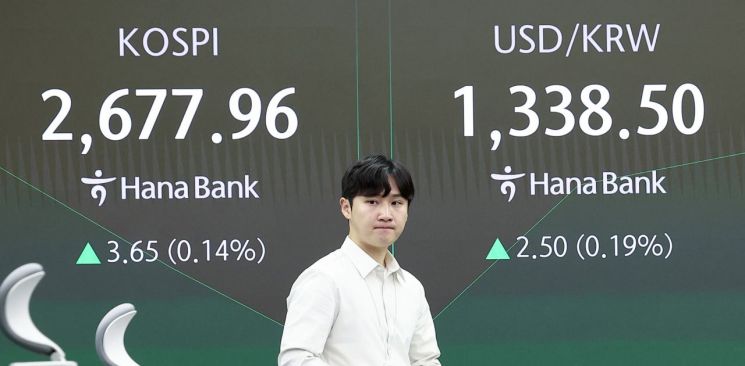
Concerns have been raised that the government’s large-scale reduction of the FESF amid recent increased exchange rate volatility could weaken its response capability. The won-dollar exchange rate showed volatility, dropping about 60 won within a month. The exchange rate, which closed at 1,385.8 won on July 26 at 3:30 p.m., fell to 1,326.8 won by August 26.
However, evaluations indicate that there is no problem with response capability even if the FESF scale is reduced, as the size of foreign exchange reserves itself is sufficient and external soundness indicators are favorable. As of the end of July, South Korea’s foreign exchange reserves stood at 413.51 billion dollars, increasing by 1.3 billion dollars from the previous month, marking an upward trend for the first time in four months. As of the end of June, South Korea’s foreign exchange reserves ranked 9th in the world. The ratio of short-term external debt to reserves (foreign exchange reserves), which indicates external debt soundness, was 34.4%, and the proportion of short-term external debt within total external debt, which indicates external payment capacity, was 21.6%. These levels are lower compared to the average of the previous five years’ quarters (37.1% and 27.5%, respectively).
The ongoing overseas stock investment boom by Seohak Gaemi also strengthens response capability. At the end of the second quarter this year, South Korea’s external financial assets balance was recorded at 2.3952 trillion dollars, marking the highest level for three consecutive quarters. This increase was influenced by a 10 billion dollar rise in direct investments in sectors such as automobiles and secondary batteries compared to the end of the previous quarter, and a 27.9 billion dollar increase in securities investments due to continued overseas stock investments.
Min Kyung-won, an economist at Woori Bank, said, "The size of South Korea’s foreign exchange reserves itself is sufficient, export companies hold ample dollars, and the number of Seohak Gaemi who can respond when the exchange rate falls is increasing, so the exchange rate can be sufficiently supported."
Economist Min added, "If the depletion speed of foreign exchange reserves were rapid, it would be a concern, but South Korea receives a large amount of dollars through current account transactions. When the won-dollar exchange rate rose to 1,410 won around 2021-2022, emerging countries’ foreign exchange reserves were depleted by more than 50%. Compared to these emerging countries, South Korea has sufficient foreign exchange reserves due to symbolic events like the foreign exchange crisis," he explained.
© The Asia Business Daily(www.asiae.co.kr). All rights reserved.

















