Commercial Banks Initiate Terms Revision
Use Not Only KB Housing Prices but Also Korea Real Estate Board Prices for Apartment Market
Household Loan Management Regulations Cast Doubt on Success
The mortgage refinancing service, which was previously only applicable to apartment housing loans, will be expanded from September 30 to include villas and residential officetels with real-time price inquiry capabilities. However, due to stricter household loan management regulations amid rising housing prices, it is uncertain whether the service will achieve the same level of popularity as when it was first launched, as aggressively lowering interest rates may be difficult.
According to the financial sector on the 3rd, commercial banks have begun revising the terms and conditions related to the refinancing loan service. KB Kookmin, Shinhan, and Woori Banks have amended the "Terms of Use for Mortgage Loan Refinancing Service through Loan Transfer System," setting the effective date as the 30th of this month. Specifically, they added types of housing for mortgage loans. This includes multi-family housing and residential officetels with real-time price inquiry capabilities. Multi-family housing includes row houses, multi-unit houses, and urban lifestyle housing. However, the condition that real-time price inquiry must be possible applies, based on KB prices or Korea Real Estate Board prices. If prices from sources other than these two are used, the institution newly handling the refinancing loan will decide autonomously. The service closing time will also be extended in line with the housing type expansion, from 8 PM to 10 PM.
Originally, the financial authorities planned to add housing types to the refinancing loan service starting from the 3rd of this month. However, considering the difficulty in accurately assessing prices compared to apartments, the date was postponed to the 30th. Accordingly, banks decided to use not only the KB prices, which they most frequently refer to, but also the Korea Real Estate Board (Real Estate Tech) prices for some row houses.
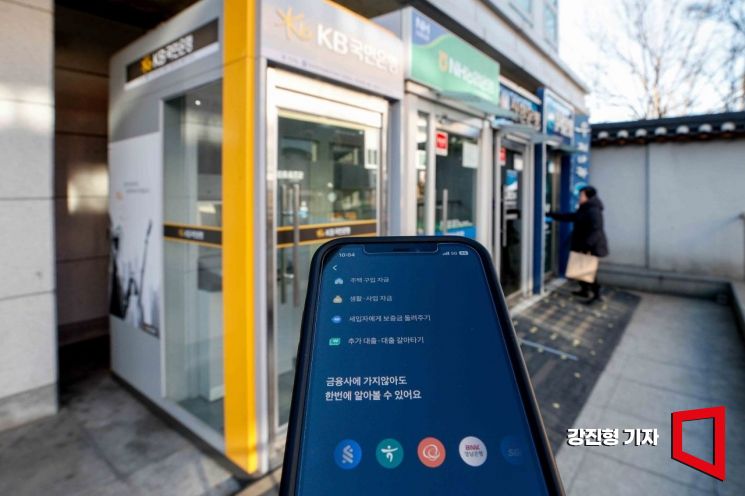 The 'Mortgage Refinancing' service through an online, one-stop refinancing infrastructure surpassed 10,000 applicants within 15 days of its launch, with the application amount approaching 1.8 trillion won. The photo shows an ATM of a commercial bank installed in Yongsan-gu, Seoul, on the 25th. Photo by Jinhyung Kang aymsdream@
With the expansion of the mortgage refinancing loan service, more financial consumers are expected to benefit. According to the Ministry of Land, Infrastructure and Transport's 2022 Housing Status Report (nationwide), 51.9% of people live in apartments, while 41% live in detached houses, row houses, or multi-unit houses. Practically, consumers with mortgage loans on all types of housing can now use the refinancing loan service. Additionally, the mortgage refinancing loan service offers larger transfer volumes and greater per-person interest savings compared to other refinancing loans (such as credit loans and jeonse loans). According to the Financial Services Commission, as of June 17, the cumulative number of borrowers using the mortgage refinancing loan service was 26,636, with a loan transfer volume of 4.8935 trillion KRW. Although the number of borrowers transferring credit loans (176,723) was the highest, the loan transfer volume (4.1764 trillion KRW) showed a difference of over 700 billion KRW. The per-person interest savings for mortgage refinancing loans was 2.73 million KRW, higher than credit loans (580,000 KRW) and jeonse loans (2.38 million KRW).
However, due to the rapid increase in household debt and the financial authorities' orders to strengthen loan management, financial companies are unlikely to competitively lower interest rates as they did when the refinancing loan service was first launched. From the banks' perspective, if customers transfer loans from other banks to their own loans, they are subject to the same household loan volume regulations. If refinancing loan interest rates are set low and demand surges, it could conflict with the authorities' stance on managing household loan growth. To respond to the increase in household loans, banks are currently raising loan interest rates, suspending some loans, and even reducing loan limits, but the upward trend has not yet been curbed. As of the 29th of last month, the household loan balance of the five major banks (KB Kookmin, Shinhan, Hana, Woori, NH Nonghyup) was 824.0617 trillion KRW, an increase of 8.3234 trillion KRW compared to the end of July (715.7383 trillion KRW). This increase is the largest since April 2021, when the increase was 9.2266 trillion KRW.
© The Asia Business Daily(www.asiae.co.kr). All rights reserved.
![Clutching a Stolen Dior Bag, Saying "I Hate Being Poor but Real"... The Grotesque Con of a "Human Knockoff" [Slate]](https://cwcontent.asiae.co.kr/asiaresize/183/2026021902243444107_1771435474.jpg)
















