Ensuring Quality Equivalent to Publicly Commissioned Construction
Providing Administrative Support Including Permit Coordination
Seoul City will manage donation facilities from the design and construction stages in private development projects. This is to ensure safety and construction quality as donation facilities are showing trends of becoming landmark-type buildings or three-dimensional and complex structures.
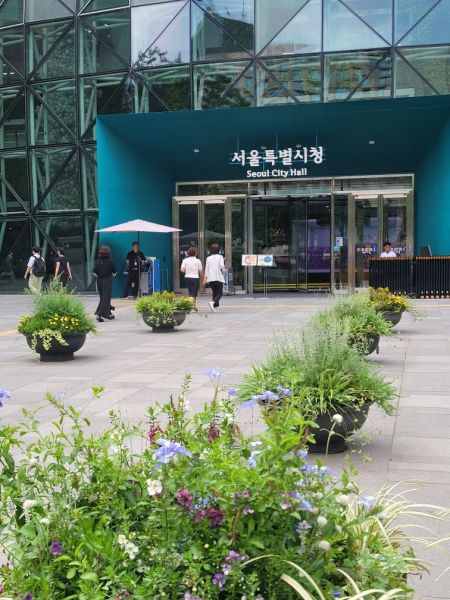
On the 2nd, Seoul City announced that it has prepared the "Measures to Secure Construction Quality of Donation Facilities," which includes these details. This is a follow-up measure to the "Seoul-type Construction Innovation Plan" announced last November to achieve "Zero Defective Construction in Seoul."
The core of this plan is to mandate design and construction management equivalent to public facilities for donation facilities above a certain scale.
Donation facilities are infrastructure and facilities that the private sector installs and provides during development projects to comply with relevant laws, standards, and guidelines or to receive benefits such as land-use zone changes and floor area ratio relaxations. In the past, these were mainly single facilities like roads and parks, but recently they have diversified to include landmark-type buildings.
Three-dimensional and complex structures in donation facilities, which must be managed by the public after completion, require technical review, appropriateness of construction execution, and safety assurance. However, there has been no legal technical review procedure, leaving a blind spot in construction quality management. This contrasts with public projects over 10 billion KRW, where construction quality is managed through the Construction Technology Deliberation Committee review from the design stage.
Accordingly, the city decided to improve the "Donation Demand and Integrated Management System" to comprehensively manage the status and list of all donation facilities. In particular, for bridges and covered structures with a total construction cost of 5 billion KRW or more, a prior technical review (consultation with the Construction Technology Deliberation Committee) will be required before facility approval. To this end, the city plans to sufficiently consult with associations and others from the early stages of various development projects to ensure compliance with review procedures and reflect the results.
The city will also conduct on-site inspections such as design review compliance management, mobilization inspections by external experts, and operation of construction quality inspection teams. To strengthen the responsibility of participating contractors and construction management service providers, the city plans to propose institutional improvements to the Ministry of Land, Infrastructure and Transport to allow "construction engineering and construction evaluation" for private donation facility construction projects.
Administrative support will also be provided, including facilitating inter-agency consultations for the approval of donation facilities. Reviews will be conducted ahead of other projects applying for review during the same period to minimize the burden on the private sector due to procedural compliance.
Im Chun-geun, Director of Construction Technology Policy at Seoul City, said, "We will actively manage the quality of all construction projects in Seoul and discover and realize leading construction technology policies going forward."
© The Asia Business Daily(www.asiae.co.kr). All rights reserved.

















