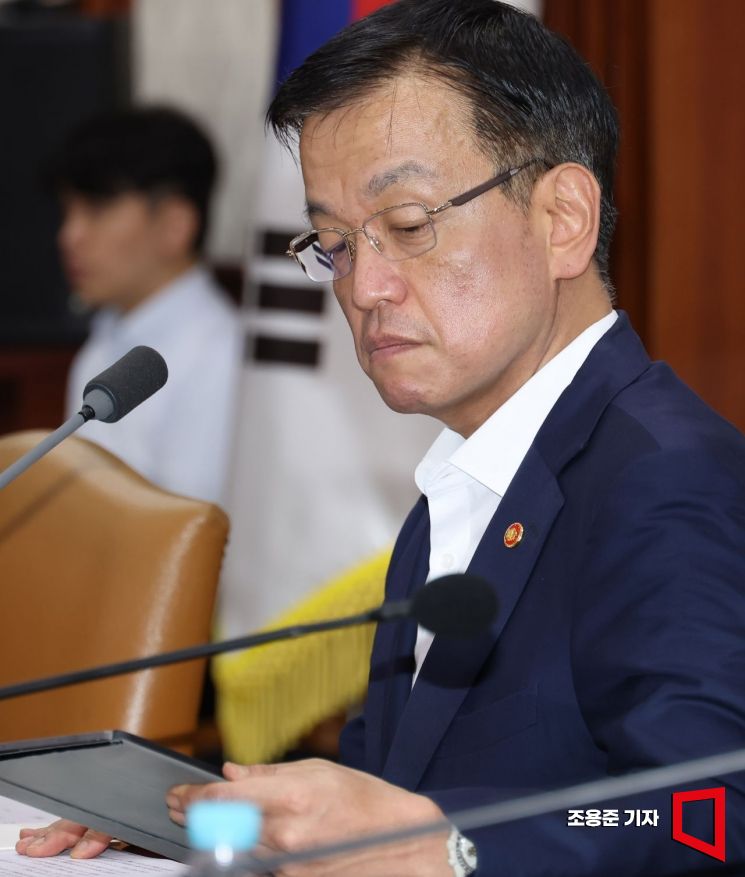
 Deputy Prime Minister and Minister of Economy and Finance Choi Sang-mok is attending the Economic Ministers' Meeting held at the Government Seoul Office in Jongno-gu, Seoul on the 28th, reviewing documents. Photo by Jo Yong-jun jun21@
The government responded to criticisms that next year's budget plan is insufficient for domestic demand recovery by stating, "We will support domestic demand recovery through revitalizing and supporting innovation in the private sector."
On the 1st, the Ministry of Economy and Finance released a press statement titled '10 Questions and Answers on the 2025 Budget Plan,' saying, "With the easing of domestic demand constraints such as high inflation and high interest rates, and the expansion of corporate profits due to strong exports, consumption and investment are expected to improve from the second half of this year."
The Ministry added, "During the economic recovery phase, we will focus on job creation by supporting vitality and innovation in the private sector rather than artificial fiscal stimulus," and stated, "Next year's budget will actively reflect projects supporting sales growth for small business owners, regional social overhead capital (SOC), investment, and exports to back domestic demand recovery."
Next year's total expenditure is set to increase by 3.2% (20.8 trillion won) compared to this year's main budget (656.6 trillion won). The 3.2% increase in total expenditure is the fourth lowest since the concept of total expenditure was introduced in 2005, following this year (2.8%) and 2010 and 2016 (each 2.9%).
Regarding criticisms that the discretionary spending growth rate is in the 0% range and insufficient for supporting livelihoods, the Ministry rebutted, "Mandatory spending also supports livelihoods through expanded targets and amounts," noting that livelihood benefits will be additionally supported by 1.41 million won annually compared to this year, due to a record-high increase in the median income standard (6.42%) for the third consecutive year.
On the reduction of the SOC budget, the Ministry emphasized, "We have expanded small-scale construction infrastructure such as local housing and sewage systems that benefit the local construction industry."
The Ministry also reiterated that next year's research and development (R&D) budget is the largest ever. The R&D budget for next year is 29.7 trillion won, an 11.8% increase compared to this year, but in total amount, it is similar to last year's 29.3 trillion won. The government explained that this is not a simple increase but a shift to leading-edge R&D by reviewing inefficiencies.
In response to concerns that 65% of the small business owners' budget being loan support makes it difficult to enhance competitiveness, the Ministry countered, "The proportion of loans has been continuously decreasing compared to the past." The loan proportion of the small business support budget was 68% in 2023, 64% in 2024, and is expected to remain at the same level next year.
Regarding concerns that a significant increase in next year's corporal pay might lower the morale of non-commissioned officers, the Ministry stated, "Despite the increase in corporal pay, sergeant pay is still on average 685,000 won higher per month than corporal pay." On the regional love gift certificates not reflected in the budget plan, the Ministry explained, "This was considered based on the nature of the office work and consumption effects."
Finally, on the discount support for regional love gift certificates, the Ministry said, "This is a matter of local government office work," adding, "Research results show that the overall consumption stimulation effect nationwide is insufficient."
© The Asia Business Daily(www.asiae.co.kr). All rights reserved.

















