Anbosil, Advancing Cybersecurity Plan Containing 100 Major Tasks
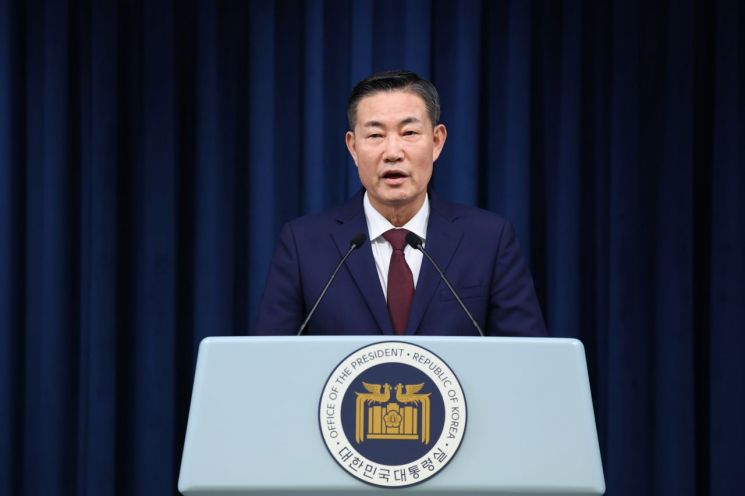 Shin Won-sik, Director of the National Security Office, is announcing the 'National Cybersecurity Basic Plan' on the 1st at the Yongsan Presidential Office building in Seoul. [Image source=Yonhap News]
The government has decided to establish and implement a joint inter-ministerial response plan to counter 'influence operations' in cyberspace and to strengthen the self-regulation of portal and platform operators such as Naver and YouTube.
On the 1st, Shin Won-sik, Director of the National Security Office, announced at a briefing at the Yongsan Presidential Office that they will promote the 'National Cybersecurity Basic Plan' to proactively respond to hostile forces' 'influence operations' in cyberspace using the latest technologies such as deepfake (Deepfake - fabricated synthetic photos and videos).
The National Security Office, together with 14 government ministries including the National Intelligence Service, Ministry of Foreign Affairs, Ministry of National Defense, Ministry of Science and ICT, as well as the prosecution and police, jointly announced the National Cybersecurity Basic Plan. This basic plan is a follow-up to the 'National Cybersecurity Strategy' announced by the Security Office in February and consists of a total of 100 practical tasks, including 93 individual tasks from 14 ministries and 7 joint tasks.
First, to prepare for influence operations such as the dissemination of false information and fake news by specific groups with intent to promote propaganda, agitation, or to incite regional sentiments or gender conflicts in cyberspace, measures will be taken to strengthen the self-regulation of portal and platform operators. In particular, as concerns have grown due to the recent surge in false information exploiting deepfake technology, items to strengthen responses have been included.
The government plans to revise related legislation, including enacting the 'Cybersecurity Basic Act,' to effectively respond to false manipulated information and influence operations originating overseas. A government official explained, "We intend to stipulate provisions that allow domestic intelligence and investigative agencies to operate against international hacking organizations and state-backed hacking groups," adding, "We are currently formulating specific legislative plans, but it is not yet the stage to disclose them."
The 100 tasks revealed on this day are detailed plans of the five major strategic tasks announced in the 'National Cybersecurity Strategy,' including ▲ strengthening offensive cyber defense activities ▲ establishing a global cyber cooperation system ▲ enhancing cyber resilience of national critical infrastructure ▲ securing competitive advantage in new technologies ▲ and strengthening the operational foundation.
A senior official from the Presidential Office told reporters, "The reason we cannot disclose all 100 tasks is that some pertain to national secrets," adding, "Some tasks themselves are classified, and some involve diplomatic cooperation with foreign countries."
© The Asia Business Daily(www.asiae.co.kr). All rights reserved.

















