The government has decided to postpone the maintenance schedules of coal and liquefied natural gas (LNG) power plants by 1 to 2 weeks in preparation for the late summer heat in September. This measure will secure an additional supply capacity of over 2GW.
The Ministry of Trade, Industry and Energy announced on the 1st that Minister An Deok-geun held an inspection meeting with related agencies on the 31st of last month to review the power supply and demand outlook and power facility management plans for September, in anticipation of continued high electricity demand due to the late summer heat.
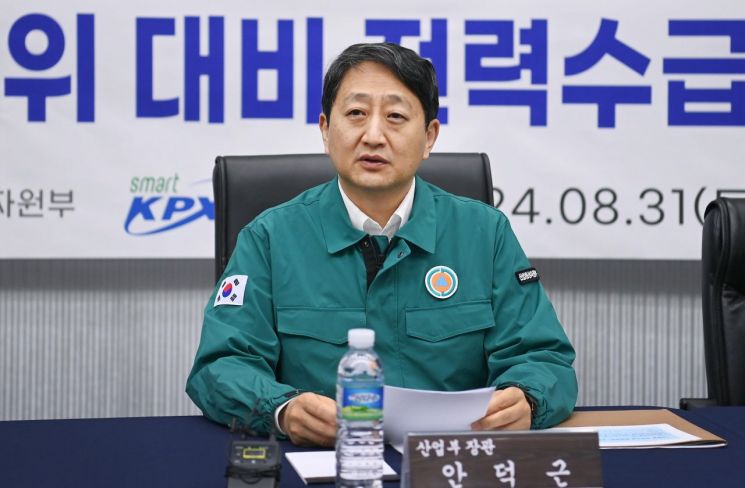 Anduk Geun, Minister of Trade, Industry and Energy, reviewed the September power supply and demand outlook and power facility management plans at the "Summer Power Supply and Demand Situation Inspection Meeting" held on the 31st of last month at the Korea Power Exchange Gyeongin Power Control Center in Uiwang-si, Gyeonggi-do.
The Korea Meteorological Administration forecasted a 60% probability that temperatures in the first week of September will be higher than average, and a 40% probability for the second week.
Typically, during the concentrated summer management period (3rd week of July to 3rd week of August), power facilities operate at maximum capacity, and maintenance of generators is sequentially carried out starting in September, after summer ends, to ensure normal operation before the winter power supply and demand management period. However, due to weather forecasts predicting continued higher-than-average temperatures in the first and second weeks of September, the Ministry of Trade, Industry and Energy has fully reconsidered the maintenance schedule for September generators.
The maintenance of seven generators originally scheduled to begin in the first week of September will be postponed by 1 to 2 weeks, securing an additional supply capacity of over 2GW. As a result, it is expected that a reserve margin of more than 10GW can be maintained. Additionally, newly constructed generators under commissioning and approximately 7GW of reserve resources that can be operated in case of reserve shortages are also prepared, making stable management of power supply and demand feasible.
Minister An said, "Despite recording the highest-ever electricity demand (97.1GW on August 20 this year) due to accumulated heat and the impact of Typhoon Jongdari, the proactive equipment management and real-time response efforts of related power agencies allowed stable management of power supply and demand. The most severe power crisis in the past did not occur in midsummer but during a late summer heatwave on September 15, 2011. Therefore, please maintain vigilance and ensure thorough management of power supply and demand until the end."
Electricity demand has sharply increased over the past five years. The peak market demand was 89.1GW in 2020, rising by 8GW (9%) to 97.1GW this year. This is also 3.5GW higher than last year's peak (93.6GW). A ministry official explained, "Due to the increase in solar power facilities, the gap between total demand and market demand has widened, causing an optical illusion that the market demand growth rate appears relatively low. Total demand was 92.8GW in 2020, but it surpassed 100GW for the first time last year, reaching 103.5GW this summer, an increase of 10.7GW (11.5%) compared to 2020."
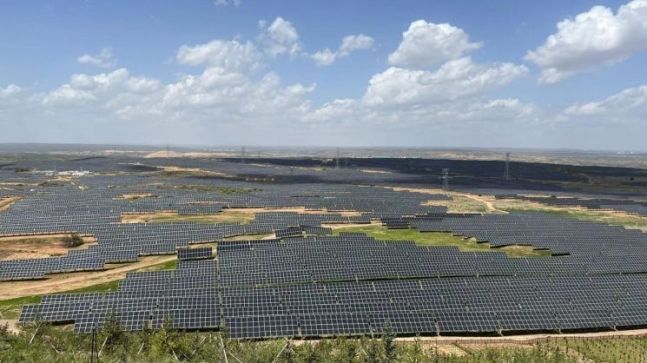
The Ministry of Trade, Industry and Energy views the increase in volatility of power demand due to the expansion of solar power as an urgent issue requiring a response system. According to the ministry, nationwide solar power facilities this summer amount to about 31GW, and a simple calculation shows that if the solar utilization rate drops by 10 percentage points, the reserve margin (the difference between supply capacity and power demand) decreases by 3.1GW. Furthermore, about 40% of solar power facilities are concentrated in the Honam region, where cloud cover can cause a sudden drop in solar utilization rates.
A ministry official stated, "As solar power capacity increases in the future, fluctuations in reserve margins due to changes in solar utilization rates will inevitably become larger, intensifying supply and demand instability. To expand solar power, it is necessary to secure capabilities for forecasting, monitoring, and controlling power generation, and to have a power mix that can buffer volatility with stable power sources and backup facilities."
© The Asia Business Daily(www.asiae.co.kr). All rights reserved.


















