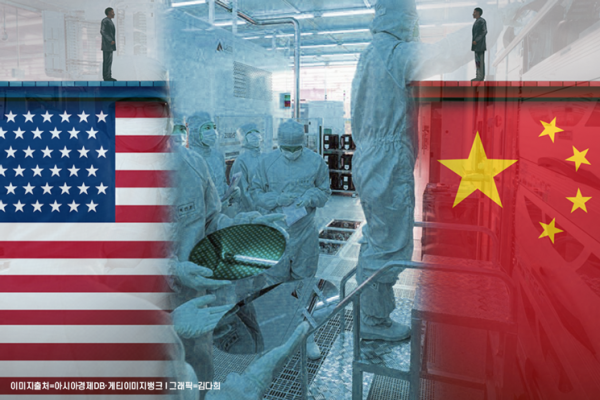
The 45-year-old U.S.-China Science and Technology Agreement (STA), which was signed 45 years ago, expired on the 27th, and discussions on its extension have not progressed, according to a report by the Hong Kong South China Morning Post (SCMP) on the 30th.
The agreement is the first bilateral agreement established when the United States and China established diplomatic relations in 1979. At that time, China's top leader Deng Xiaoping and U.S. President Jimmy Carter signed it.
Through the STA, financial, legal, and political support has been provided to U.S. and Chinese researchers in fields such as agriculture, energy, environment, nuclear fusion, earth sciences, atmospheric environment, marine science, and remote sensing technology, fostering scientific and technological cooperation between the two countries.
The STA, which has been extended every five years, lasted until August last year, but controversy arose over its continuation amid intensified strategic competition between the U.S. and China. After two six-month extensions, it ceased to be effective on the 27th.
SCMP quoted a U.S. State Department official saying that "(regarding the extension) the U.S. and China are communicating," but reported that "there is no evidence of progress."
In this regard, Chinese Foreign Ministry spokesperson Lin Zhen said at a briefing that, without providing specific details, "the two countries are maintaining communication regarding the U.S.-China Science and Technology Agreement."
The U.S. side has been demanding the establishment of protective measures for its science and technology during the implementation of the agreement, along with strengthening transparency and reciprocity in scientific data exchange, but it is reported that China has shown a lukewarm response.
This conflict and confrontation have been ongoing for a long time, and as a result, there is a general view within the U.S. that there is considerable resistance to the STA.
Critics argue that due to China's control over scientific and technological projects, U.S. researchers cannot achieve effective results using the STA, while Chinese researchers, who have easy access to the academic environment in the U.S., produce world-class achievements in fields such as electric vehicles and renewable energy, making the agreement unfair. In particular, opposition from the U.S. Republican Party is strong.
Republican House members, including Mike Gallagher, chairman of the U.S.-China Strategic Competition Special Committee, have continuously argued that the STA is a one-sided agreement ultimately used only to strengthen China's core technological competitiveness and military power, and that it should be abolished.
The Biden administration also views China's technological development in advanced fields such as semiconductors, artificial intelligence (AI), and quantum computing as a potential threat to U.S. security and has implemented a de-risking policy that severely restricts China's access, showing little favor toward the STA.
On the other hand, China appears to be making every effort, both materially and morally, to extend the STA.
With the U.S. strengthening its de-risking policy and the European Union (EU) and Japan joining in, China is focusing all its efforts on avoiding "isolation in advanced science and technology."
Spokesperson Liu Fengyu of the Chinese Embassy in the U.S. emphasized to SCMP that "the STA benefits both China and the United States."
There is also analysis that the Biden administration is reluctant to extend the STA to avoid giving the opposition Republican Party an opportunity to attack ahead of the year-end elections.
Given the strong anti-China sentiment and the political advantage of criticizing China, extending the STA could be interpreted as "benefiting China," which could negatively affect Kamala Harris, the Democratic presidential candidate.
Dennis Simon, former vice president of Duke Kunshan University, jointly established by Duke University and Wuhan University, pointed out, "The fact that the STA, which has been renewed for decades without controversy, is now causing debate over its extension shows that both sides are facing complex and new issues."
© The Asia Business Daily(www.asiae.co.kr). All rights reserved.
![Clutching a Stolen Dior Bag, Saying "I Hate Being Poor but Real"... The Grotesque Con of a "Human Knockoff" [Slate]](https://cwcontent.asiae.co.kr/asiaresize/183/2026021902243444107_1771435474.jpg)
















