Seoul City Completes Accident Site Restoration and Conducts Additional Peripheral Investigation
Void 'Gongdong' Confirmed... Road Subsidence Also Detected, Restoration Underway
Investigation Expanded and Excavation Site Management Strengthened to Prevent Gongdong
The Seoul Metropolitan Government has completed the restoration of the ground subsidence accident site on Seongsan-ro in Yeonhui-dong, Seodaemun-gu. However, during the inspection of the surrounding area centered on the accident site, additional voids called 'gongdong' and road subsidence were confirmed, and restoration work is underway.
On the 30th, Seoul City announced that based on the accident site, a total 1 km section covering 500 m to the left and right and all 8 lanes underwent GPR (Ground Penetrating Radar) exploration, resulting in the discovery of one suspected void, prompting further investigation. Additionally, while patrolling the Seongsan-ro area, road subsidence was confirmed 30 m away from the accident site, and restoration work is currently being carried out.
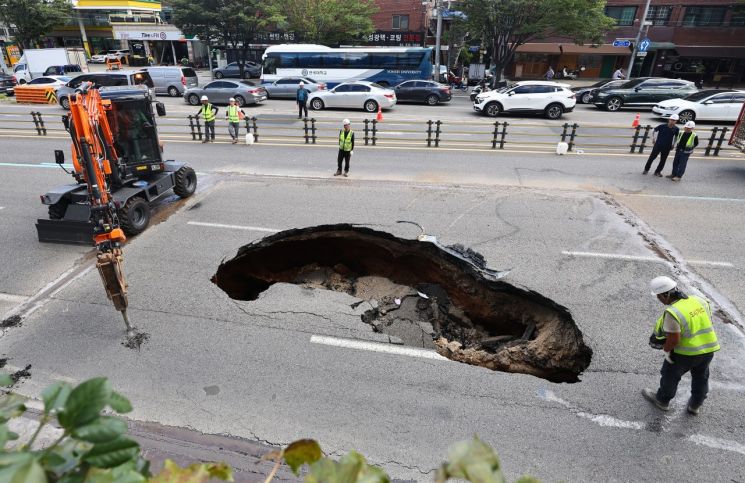
The newly discovered road subsidence point was examined by removing the road pavement and inspecting the underlying area, and unlike the previous day’s accident, there was no immediate risk of rapid ground subsidence. However, Seoul City decided to conduct a large-scale comprehensive inspection focusing on the area where additional subsidence was found. The targets include large construction sites and excavation works such as underground roads.
Along with this, Seoul City plans to continuously promote annual 'regular inspections' using GPR and 'special inspections' for vulnerable areas. The 'regular inspections' are conducted annually on all city and provincial roads according to a five-year plan (2,200 km per year), while the 'special inspections' involve intensified exploration of ground subsidence risk areas selected by Seoul City (5,000 km annually starting this year). The Yeonhui-dong site where the subsidence occurred was included in the regular inspection target section but no voids were found during the investigation in May.
Seoul City also announced plans to strengthen GPR exploration. Using information from the integrated underground safety management system, a 'Ground Subsidence Risk Map' will be created and managed to classify the risk levels of each ground area. Starting next year, the city will operate the nation’s first ground subsidence observation network. This system involves drilling observation wells approximately 10 meters deep, installing sensors to measure ground movement, and comprehensively analyzing the collected data.
Meanwhile, Seoul City held a joint inspection meeting in the afternoon to conduct an accurate cause analysis of the Yeonhui-dong accident. The meeting included officials and experts from the Seoul Disaster and Safety Office, Western Road Office, Seodaemun-gu Office, and the Urban Infrastructure Headquarters.
© The Asia Business Daily(www.asiae.co.kr). All rights reserved.
![Clutching a Stolen Dior Bag, Saying "I Hate Being Poor but Real"... The Grotesque Con of a "Human Knockoff" [Slate]](https://cwcontent.asiae.co.kr/asiaresize/183/2026021902243444107_1771435474.jpg)











