"BORING!!!" This was the assessment made by former President Donald Trump regarding the first television interview of U.S. Vice President Kamala Harris, the Democratic presidential candidate. So, how are major foreign media outlets evaluating this interview?
The progressive media outlet The New York Times (NYT) stated that it "did not leave a strong impression," but also noted that "there was nothing said that could cause political problems." The congressional-focused media The Hill gave a moderate rating, saying, "Trump overlooked the fact that being 'boring' is actually good for Harris," and "there was nothing that could halt her recent upward momentum." The LA Times predicted, "The real headlines in the presidential race will come on September 10, when Harris and Trump debate."
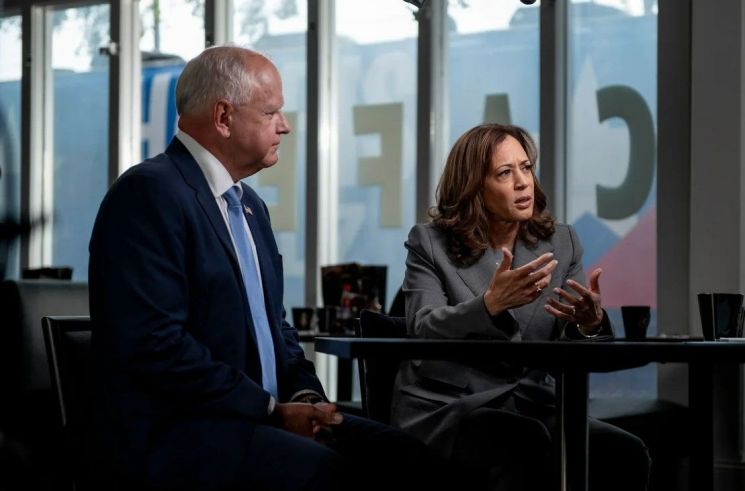 Vice President Kamala Harris (right), the Democratic presidential candidate in the United States, and Minnesota Governor Tim Walz are attending and responding to an interview with CNN broadcast held on the 29th (local time) in Savannah, Georgia.
[Photo by Will Lanzoni, CNN]
First Interview as a Presidential Candidate... "Targeting Moderate and Anti-Trump Conservative Votes"
The interview aired on the night of the 29th (local time) on CNN was notable as it was Vice President Harris's first media interview as the Democratic presidential candidate, 39 days after President Joe Biden withdrew from the race last month. Until now, the Republican Party and former President Trump had criticized Harris for avoiding press conferences and in-depth interviews, accusing her of evading scrutiny as a presidential candidate. In this context, Harris chose an easier path by selecting CNN, a pro-Democratic outlet, for her first interview, along with her running mate, Minnesota Governor Tim Walz.
Excluding the host's remarks, the approximately 27-minute CNN interview saw Vice President Harris emphasize President Biden's achievements while stressing that her progressive values remain unchanged. She also reaffirmed the 'unity' theme declared in her acceptance speech last week by stating her intention to appoint Republicans to her cabinet if elected.
NYT noted that Harris "defended President Biden's policies" on issues covered that day, including the economy, Gaza, and border policy, while also "showing cautious movement toward the center, aiming to attract Republican votes." In particular, the declaration to appoint Republicans to the cabinet was seen as a promise to overcome political division and an indication that conservative voices would be partially reflected in the Harris administration's policies. This could be a persuasive appeal to supporters of Nikki Haley, the former U.S. Ambassador to the UN, who has a clear anti-Trump stance. Last week’s Democratic National Convention also featured several Republican speakers with anti-Trump positions.
The Hill evaluated, "Harris tried to appear as attractive as possible to moderate voters and those close to the Republican Party but concerned about Trump," adding, "This election is likely to be decided by a small number of undecided voters in seven battleground states." The Associated Press (AP) reported, "The interview mainly focused on policy," and assessed that "Harris tried to appear more moderate on issues where Republicans have criticized her as extreme."
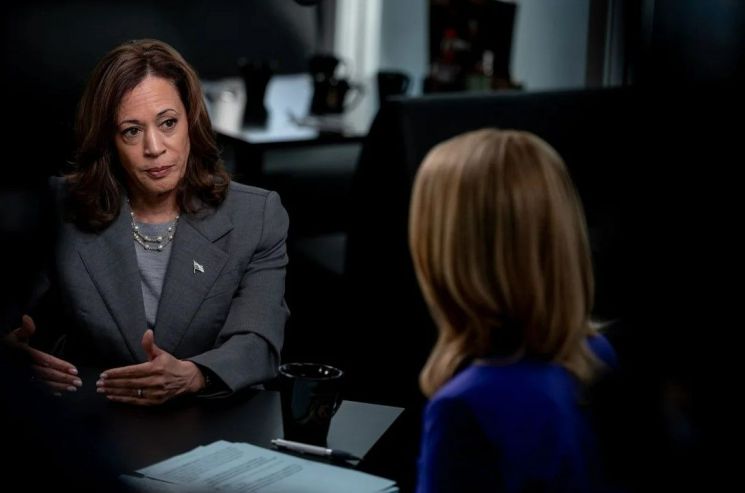 U.S. Vice President and Democratic presidential candidate Kamala Harris is being interviewed by CNN in Savannah, Georgia, on the 29th (local time).
[Photo by Will Lanzoni, CNN]
Harris Avoided Emphasizing Race and Gender... Instead of Responding to Trump, She Said 'Let's Move to the Next Question'
Major foreign media also noted that Vice President Harris did not want to emphasize her race or gender throughout the interview. Many outlets, including NYT and The Guardian, highlighted a moment where Harris dismissed former President Trump's racial identity attacks with a brief response: "It's the same old, tired strategy. Let's move to the next question." When the host asked, "Is that all?" Harris replied, "That's all." When asked about becoming the first female and Black female president if elected, Harris responded, "I am running because I believe I am the best candidate to serve all Americans, regardless of race or gender."
The Guardian summarized the key takeaway from the interview as "Let's move to the next question," noting that "Harris recognized this moment as especially important to younger generations and simultaneously seized an opportunity beyond racial differences." In a Washington-based analysis, the outlet pointed out that "Harris could have unleashed a tirade against Trump's history of racist remarks, but instead, she wisely made her point." This approach is seen as a hint of Harris's strategy ahead of the September presidential debate, focusing on presenting an optimistic and forward-looking agenda rather than responding to Trump-style attacks.
Harris's strategy is believed to have learned from the example of former Secretary of State Hillary Clinton, who lost the 2016 election despite winning the popular vote by over 2.8 million votes, due to factors such as resistance to the first female president and backlash against establishment politics. Harris is emphasizing her background as a prosecutor from a middle-class family. This is similar to former President Barack Obama, the first Black president in U.S. history, who minimized references to race during his past campaigns.
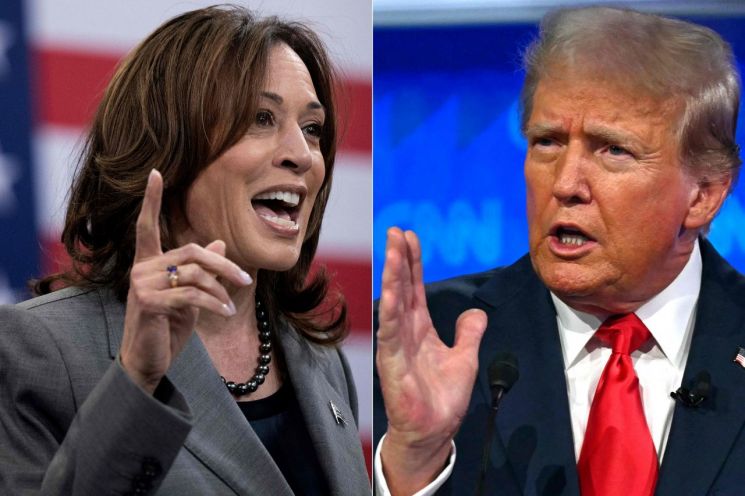
Did Not Leave a Strong Message... Vice Presidential Candidate Walz Just Sat and Smiled
However, Harris was evaluated as not having left a strong message or impression on American voters through this interview. NYT pointed out that "she showed she could ramble without a script," and "it was not as simple or declarative as a campaign speech." While there were no major mistakes, there was also no precise diagnosis or sharp solutions. The overall atmosphere of the interview was more of a friendly explanation and opportunity for clarification rather than a grilling or pressing questioning by CNN, which leans pro-Democratic.
The Guardian summarized the interview by saying, "It is unclear how the Harris administration would differ from the Biden administration." Political consultant Frank Luntz criticized Harris's answer to the first question about what she would do on her first day in office (opportunity economy) as "too vague to be meaningful," calling it "a poor start."
The LA Times noted, "The most memorable moments for viewers were when Harris and Walz shared personal stories," introducing their remarks about President Biden, who decided not to seek re-election, calling Harris, and about Walz's son Gus standing up and shouting when Walz appeared on the Democratic National Convention stage. According to the interview, Harris was spending a relaxed Sunday with her family eating pancakes when she heard Biden's decision and asked, "Are you serious?" She also said that her first thought upon receiving Biden's call was "It was not about me, but about him."
The LA Times concluded, "The interview lasted less than 30 minutes," and "the remarks made that day are unlikely to change the course of the fierce presidential race." The Hill also summarized, "This CNN interview is unlikely to enter the hall of fame for political persuasion skills." However, the outlet noted, "Harris and Walz at least met the standard of doing interviews with major media," and "they did nothing to halt their momentum. They completed a simple mission."
Vice Presidential candidate Walz was even less prominent. AP reported, "Walz was asked only four questions, one of which was a follow-up," and "Walz did not intervene or add to Harris's answers." NYT described Walz as playing the role of an excited cheerleader, mostly sitting quietly, noting that "he did not speak for a full eight minutes at the beginning of the interview," and that the host knew Harris was the one who should answer, and Walz likely knew that as well.
© The Asia Business Daily(www.asiae.co.kr). All rights reserved.



















