Performance Decline Attributed to Provisions, Transfer Amount Up by 390 Billion KRW
D-Rated Workplaces 3 Trillion KRW "Will Focus on Auctions and Public Sales"
Delinquency Rate Falls to 8.36%... Slight Increase in July and August
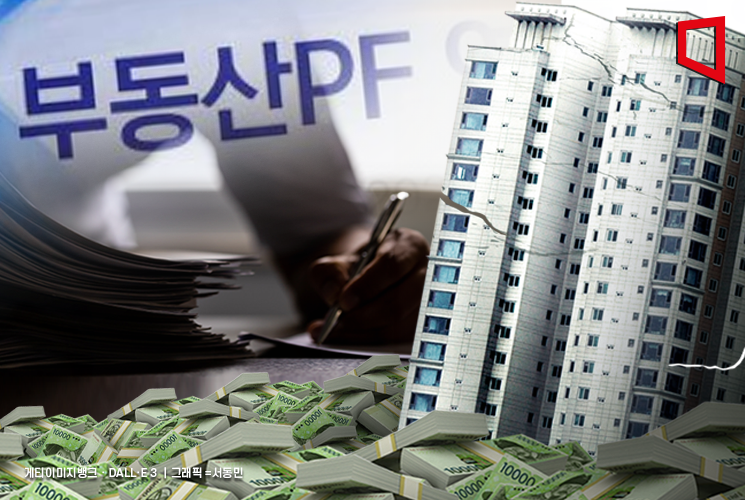
The savings bank industry continued to incur losses in the first half of this year following last year's fallout from real estate project financing (PF) defaults. The industry expects to exit the deficit by the first half of next year at the latest and is discussing with financial authorities ways to resolve the PF 'concentration phenomenon.'
According to the Korea Federation of Savings Banks on the 30th, 79 savings banks nationwide posted a total net loss of 380.4 billion won in the first half of this year. The deficit expanded by 283.9 billion won compared to the same period last year and increased by 226.1 billion won compared to the previous quarter. The Korea Federation of Savings Banks explained that the deterioration in performance was due to an increase in loan loss provisions. The amount of provisions transferred by savings banks in the first half of this year was 2.3285 trillion won, an increase of 396.2 billion won from 1.9323 trillion won in the first half of last year.

At a press briefing on the same day, Oh Hwakyung, chairman of the Korea Federation of Savings Banks, said, "The timing of profitability improvement depends on the speed and volume of the disposal of (non-performing projects)." He added, "If all (non-performing projects) are disposed of quickly, the loss will be large once, but after that, the performance will improve." He also cautiously predicted, "It would be best if the deficit period continues only until the end of this year, and I think the bottom will be passed after the first half of next year."
It was confirmed that the projects the savings bank industry plans to quickly dispose of account for 20% of the total. According to the Korea Federation of Savings Banks, the industry's real estate PF loans and land-secured loans amounted to 15.5 trillion won as of the end of June. According to the Financial Services Commission's first real estate PF feasibility evaluation, projects rated C (caution) amount to 1.4 trillion won, and those rated D (lowest grade, at risk of default) amount to 3.2 trillion won. The financial authorities have strengthened post-measures requiring restructuring for projects rated C or below, and increased the provision ratio to 75% for projects rated D, which are subject to auction or forced sale. Currently, the provision ratio for savings banks on D-rated projects is about 30%.
At the briefing, Choi Byung-ju, senior managing director of the Korea Federation of Savings Banks, said, "We plan to focus on auction and forced sale for projects classified as D grade." He added, "If the market situation requires a PF normalization fund at the Korea Federation of Savings Banks level, we will consult with financial authorities and proceed with additional funds."
The Korea Federation of Savings Banks explained that it will strive to resolve the industry's concentration on real estate PF going forward. Senior Managing Director Choi said, "Since savings banks do not have a unique domain, the concentration phenomenon repeats in the loan portfolio." He added, "We are discussing with financial authorities about relaxing the criteria for mid-interest loans or strengthening the role of savings banks in policy products so that savings banks can focus on financing for ordinary citizens." Chairman Oh also mentioned, "Savings banks have very few sources of income," and said, "While institutional improvements related to real estate PF are necessary, it is also necessary to diversify the loan portfolio."
The delinquency rate slightly improved compared to the previous quarter. The delinquency rate of savings banks was about 8.8% in the first quarter of this year but fell by 0.44 percentage points to 8.36% in the second quarter. Lee Kyung-yeon, head of the Korea Federation of Savings Banks, explained, "The savings bank industry reduced the delinquency rate by selling 2.9 trillion won worth of (non-performing) bonds in the first half of this year." Senior Managing Director Choi also said, "Compared to the 2022 Legoland incident, PF-related loans in the savings bank industry decreased by 37% (9.4 trillion won)," adding, "The reduction scale is significantly larger than other sectors."
However, the delinquency rate slightly increased in July and August. Director Lee said, "The delinquency rate has slightly risen recently in personal business owners with deteriorated debt repayment ability and PF corporate loans," and added, "We are proceeding with sales and write-offs through joint sales, self-sales, occasional write-offs, and loan loss write-offs." Chairman Oh said, "We are making efforts to reduce (the delinquency rate) in July and August, so we will ensure it does not rise further next month."
© The Asia Business Daily(www.asiae.co.kr). All rights reserved.


















