Insert the tee on a flat area up to two clubs behind
If the ball flight hooks, aim left; if it slices, aim right
High tee results in a high-trajectory draw, low tee produces a low-trajectory fade
The tee box is the starting point of golf. You insert the tee, place the ball on it, and take your shot. It is the space where play begins. Most amateur golfers take their shots on the tee box without much thought. To achieve a good score and satisfactory ball flight, it is essential to actively utilize the tee box with proper know-how.
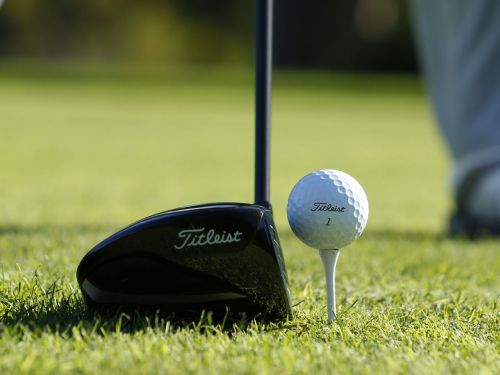
Be careful even when inserting the tee. The tee box is not flat like a driving range. If you look closely, there is a slight slope. You should place the tee where it does not affect the ball flight. Depending on the slope of the tee box, hooks or slices can occur. Use the area allowed within two clubs effectively. Even if you move backward, your priority is to find the flattest ground possible. Check where your fellow players place their tees. Observe from outside the tee box. Once on the tee box, feel the slope with your feet. The address position should be flat. If there are small stones after addressing, move to another spot.
When standing on the tee box, decide on a safe target point. Aim to avoid hazards, out of bounds, bunkers, and other dangerous areas. If there is an obstacle on the left, place the tee on the left side of the tee box and aim toward the center to open up the right side. If there is a hazard on the right, use the right side of the tee box for your shot. This is the minimum effort to avoid losing strokes.
Use the tee box according to your ball flight. Golfers whose shots tend to go left should use the left side of the tee box, and those whose shots curve right should use the right side. Adjust the tee height as well. When facing a strong headwind, tee the ball slightly lower than usual. Lowering the trajectory minimizes the wind’s effect. Conversely, when there is a tailwind, tee the ball slightly higher to take advantage of the wind and maximize distance.
Adjust tee height according to the club. Even professional players make subtle adjustments to tee height depending on the loft of the iron and the length of the shaft. This is especially important on par 3 holes. When using short irons (#7-9), tee the ball close to the ground. When using long irons (#4-6), tee the ball slightly higher than with short irons. Long irons are not easy clubs even for tour players. Be careful of hitting behind the ball when teeing off with long irons. Players also use the slope when inserting the tee. If you insert the tee angled toward the target direction, the trajectory lowers and produces a fade ball flight at the same height; the opposite angle raises the trajectory and produces a draw ball flight.
Etiquette must be observed on the tee box. Once the tee shot order is set, focus on your playing partners’ shots. Even if chatting, remain silent once someone begins their swing routine. Noise can interfere with the shot. Mutual consideration is necessary for an enjoyable round. Sometimes, a beginner golfer (golfer + child, called "gollini") stands right behind to watch the tee shot closely. They may come into the line of sight during the shot. It is sufficient to watch from a distance.
Be careful when placing the tee. The “navel” (center of the teeing area) must not be violated. You must tee off within the teeing ground. This is a rectangular area extending two clubs behind a straight line connecting the two tee markers. It is acceptable to take your stance outside this area. Sometimes during practice swings, the ball may be hit or fall due to vibration. If there was no intention to hit the ball, there is no penalty. Simply place the ball back and hit again.
© The Asia Business Daily(www.asiae.co.kr). All rights reserved.

















