Rejection of Claim for Legitimate Act, Recognition of Obstruction of Business
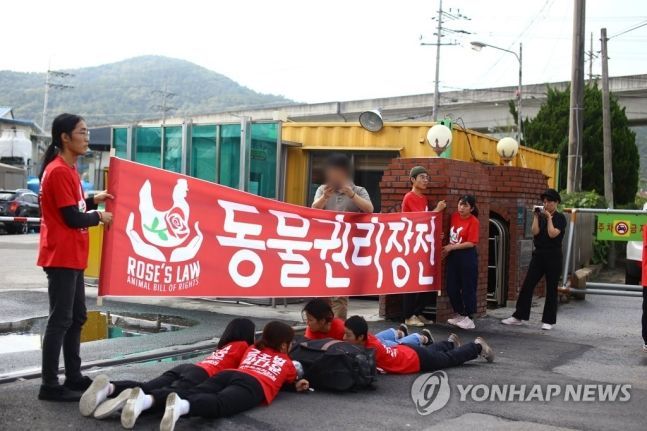 Animal rights activists protesting in front of the livestock market. Photo by Yonhap News Agency (provided by DXE Korea)
The conviction for obstruction of business against animal rights activists who lay down in front of a slaughterhouse and blocked the progress of trucks carrying live chickens to express their opposition to corporate (factory-style) livestock systems has been upheld.
They claimed that their actions constituted justifiable acts under criminal law and were therefore not illegal, but this was not accepted.
According to the legal community on the 30th, the Supreme Court's 2nd Division (Presiding Justice Shin Sook-hee) dismissed all appeals in the final trial of three animal rights activists, including Mr. A, who were charged with obstruction of business, confirming the original sentence of a 3 million won fine each.
The court stated, "There is no error in the lower court's judgment that violates the rules of experience or exceeds the limits of free evaluation of evidence, nor any misunderstanding of the principles of trial-centeredness, the establishment of obstruction of business, or the legal principles of justifiable acts under Article 20 of the Criminal Act, nor any failure to conduct necessary investigations that affected the judgment."
Mr. A and others, members of the animal rights protection group DxE (Direct Action Everywhere), were tried for obstructing the transportation and slaughter operations of a victim company by lying down on the road in front of the main gate of a slaughterhouse in Cheoin-gu, Yongin-si, Gyeonggi Province, from 1:30 p.m. to 6:30 p.m. on October 4, 2019, with their hands bound to a suitcase filled with concrete, blocking five trucks carrying live chickens, shouting slogans such as "Don't kill chickens," and singing songs to exert influence.
It was reported that this protest was part of a "Global Lockdown" (direct action to occupy slaughterhouses and halt operations) held worldwide on the occasion of World Animal Day.
In court, they argued that their actions were expressions of political freedom and did not constitute the exercise of force required for obstruction of business. They also claimed their acts were justifiable and did not violate social norms.
However, the first-instance court found them guilty of obstruction of business and sentenced each defendant to a fine of 3 million won.
The court stated, "The defendants lay down on the road in front of the victim company's main gate for more than four hours with their hands bound by a suitcase containing concrete, and the act only stopped after the fire department intervened and dismantled the concrete using industrial grinders and drills. Considering that these acts were based on the defendants' personal beliefs and clearly disrupted the victim company's operations, it is difficult to see the defendants' actions as socially reasonable to the extent that they can be tolerated under the overall legal order, and they constitute the exercise of force as defined in obstruction of business."
The court also rejected their claim of justifiable acts, stating, "Even if the defendants' actions were based on their beliefs and the corporate livestock facilities and slaughterhouse operations in Korea are conducted in ways contrary to those beliefs, it cannot be said that the victim company's operations of receiving live chickens and slaughtering them are entirely unprotected under criminal law. Moreover, the means and methods of the defendants' actions are not reasonable, nor can it be said that there were no other means or methods available. Therefore, the defendants' actions cannot be considered justifiable acts that do not violate social norms."
Regarding sentencing, the court said, "It is now appropriate to refrain from treating animals simply as food resources as in the past. Also, recognizing that animals are living beings capable of feeling pain, efforts should be made to create a healthy and responsible breeding culture, improving breeding environments and conducting slaughter in ways that respect life as much as possible." It added, "Considering global movements and changes in awareness in Korea, the beliefs held by the defendants are not significantly different within a broad framework."
It further stated, "In a way, the defendants' actions can be seen as an expression of pure affection for animals and a hope that others share their values and respect animals as beings worthy of living together."
However, the court noted, "Nonetheless, as previously examined, it is clear that the defendants' actions themselves cannot be granted legitimacy or justification." It also pointed out, "The method of causing harm to others and violating the law based on the belief that 'I am right and you are wrong' only forces others to accept their beliefs and causes resentment, making it difficult for the defendants to gain the sympathy and support they desire."
It continued, "Instead of only criticizing unsanitary breeding environments and slaughter processes that do not respect life by committing acts like those in the criminal facts, the defendants should take a step back to consider whether their actions might cause further harm to others and act within the scope where justification and reasonableness are recognized according to their beliefs. Eventually, they will gain the sympathy and support of the majority. This may also be the wish of the chickens like Yeoreum, whom the defendants represent."
Mr. A and others appealed, but the second-instance court's judgment was the same.
The court stated, "It is acknowledged that the defendants engaged in the acts described in the indictment to protect animal life and safety and to express opposition to corporate livestock systems, so there is sufficient room to recognize the legitimacy of the defendants' motives and purposes."
However, the court rejected the claim of justifiable acts, stating, "As previously noted, the defendants' actions lack proportionality in means and methods and balance of legal interests, and it cannot be said that there were no other means or methods available, so subsidiarity is not recognized. Therefore, the defendants' claims alone cannot establish that their actions meet all the requirements of justifiable acts under criminal law."
The Supreme Court also found no problem with the second-instance court's judgment.
© The Asia Business Daily(www.asiae.co.kr). All rights reserved.
![A Woman with 50 Million Won Debt Clutches a Stolen Dior Bag and Jumps... A Monster Is Born [Slate]](https://cwcontent.asiae.co.kr/asiaresize/183/2026021902243444107_1771435474.jpg)
















