Statistics Korea July Industrial Activity Trends Announced
Total Industry Production Down 0.4% Month-on-Month
Retail Sales Record Triple Decline
Construction Output -1.7%... Decreasing for Three Consecutive Months
Total industrial production has declined for the third consecutive month. In July, production indicators centered on manufacturing, such as automobiles and semiconductors, fell further compared to the previous month. Retail sales turned to a downward trend amid prolonged domestic demand weakness. Facility investment increased double digits due to the effect of aircraft imports.
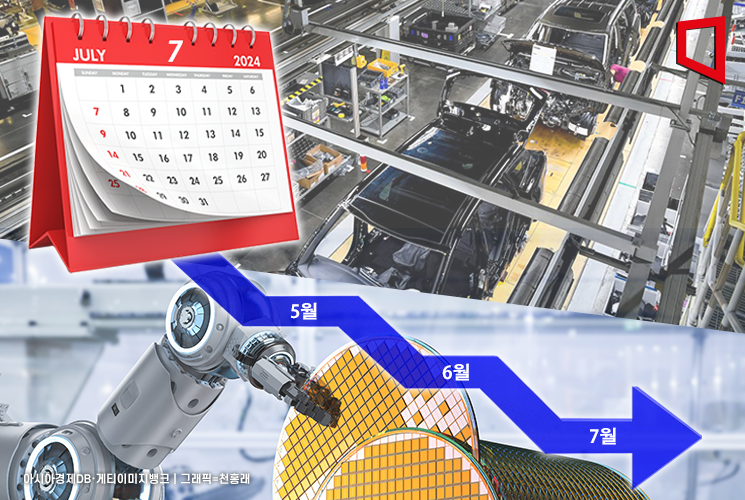
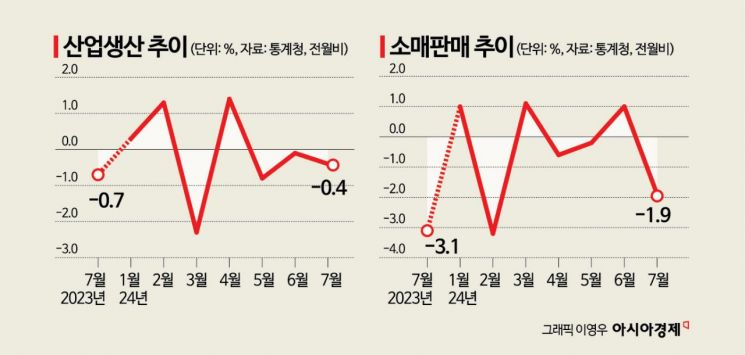
According to the 'July Industrial Activity Trends' released by Statistics Korea on the 30th, total industrial production decreased by 0.4% compared to the previous month. This marked the third consecutive month of negative growth following May (-0.8%) and June (-0.1%). While public administration (6.0%) and services (0.7%) increased for two consecutive months, production declined in mining and manufacturing (-3.6%) and construction (-5.3%). It is the first time in 21 months since August to October 2022 that total industrial production has decreased for three consecutive months.
In mining and manufacturing, manufacturing production, which accounts for the majority, fell by 3.8%. This is the largest decline since December 2022 (-3.7%). In particular, production of the two major pillars of manufacturing, semiconductors (-8.0%) and automobiles (-14.4%), decreased significantly. Semiconductors experienced a base effect from the previous month (7.9%), which was the highest since statistics began. The overall business conditions and demand trends are considered favorable according to Statistics Korea. Automobiles recorded the largest drop in 50 months since May 2020 (-24%).
Gong Mi-sook, Director of Economic Trend Statistics at Statistics Korea, explained, "Automobile production decreased due to parts suppliers' strikes and line maintenance work." She added, "Although production figures are worse than the same month last year, they fluctuate compared to the previous month. The index itself is not low, so it is necessary to understand the overall situation, and there were special circumstances in July."
On the other hand, telecommunications and broadcasting equipment (48.8%) showed a remarkable increase due to the launch of new mobile phone models last month. The production increase was also influenced by the inclusion of domestic camera modules in the new mobile phones to be released next month.
Retail sales, which indicate goods consumption trends, decreased by 1.9% compared to the previous month. After continuing a negative trend from February to May, retail sales seemed to rebound in June (1.0%) but returned to a decline. Sales decreased across the board, including nondurable goods such as vehicle fuel (-1.6%), durable goods such as passenger cars (-2.3%), and semi-durable goods such as entertainment and hobbies (-2.1%), showing a triple decline for the first time since July last year. This fully reflects the impact of prolonged domestic demand weakness.
Facility investment increased by 10.1% compared to the previous month, continuing the upward trend following June (3.4%). Although investment in machinery such as computers and office equipment decreased (-1.6%), the increase in transportation equipment (50.5%), including aircraft imports, was prominent. Deferred investments from the first half of the year are gradually increasing in scale as the second half begins. Director Gong explained, "Even excluding transportation, facility investment is positive, so it is necessary to monitor the recovery trend."
Construction output decreased by 1.7% compared to the previous month. It continued a three-month decline following May (-4.6%) and June (-0.8%). Although construction work increased by 0.9%, civil engineering work decreased significantly by 8.9%, widening the decline compared to the previous month. However, construction orders increased by 28.4% compared to the same month last year, continuing the upward trend for the second consecutive month following 36.9% in the previous month, so positive effects may appear in the second half of the year. Kim Gwi-beom, Director of Economic Analysis at the Ministry of Economy and Finance, forecasted, "As the year-end approaches in the fourth quarter, civil engineering and construction work will be completed, so conditions may improve compared to the third quarter."
The coincident composite index cyclical component fell by 0.6 points from the previous month to 98.4 due to decreases in the domestic shipment index and construction output, marking the fifth consecutive month of decline. This is the first time in 18 months since September 2022 to January 2023. On the other hand, the leading composite index cyclical component remained steady at 100.6 compared to the previous month, maintaining a positive trend for 15 consecutive months since May 2023.
Director Gong said, "The coincident index reflects decent production but weak consumption and construction. The leading index is moving positively, so the coincident index is expected to follow, but currently, it is necessary to interpret the economic situation together with other indicators." Director Kim also explained, "The lag between the coincident and leading indices averages 7 to 8 months and can be up to 19 months, so we are monitoring when the coincident index will be affected by the leading index."
The government interpreted the pronounced production decline centered on mining and manufacturing as a 'temporary adjustment.' This is because export growth continues and major manufacturing sectors showed strong performance in the first half of the year. To promote economic recovery, the government plans to boost domestic tourism and reinforce construction investment by 5 trillion won, focusing on policies to revive domestic demand. Key policies for stabilizing livelihoods during Chuseok will also be implemented promptly.
© The Asia Business Daily(www.asiae.co.kr). All rights reserved.


















