Blackwell Delay and Nvidia Correction
Korean Companies and TSMC Also 'Tumbling'
Demand and Supply Steady... No Long-Term Correction Expected
NVIDIA announced second-quarter earnings that exceeded market expectations, and SK Hynix completed the development of the world's first 10-nanometer (nm; 1 nanometer is one billionth of a meter) 6th generation (1c) technology, but stock prices fell, continuing the 'semiconductor peak theory.' As NVIDIA struggles with delays in the launch of its next-generation artificial intelligence (AI) chip 'Blackwell,' the stock prices of suppliers such as SK Hynix and Samsung Electronics are also undergoing adjustments. While some voices are raising the 'semiconductor peak theory' following the AI peak theory, experts responded that the semiconductor industry's future is bright in the long term, so stock prices will likely only experience short-term corrections.
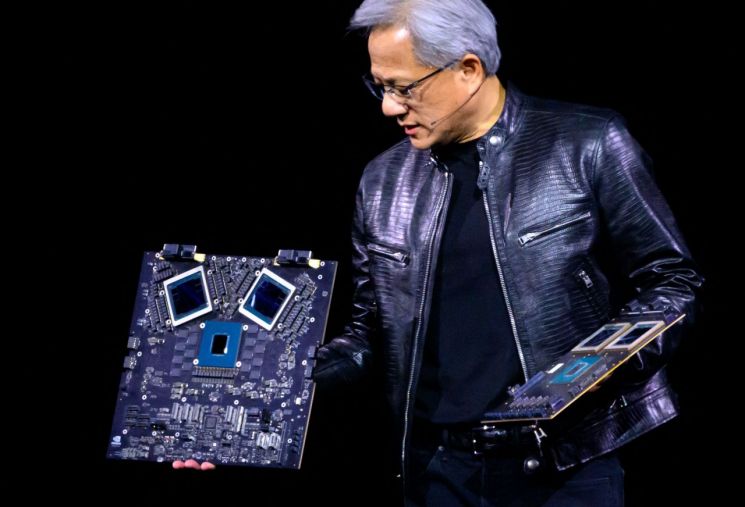 Jensen Huang, CEO of NVIDIA, unveiled Blackwell for the first time at the AI conference 'GTC 2024' held in San Jose, California, USA, on March 18 (local time).
 [Photo by AFP]
NVIDIA's stock price closed at $125.64, down 2.1%, on the New York Stock Exchange on the 28th (local time). It had risen 12.56% over the past month before undergoing a correction. Despite recording fiscal second-quarter (May to July) revenue of $30.04 billion (40.1785 trillion KRW) and earnings per share of $0.68 (909 KRW), surpassing market expectations ($28.7 billion and $0.64), the stock price fluctuated, raising concerns about a 'semiconductor market peak.'
SK Hynix, which announced the development of new technology, closed at 169,700 KRW on the Korea Exchange on the 29th, down 5.35% from the previous trading day. Samsung Electronics also fell 3.14% to 74,000 KRW. Not only in Korea, but semiconductor-related stocks such as TSMC (-2.18%), Texas Instruments (-1.4%), Intel (-2.29%), and AMD (-2.75%) also declined consecutively.
The financial investment industry interprets the confirmed delay of NVIDIA's next-generation AI chip 'Blackwell' shipment from the third quarter to the fourth quarter as a factor that fell short of investors' expectations. There is also an opinion that uncertainty increased because NVIDIA's management did not specifically explain how Blackwell's shipment would impact additional revenue growth.
Another analysis points to the lack of 'killer content' exceeding expectations after ChatGPT, which uses NVIDIA's graphics processing units (GPUs), as a reason for the stock price adjustment. This negatively affected the stock prices of suppliers such as TSMC and SK Hynix, as well as related stocks. Joon-ki Cho, a researcher at SK Securities, said, "If they did not present figures that satisfy the market, new 'materials' need to emerge, but since that did not happen, profit-taking occurred," adding, "Innovative technology needs to lead to software or killer applications (surpassing ChatGPT) for NVIDIA's stock price to rise to the next level."
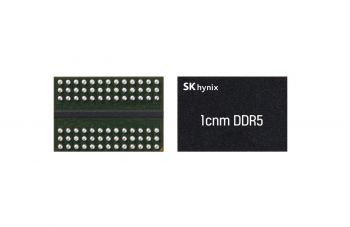 SK Hynix 6th generation 10-nanometer (nm; 1 nanometer = one billionth of a meter) DRAM '1c Double Data Rate (DDR)5'.
 [Photo by SK Hynix]
The semiconductor industry and academia expressed surprise at the stock price decline following NVIDIA's strong earnings announcement but largely agreed that there is no doubt about a structural 'long-term boom.' According to the industry, the 6th generation 10nm DRAM announced by SK Hynix is expected to be applied to the 7th generation HBM4E, which aims for mass production in 2026, surpassing the currently mass-produced 5th generation HBM (HBM3E). This means that demand for next-generation AI semiconductors is increasing, and technological advancements to meet this demand are progressing smoothly. Many believe that after a short-term correction, stock prices will rise again.
Jin-wook Beom, a professor of electronic engineering at Sogang University, said, "As electronic products worldwide become smaller, semiconductor demand will increase, so it is difficult to agree with the opinion that this is a 'peak' when looking at the long-term trend." Hyeon-jae Kim, a professor of electrical and electronic engineering at Yonsei University, also said, "It is not a peak but just the beginning, especially for memory, which is expected to see a boom when the 6th generation high-bandwidth memory (HBM) product 'HBM4' scheduled for mass production next year is released," adding, "It is difficult to assert a 'peak' based on the stock price adjustment on this day."
© The Asia Business Daily(www.asiae.co.kr). All rights reserved.

![Clutching a Stolen Dior Bag, Saying "I Hate Being Poor but Real"... The Grotesque Con of a "Human Knockoff" [Slate]](https://cwcontent.asiae.co.kr/asiaresize/183/2026021902243444107_1771435474.jpg)
















