Confidence in superiority in production efficiency, mass production system, and delivery performance
Full-scale order competition next year... Ahead of Samsung and Micron
Samsung also stakes life on 6th and 7th generation... Competition in DDR following HBM
SK Hynix has succeeded in developing the world's first 10nm (1nm = one billionth of a meter) 6th generation (1c) DRAM semiconductor, surpassing Samsung Electronics and US-based Micron. As early as the end of this year, it plans to complete preparations for mass production, obtain compatibility certification for Intel server CPUs, and start supplying products from early next year.
Until 2019, when 3rd generation 10nm-class DRAM (1z) was being produced, Samsung Electronics held a technological lead of 1 to 2 years over SK Hynix and Micron. However, with SK Hynix taking the lead in the 6th generation, Samsung is now focusing intensely on advanced DRAM processes for the 6th and 7th generations. The competition between Samsung and SK Hynix is becoming fiercer. Both companies consider the 6th generation 10nm 1c DRAM technology a critical field that must not be lost, as it is used not only in high-bandwidth memory (HBM) for artificial intelligence (AI) semiconductors but also in all DRAM solutions including double data rate (DDR) and compute express link (CXL).
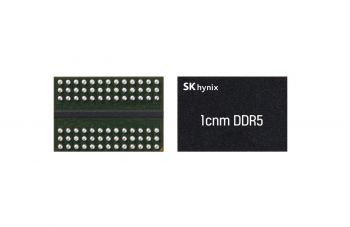 SK Hynix 6th generation 10-nanometer (nm; 1 nanometer = one billionth of a meter) DRAM '1c Double Data Rate (DDR)5'.
 [Photo by SK Hynix]
On the 29th, SK Hynix announced that it had successfully developed a 16Gb DDR5 DRAM applying the 6th generation 1c technology. It plans to complete preparations for mass production within the year and supply products starting next year. This timeline is several months ahead of Samsung Electronics, which is reportedly following a 'Q3 development - year-end to June next year mass production' scenario. If this continues, the scenario where Samsung struggles to catch up with SK Hynix's Nvidia orders in HBM could be replicated in the DRAM market for PC servers and DDR.
The key factor is productivity. In the order competition, how stably the mass production system is established is more important than the speed of development. SK Hynix expressed confidence that its productivity is higher than that of rival companies. The 6th generation DRAM secured cost competitiveness through extreme ultraviolet (EUV) process optimization, increasing productivity by more than 30% compared to the 5th generation. The operating speed is 8Gbps (8 gigabits per second), 11% faster than the 5th generation 1b. Power efficiency improved by more than 9%. SK Hynix explained, "Applying SK Hynix's 6th generation 1c DRAM to data centers of cloud service customers could reduce power costs by up to 30% compared to before."
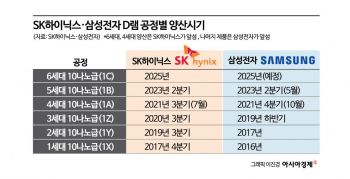
Looking at DRAM history, Samsung Electronics had consistently led up to the 3rd generation 10nm DRAM (1z). Micron led the 4th generation (1a), but Samsung reclaimed the throne with the 5th generation (1b). Although it lagged in HBM, Samsung was still confident of its superiority in PC server DDR and other areas. The title of being the No. 1 DRAM maker for 32 consecutive years since 1992 remained unblemished. However, Samsung has been losing to SK Hynix in HBM orders for the past 1-2 years and was late again in the 6th generation DRAM (1c). There is a growing sense of crisis that if Samsung does not counterattack in process technology and next-generation packaging competition from the 6th and 7th generations onward, it will be left behind in the market.
For Samsung Electronics, although it has fallen behind in HBM, it is accelerating the development and mass production speed of 6th generation DRAM to regain the lead in other main products such as DDR. It has also established an advanced process technology development organization for the 7th generation DRAM and beyond. In May, it reportedly reorganized to bring semiconductor engineers and process engineers together from the technology development stage, aiming to advance production and delivery schedules by developing and preparing for mass production simultaneously.
For now, the prevailing view is that SK Hynix will have higher production quality in the 6th generation DRAM. It is expected to have advantages in the number of chips produced per wafer, process efficiency, and yield (ratio of good products). An industry insider said, "The company that first develops 6th generation DRAM technology is likely to hold overall leadership across major DRAM market products such as DDR, HBM, and CXL."
Kim Jong-hwan, Vice President in charge of DRAM development at SK Hynix, said, "We will apply the 1c technology, which simultaneously meets the highest performance and cost competitiveness, to next-generation HBM, LPDDR6, GDDR7, and other cutting-edge DRAM main product lines to provide differentiated value to customers. Going forward, we will maintain our leadership in the DRAM market and solidify our position as the most trusted AI memory solution company by customers."
© The Asia Business Daily(www.asiae.co.kr). All rights reserved.
![Clutching a Stolen Dior Bag, Saying "I Hate Being Poor but Real"... The Grotesque Con of a "Human Knockoff" [Slate]](https://cwcontent.asiae.co.kr/asiaresize/183/2026021902243444107_1771435474.jpg)

















