Field Experts Gather to Discuss Countermeasures
Legal and Institutional Reforms Needed Along with New Technology Adoption
20 Billion Won R&D Budget Planned for Next Year
"Deepfake sexual crimes are causing growing public anxiety because it is difficult to identify perpetrators and an unspecified number of people can be victimized." (Shin Young-sook, Vice Minister of the Ministry of Gender Equality and Family)
"We will expand inter-ministerial collaboration to establish a sound digital order." (Kang Do-hyun, 2nd Vice Minister of the Ministry of Science and ICT)
To prepare countermeasures against deepfake synthetic illegal pornography, which has sparked social outrage, the Ministry of Science and ICT and the Ministry of Gender Equality and Family met. The two vice ministers held a private meeting for over an hour on the 28th at the Korea Women's Human Rights Institute in Jung-gu, Seoul, discussing cooperation plans. After the meeting, Vice Minister Kang told Asia Economy, "We decided to strengthen cooperation not only between the two ministries but also with related ministries and to expand technical and institutional support."
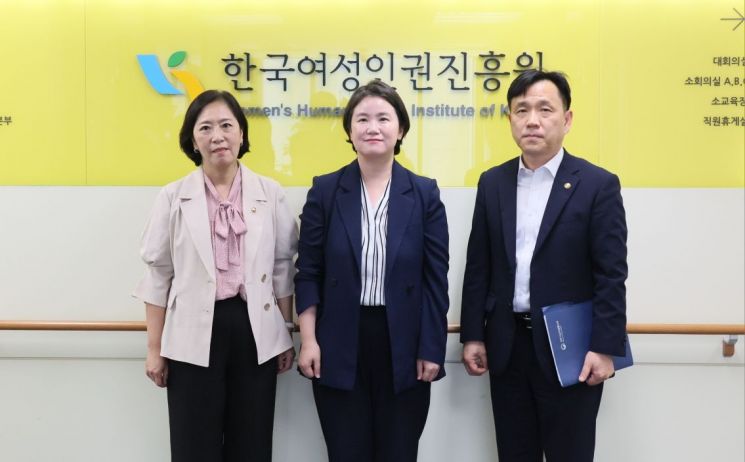 Kang Dohyun, Vice Minister of Science and ICT (right), and Shin Youngsook, Vice Minister of Gender Equality and Family (left), visited the Digital Sexual Crime Victim Support Center at the Korea Women's Human Rights Institute in Jung-gu, Seoul, on the 28th and took a commemorative photo with Director Shin Bora.
 [Photo by Ministry of Science and ICT]
Requests for Correction of Deepfake Pornography Quadruple
As artificial intelligence (AI) technology spreads comprehensively, deepfake sexual crimes have emerged as the biggest social side effect. According to the Korea Communications Standards Commission, the number of correction requests for deepfake sexual crime videos reached 6,434 by the end of last month, a fourfold increase compared to the same period last year.
The number of deepfake victim support cases reported to the Digital Sexual Crime Victim Support Center (DiSeong Center) also surged more than elevenfold, from 69 cases in 2018 to 781 cases this year (as of August 25). According to the National Police Agency, 297 deepfake sexual crime reports were received from January to July, and among 178 suspects booked, teenagers accounted for 131, or 73.6%. President Yoon Suk-yeol also instructed strong measures to eradicate digital sexual crimes using deepfakes during the Cabinet meeting on the 27th.
Related Ministries to Hold Working-Level Meeting on the 30th
Preventing digital sexual crime damage requires legal and institutional support as well as technological development for prevention, deletion and blocking of illegal pornography, and punishment of suspects. Officials from the Ministry of Science and ICT, Ministry of Gender Equality and Family, Korea Communications Commission, Korea Communications Standards Commission, Ministry of Education, Ministry of Justice, and National Police Agency will hold a working-level meeting on the 30th.
The Ministry of Science and ICT and the Ministry of Gender Equality and Family have already been conducting joint policy research on responding to deepfake sexual crimes since last month. By the end of the year, they plan to prepare measures for preventing and protecting digital sexual crime victims together with the Korea Intelligent Information Society Agency and Hanshin University Industry-Academic Cooperation Foundation. The main research topics include ▲amendment of the Sexual Violence Punishment Act ▲practical support measures for victims ▲establishment of a system capable of searching, blocking, and tracking illegal digital sexual crime content. Shin Bo-ra, President of the Korea Women's Human Rights Institute, said, "Although deepfake cases have brought this issue to the surface, digital sexual crimes were already a serious problem."
 Ryu Hee-rim, Chairman of the Korea Communications Standards Commission (right), is taking a commemorative photo with Seoul Mayor Oh Se-hoon on the 28th after signing a business agreement to establish a rapid response cooperation system for deepfake sexual crime videos.
 [Photo by Korea Communications Standards Commission]
AI Side Effects Solved by AI... Urgent Need for Legal Amendments
Problems caused by AI technology are expected to be solved by AI technology. The Ministry of Science and ICT announced that it will invest a total of 2 billion KRW next year to promote research and development (R&D) projects related to deepfakes. The DiSeong Center urgently needs to build an AI-based automated system for deletion support. Currently, center staff manually check problematic URLs and request deletion one by one on online platforms. The deletion request methods vary by platform, and it is cumbersome to later directly access the URL to verify whether deletion has been properly carried out. Considering the rapid spread of victim videos in the digital era, it is essential to establish an automated system that monitors and requests deletion of victim videos 24/7.
The Ministry of Gender Equality and Family is pushing for a legislative amendment to the Sexual Violence Prevention Act through parliamentary legislation to allow deletion not only of illegal filming materials but also of victims' personal information. The Korea Communications Standards Commission plans to form a consultative body with global online platform companies such as Telegram, Facebook, and X (formerly Twitter) to request voluntary regulation. The Commission has signed a business agreement with Seoul City to operate a 'hotline' that deletes deepfake pornography within 24 hours. The Korea Communications Commission announced it will conduct a legal review to impose obligations to delete and prevent distribution of illegal filming materials even in group chats on platforms like Telegram.
© The Asia Business Daily(www.asiae.co.kr). All rights reserved.
![Clutching a Stolen Dior Bag, Saying "I Hate Being Poor but Real"... The Grotesque Con of a "Human Knockoff" [Slate]](https://cwcontent.asiae.co.kr/asiaresize/183/2026021902243444107_1771435474.jpg)

















