Surgery, Treatment, and Anesthesia Fees Increased by 200% After Emergency Room Consultation
The government has designated approximately two weeks before and after the Chuseok holiday as the 'Chuseok Holiday Emergency Response Week' and will support emergency medical care by increasing emergency room specialist consultation fees up to 250%.
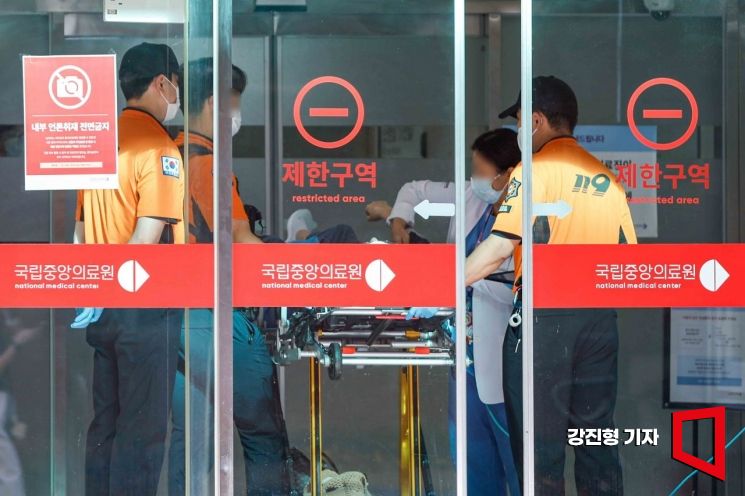 Medical staff are checking the condition of patients in the emergency room at the National Medical Center in Jung-gu, Seoul, on the 28th, as the National Health and Medical Industry Labor Union has announced a strike starting on the 29th. Photo by Jinhyung Kang aymsdream@
On the 28th, Cho Kyu-hong, Minister of Health and Welfare, held a briefing at the Central Disaster and Safety Countermeasure Headquarters (CDSCH) regarding the doctors' collective action and stated, "To ensure that emergency patient care is not disrupted even during the Chuseok holiday when clinics and hospitals close, we have designated September 11 to 25 as the Chuseok Holiday Emergency Response Week and will support emergency medical care."
First, to ensure that critically ill emergency patients receive timely treatment and to distribute patients according to severity, the government will operate at least one 'Dedicated Severe Emergency Room' in each of the 29 emergency medical zones nationwide.
In the Dedicated Severe Emergency Rooms, only critically ill emergency patients classified as KTAS (Korean Triage and Acuity Scale) levels 1 to 2 will be promptly treated. Even if patients classified as KTAS levels 3 to 5, which correspond to moderate severity (between severe and mild), are not treated here, it will not be considered a refusal of treatment. Patients with moderate or lower severity can receive treatment at regional emergency medical institutions and non-base regional emergency medical centers.
The government plans to increase the out-of-pocket expenses up to 90% for mild and non-emergency patients who use regional or local emergency medical centers, and aims to implement this within September by accelerating the process.
Additionally, to enhance emergency room treatment capacity, during the Emergency Response Week, the emergency room specialist consultation fee will be increased from the existing 150% to 250%, a 100 percentage point increase.
Minister Cho explained, "We will expand labor cost support to secure personnel capable of stably operating regional centers," and added, "We will also promote a plan to provide targeted 'pinpoint support' with substitute personnel such as military doctors and general practitioners, focusing on medical institutions urgently needing manpower." He continued, "We will continue to flexibly apply emergency room staffing standards, which have been implemented since the emergency treatment measures period, according to each hospital's situation," and said, "Hospitals can operate dedicated emergency room personnel without limiting to specialized departments, adapting to their circumstances."
Incentives will also be increased to ensure rapid admission and transfer after emergency room treatment. The fee for surgery, procedures, anesthesia, etc., following emergency room treatment will be raised from the existing 150% to 200% to enhance the capacity to accommodate critically ill emergency patients. Starting in September, institutions with excellent patient transfer acceptance rates will be rewarded with incentives.
The government will also operate more than 4,000 on-duty hospitals and clinics during the Chuseok holiday, about 400 more than during this year's Lunar New Year holiday, to increase medical accessibility for mild patients. To distribute mild patients, the 'temporary emergency consultation fee surcharge,' previously applied only to 408 emergency medical institutions, will be expanded to 112 additional emergency medical facilities.
Minister Cho urged, "We will provide information on medical institutions open during the holiday, such as hospitals and clinics, through the Emergency Medical Portal and the Ministry of Health and Welfare and local governments, and will clearly promote which symptoms are considered mild and which medical institutions to visit in such cases." He added, "We ask the public to use this information and, in cases of minor symptoms, to use medical institutions other than emergency rooms."
© The Asia Business Daily(www.asiae.co.kr). All rights reserved.
![Clutching a Stolen Dior Bag, Saying "I Hate Being Poor but Real"... The Grotesque Con of a "Human Knockoff" [Slate]](https://cwcontent.asiae.co.kr/asiaresize/183/2026021902243444107_1771435474.jpg)
















