'Generative AI' Topic National Life Science and Technology Forum Held
Ministry of Science and ICT "Continued R&D on Deepfake Detection and Blocking Technologies"
The Ministry of Science and ICT announced that as a countermeasure against the side effects of deepfakes, it will include provisions in the AI Basic Act requiring watermarks to be displayed when content is created using generative artificial intelligence (AI). The AI Basic Act is a bill that contains provisions for fostering and regulating the AI industry.
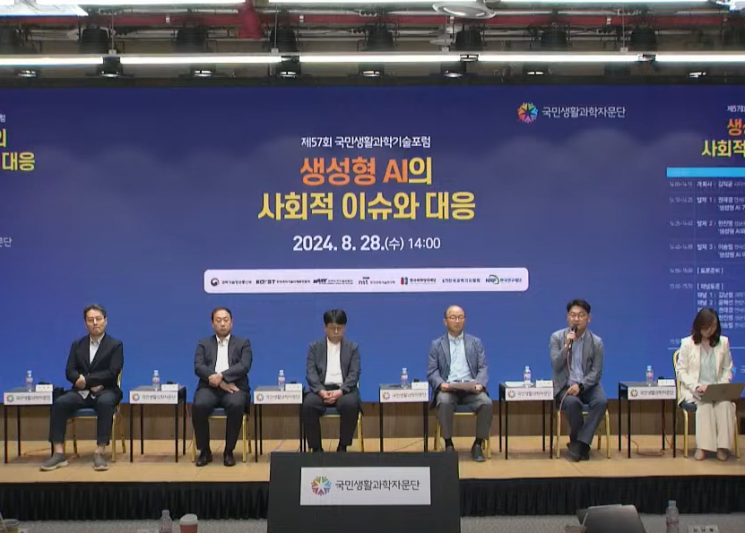
At the 57th National Life Science and Technology Forum held on the 28th, during a discussion on generative AI, Kim Nam-chul, Director General of the Information and Communication Policy Division at the Ministry of Science and ICT, stated, "We are preparing to include a watermark system related to fake news and deepfakes in the AI Basic Act," adding, "We aim to enhance transparency by including regulations that require labeling content as generated by generative AI." The forum was held under the theme "Social Issues and Responses to Generative AI."
Kim also added, "For high-risk AI, we are working on legislation that includes provisions related to the AI Safety Research Institute to ensure reliability."
However, he noted that due to practical legal constraints on the watermark system, it is also important to raise individual awareness about generative AI. Kim said, "Telegram does not have servers in Korea, so even if violations of the law are known, it is difficult to access," and added, "We are doing our best to respond, but there are challenges as laws change according to technology."
He further stated, "Education that rejects illegal activities based on personal ethics and culture must start from schools," and added, "Along with raising awareness of risks within the community, awareness-raising campaigns should also be conducted."
In addition, the Ministry of Science and ICT noted that since 2022, it has been conducting research and development (R&D) on detection and blocking technologies to respond to deepfakes.
Kim also emphasized the role of the National Artificial Intelligence Committee, which is scheduled to be launched in September. He said, "The legal basis for establishing the committee was promulgated this month, and we are appointing private members," adding, "With the committee launching next month, the government, private experts, and companies will come together to develop the positive aspects and create safety measures against side effects such as deepfakes."
During the discussion, opinions and alternatives regarding job changes expected from generative AI, as viewed by the government, were also heard. Kim said, "While generative AI may change jobs themselves, there may also be changes in the nature of the tasks," adding, "Support tasks and simple technical jobs may be vulnerable, so we will expand AI competency development programs from elementary school through graduate school."
He also said, "For vulnerable groups such as the elderly, we are conducting a Digital Learning Center project to enhance kiosk usage skills," and added, "We are making continuous improvements every year to support them so they do not fall behind when new technologies and tools emerge."
© The Asia Business Daily(www.asiae.co.kr). All rights reserved.

















