The ruling and opposition parties have agreed to pass major livelihood bills for the first time since the opening of the 22nd National Assembly.
According to the plenary session of the National Assembly on the 28th, major livelihood bills including the so-called 'Goo Hara Act,' the Special Act on Jeonse Fraud, and the Nursing Act were passed one after another.
The Goo Hara Act (Civil Code amendment) was approved with 284 votes in favor and 2 abstentions out of 286 members present. Named after the late singer Goo Hara, the Goo Hara Act centers on provisions allowing the loss of inheritance rights for direct ascendants who violate their support obligations. It was originally proposed by Representative Seo Young-kyo of the Democratic Party of Korea in 2019. Although the Goo Hara Act made progress in discussions during the 21st National Assembly, it ultimately failed to pass due to disagreements between the ruling and opposition parties.
The passed amendment specifies that direct ascendants of the decedent who seriously violate their support obligations, commit serious criminal acts, or otherwise treat the decedent in an extremely unfair manner may lose their inheritance rights. This amendment will take effect from January 2026. The law will apply to inheritances occurring after April 25 of this year.
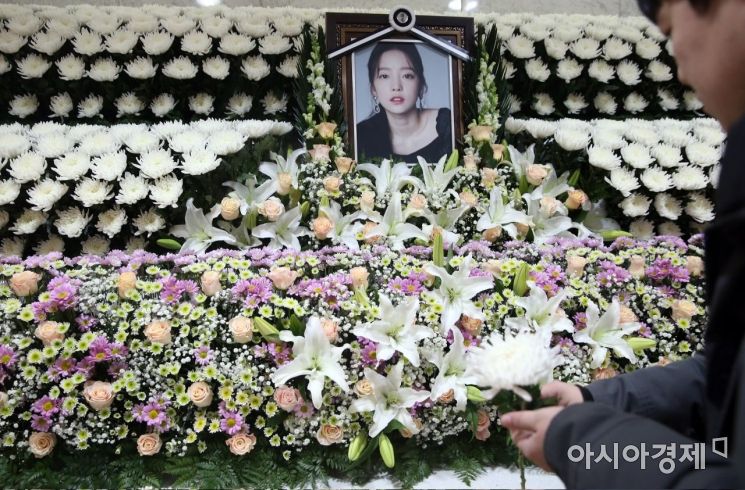 The funeral hall for the late Goo Hara was set up on the 25th at Seoul St. Mary's Hospital. This hall is designated for fans, while a separate hall for family and close acquaintances has been arranged at another hospital. According to the wishes of the bereaved family, all funeral procedures, including the departure and burial, will be conducted privately. Photo by Joint Press Corps
The Nursing Act, which was once discarded in the 21st National Assembly, was also passed by bipartisan agreement. The Nursing Act was approved with 283 votes in favor, 2 against, and 5 abstentions out of 290 members present. Based on 300 members of the National Assembly, over 94% voted in favor, leading to the bill's passage. The Nursing Act clarifies the scope of work for 'Physician Assistant (PA) nurses,' who perform some duties of doctors. With the legalization of PA nurses through the Nursing Act, it is expected to partially alleviate the medical gap caused by the current departure of residents.
Representative Kang Sun-woo of the Democratic Party, a member of the National Assembly's Health and Welfare Committee, stated in a report that day, "The Nursing Act is a consolidated adjustment of three bills respectively proposed by Representatives Kang Sun-woo, Lee Soo-jin, and Kim Sun-min, and one bill proposed by Representative Chu Kyung-ho." She added, "The purpose is to establish an independent legal system for nursing-related matters, which are broadly regulated under the current Medical Service Act, thereby improving the quality of nursing services and contributing to public health." She continued, "The main content includes improving labor conditions and establishing rights provisions to enhance the treatment of nursing personnel." Furthermore, she explained, "The specific scope and limits of physician assistant duties are delegated to be determined by presidential decree to reduce confusion among professional groups." She emphasized, "This Nursing Act is by no means a bill to fill or manage the medical gap caused by the recent medical crisis."
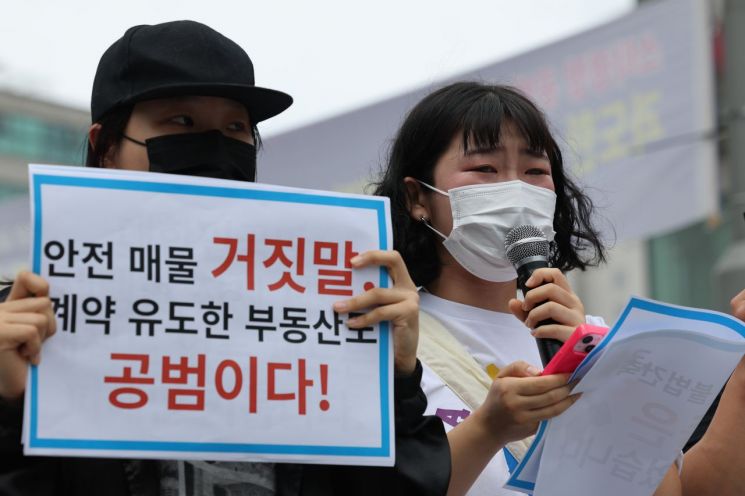
Government support measures for victims of jeonse fraud were also legislated. The 'Special Act on Jeonse Fraud Victim Support and Housing Stability' amendment passed by the National Assembly that day expands the recognition scope of jeonse fraud victims and provides for the provision of the affected housing as public rental housing to victims for up to 20 years. Previously, the Democratic Party had unilaterally passed a special act on jeonse fraud with a 'compensation first, recovery later' approach during the 21st National Assembly, but it was discarded after President Yoon Seok-yeol exercised his veto power and a re-vote.
The passed amendment allows victims to reside in the affected housing, which the Korea Land and Housing Corporation (LH) acquires through auction and provides as public rental housing, for a basic period of 10 years. If they wish to stay longer, they can pay rent at the level of general public rental housing and reside for an additional 10 years. If victims do not wish to live in the affected housing, they can choose to receive auction profits and vacate or opt for 'jeonse rental,' where LH directly signs a jeonse contract with private housing and rents it out.
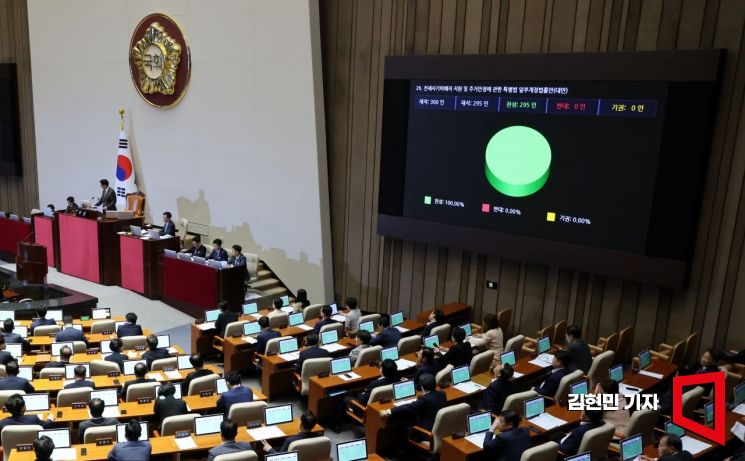 On the 28th, the amendment to the Special Act on Support for Jeonse Fraud Victims and Housing Stability was passed at the National Assembly plenary session. Photo by Hyunmin Kim kimhyun81@
The limit on the deposit amount for recognizing victims of jeonse fraud has been raised from the previous 'up to 300 million KRW' to 'up to 500 million KRW,' and the local government head of the area where the affected housing is located is authorized to manage and supervise the safety of the housing. The amendment will take effect immediately upon promulgation. However, some provisions related to the purchase of jeonse fraud victim housing will have a two-month grace period after the law's promulgation.
In addition, livelihood-related bills such as the 'Win-Win Cooperation Act,' which grants small and medium-sized enterprises the right to claim 'prohibition of technology theft,' amendments to the Urban Gas Business Act, the Industrial Cluster Activation Act, the Crime Victim Protection Act, and the amendment to the Livelihood Finance Support Act, which raises the contribution rate of banks to livelihood finance, were passed by bipartisan agreement.
© The Asia Business Daily(www.asiae.co.kr). All rights reserved.
![Clutching a Stolen Dior Bag, Saying "I Hate Being Poor but Real"... The Grotesque Con of a "Human Knockoff" [Slate]](https://cwcontent.asiae.co.kr/asiaresize/183/2026021902243444107_1771435474.jpg)


















