CEO Investor Day Held and Mid-to-Long-Term Business Strategy Announced
"Advancing Hyundai Way with Dual Pillars of Mobility and Energy"
Hyundai Motor Company plans to increase its hybrid vehicle lineup from the current 7 models to 14. The premium brand Genesis will offer hybrid options for all its models. Extended-range electric vehicles (EREVs) will be sold mainly in North America and China, strengthening the company's ability to flexibly respond to external environmental changes during the electrification transition. Battery development capabilities will also be significantly enhanced.
The investment amount for mid- to long-term future businesses has been raised by more than 10% compared to last year's plan. While major automakers have been shrinking or adopting passive strategies amid increasing uncertainties in the global mobility market, Hyundai has clearly stated its strategy to invest aggressively to seize the initiative.
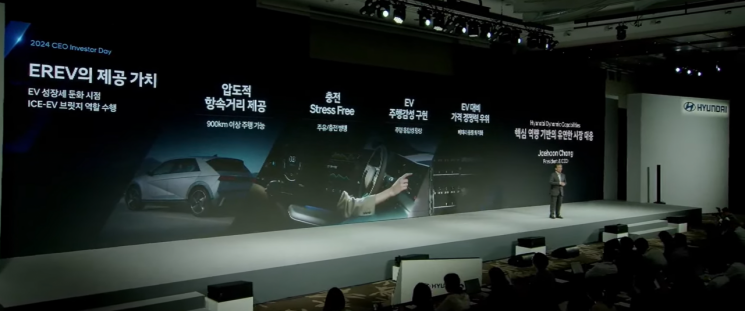 Jang Jae-hoon, President of Hyundai Motor Company, is presenting the mid- to long-term business strategy at the CEO Investor Day on the 28th. [Screenshot from YouTube live broadcast]
On the 28th, Hyundai Motor President Jang Jae-hoon and other key executives held a CEO Investor Day, unveiling the business plan and mid- to long-term strategic direction called "Hyundai Way." Before fully transitioning to the electric vehicle era, the company plans to expand various electrified vehicle options and further refine its existing energy and mobility businesses.
Regarding the electrification transition, the company announced that it is simultaneously developing various vehicle types and technologies. It set a global sales target of 5.55 million units by 2030, up more than 30% from approximately 4.22 million units sold last year. The company plans to increase production capacity by an additional 1 million units by expanding manufacturing facilities overseas.
Electric vehicle sales are targeted to reach 2 million units by 2030, accounting for more than one-third (36%) of total sales. The goals include 690,000 units in North America and 467,000 units in Europe.
The company aims to build capabilities to flexibly respond to rapidly changing market conditions. It intends to refine transitional technologies that can serve as a bridge during the electrification process, such as hybrids, and bring mass-produced vehicles to market. A representative example is the new hybrid system nearing the final stages of development. The next-generation system (TMED-II), which significantly improves performance and fuel efficiency compared to the existing TMED, is planned to be applied to mass-produced vehicles starting January next year. The company explained, "While maintaining a cost level similar to the existing system, we have improved performance and efficiency, securing a competitive edge over rival systems in terms of power output and fuel economy."
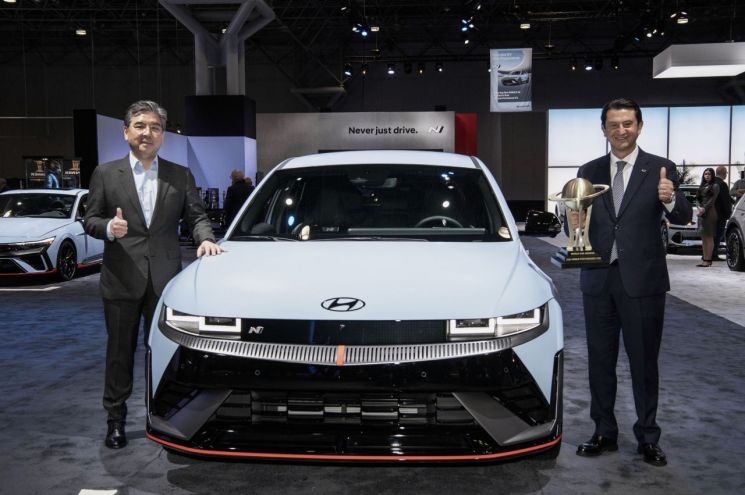
The company also plans to apply smart regenerative braking, which was used in recently released new electric vehicles, and Vehicle-to-Load (V2L) technology that supplies electricity externally, to hybrid vehicles. By 2028, global hybrid sales are expected to reach approximately 1.33 million units, an increase of more than 40% compared to last year. The new factory under construction in Georgia, USA, has shifted its focus from exclusively electric vehicle production to mixed production of hybrids as well.
EREVs will be launched in earnest starting the year after next. This type of vehicle generates electricity inside the vehicle using an engine to charge the battery and drive the vehicle electrically. Hyundai has independently developed the drive system to enable all-wheel drive with two motors. The engine uses existing products, and the battery capacity is reduced by 30% compared to electric vehicles, allowing the company to price the vehicle competitively even compared to plug-in hybrids. The goal is to achieve a driving range of over 900 km on a single charge.
Mass production of EREVs will begin at the end of 2026 in North America and China. In North America, the vehicles will be launched first as mid-size (D-segment) SUVs under the Hyundai and Genesis brands, with an annual sales target of 80,000 units. In China, the target is 30,000 units annually for compact (C-segment) SUVs. The vehicles will be introduced in other regions depending on market conditions.
President Jang said, "Hyundai Motor in the electrification era is a unique company that has introduced the fastest and most comprehensive electric vehicle lineup, including not only mass-market brands but also premium and high-performance models. Based on the highest level of technology accumulated over the years and a commitment to innovation, Hyundai will prepare for the upcoming electrification era and lead the electric vehicle market."
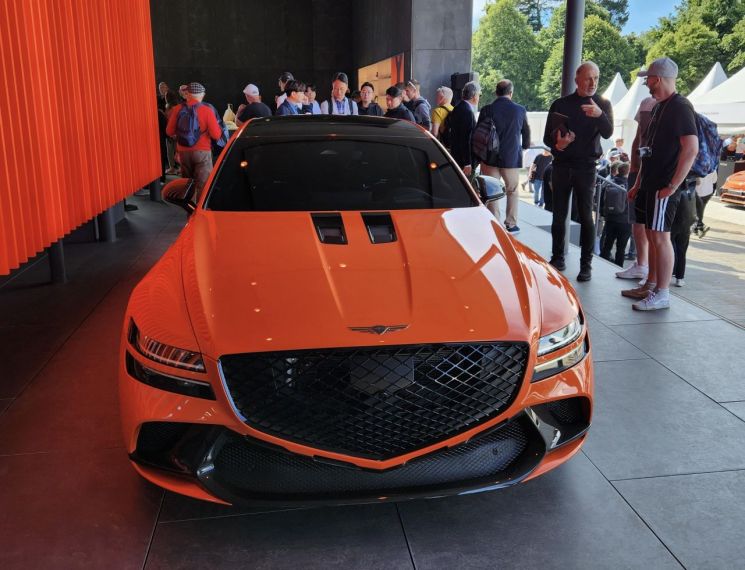 Reporters and visitors are gathered around the Genesis exhibition space installed at the Goodwood Festival of Speed held last month in Chichester, England, UK.
 [Photo by Yonhap News]
Battery technology, considered a core component of electrified vehicles, will also be refined. Building on existing battery development experience, Hyundai plans to enhance competitiveness from the battery cell level and advance safety technologies.
By 2030, the company aims to develop and launch an affordable NCM (Nickel-Cobalt-Manganese) battery with reduced nickel content to lower costs. Battery energy density is also expected to improve, with a projected increase of more than 20% by 2030. Safety technologies, which have recently gained attention due to electric vehicle fires, will be advanced as well. The company plans to strengthen abnormality pre-diagnosis technology for the Battery Management System (BMS) and apply heat transfer prevention technology between cells.
Hyundai will internalize battery development capabilities and introduce a new battery integration method called CTV (Cell to Vehicle). This structure integrates the battery with the vehicle body, reducing parts and improving battery packing density. Compared to the previous CTP (Cell to PACK) method, the battery system weight is expected to decrease by 10%, while heat transfer performance could improve by up to 45%. The company plans to accelerate future technology development, including solid-state batteries, at the next-generation battery research building at Hyundai Motor's Uiwang Research Center, scheduled for completion in December this year.
To realize these mid- to long-term business directions, Hyundai plans to invest 120.5 trillion KRW over the next 10 years. This includes 54.5 trillion KRW for research and development (R&D), 51.6 trillion KRW for facility investment, and 14.4 trillion KRW for strategic investments. The company initially announced a 10-year investment scale of 109.4 trillion KRW last year, so this represents a 10.1% increase.
Of the total investment, approximately 77%, or 92.7 trillion KRW, will be allocated to electrification transition and battery internalization. The company also set a goal to gradually increase its operating profit margin, aiming to achieve over 10% on a consolidated basis by 2030.
© The Asia Business Daily(www.asiae.co.kr). All rights reserved.



















