Ralph Cossa, Honorary Chairman of the Pacific Forum, Keynote Speech
"China, an Unpredictable Variable in Strengthening ROK-US-Japan Cooperation"
"China's Attitude Must Change to 'Taiwan' Regarding Issues Like Repatriation"
At a forum held to mark the first anniversary of the 'Camp David' summit, a U.S. expert suggested that South Korea, the United States, and Japan should use Taiwan as leverage to influence China in response to North Korea's security threats.
Ralph Cossa, Honorary Chairman of the Pacific Forum at the Center for Strategic and International Studies (CSIS), stated on the 28th at an international academic conference hosted by the Ministry of Unification and the National Research Council for Economics, Humanities and Social Sciences, themed "One Year After Camp David and the August 15 Unification Doctrine," that "the importance of security cooperation among South Korea, the U.S., and Japan is nothing new, but its significance is gradually increasing today," adding, "Meanwhile, China remains an unpredictable variable."
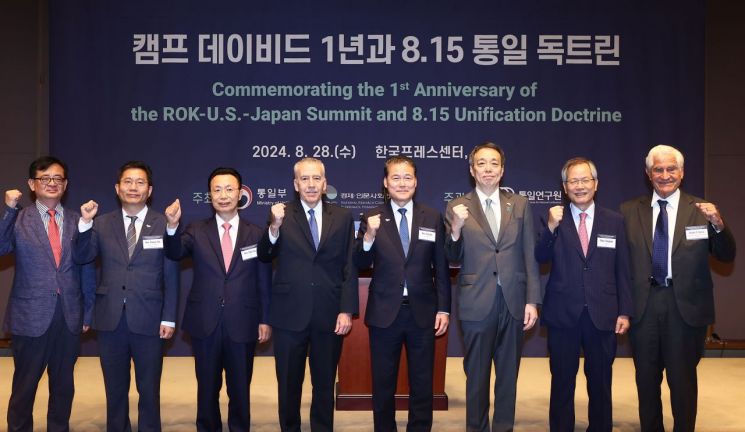 On the morning of the 28th, at the Korea Press Center in Jung-gu, Seoul, participants including Kim Young-ho, Minister of Unification, Philip Goldberg, U.S. Ambassador to Korea, Koichi Mizushima, Japanese Ambassador to Korea, and Kim Cheon-sik, President of the Korea Institute for National Unification, are taking a commemorative photo at the international academic conference marking the 1st anniversary of the Camp David Korea-U.S.-Japan summit meeting.
 [Photo by Yonhap News]
Honorary Chairman Cossa said, "Over the past several decades, our three countries?South Korea, the U.S., and Japan?have made efforts to involve China in resolving various issues caused by North Korea," explaining, "This was based on the belief that handling numerous difficult problems, including North Korea's nuclear program, would be impossible without China's support or consent."
He criticized, "Despite North Korea's ongoing threats, provocations, and human rights abuses, China continues to defend and empower the North Korean regime," and "Together with Russia, China blocks the enforcement or strengthening of United Nations Security Council (UNSC) resolutions." He further condemned, "In particular, China abets North Korea's human rights violations by forcibly repatriating defectors who face torture or worse punishment upon return."
Honorary Chairman Cossa pointed out, "Among China's support for North Korea, the decision to repatriate defectors dealt a significant blow to the international reputation of the Xi Jinping regime," emphasizing, "Sending defectors back to North Korea, where they may face torture or death, demonstrates China's disregard for international norms and procedures, as well as its callous indifference to human suffering."
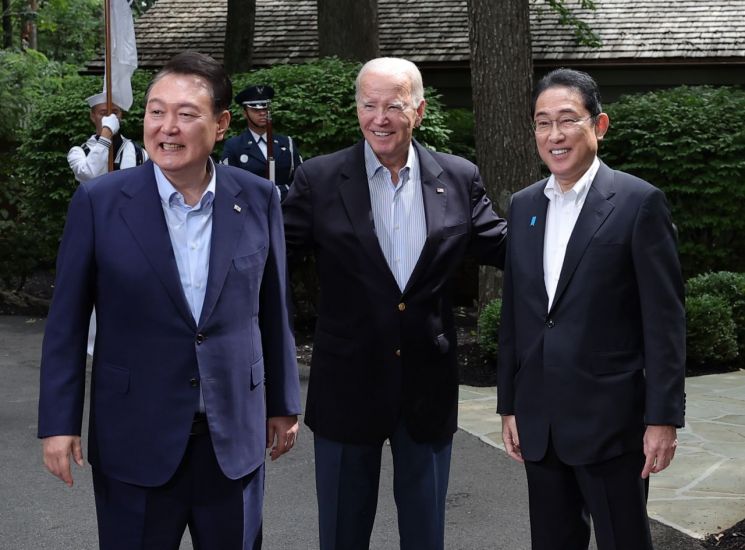 Last August, President Yoon Suk-yeol, U.S. President Joe Biden, and Japanese Prime Minister Fumio Kishida posed for a commemorative photo ahead of the South Korea-U.S.-Japan summit held at Camp David, the U.S. presidential retreat near Washington, D.C. Photo by Yonhap News.
He noted that to counter the security threats posed by North Korea, strengthening trilateral security cooperation among the three countries is necessary, along with measures beyond that. Such measures should deter China from empowering North Korea or repatriating defectors. Honorary Chairman Cossa proposed Taiwan as that 'card.'
He said, "South Korea, the U.S., and Japan each possess leverage in their dealings with China that has not been fully explored or utilized, with Taiwan being an example." He added, "Last year, Taiwan's direct investment in Southeast Asia surpassed its direct investment in China, marking a significant change driven by economic and political considerations," advising, "South Korean and Japanese companies should also participate in this shift."
Since China, which pursues the 'One China' principle, is extremely sensitive about the Taiwan issue, the implication is that Taiwan should be used as leverage to induce changes in China's North Korea policy.
Additionally, he pointed out the need to 'institutionalize' trilateral cooperation among South Korea, the U.S., and Japan, noting that "there is a high possibility that tactics and policies managing the alliance will change significantly depending on the outcome of the U.S. presidential election."
© The Asia Business Daily(www.asiae.co.kr). All rights reserved.


















