Next Year's Budget Set at 964.9 Billion Won
Research on Recyclable Launch Vehicles Also Begins
The budget for the Space Aviation Agency next year has increased by as much as 27% compared to this year, reaching 964.9 billion won. Although the government has stated its intention to maintain strict fiscal austerity, it appears to show strong commitment to supporting the space sector.
While research on reusable launch vehicles has begun and the budget for lunar exploration has been significantly increased, the budget for deep space exploration, which was expected to start with the launch of the Space Aviation Agency, was not included.
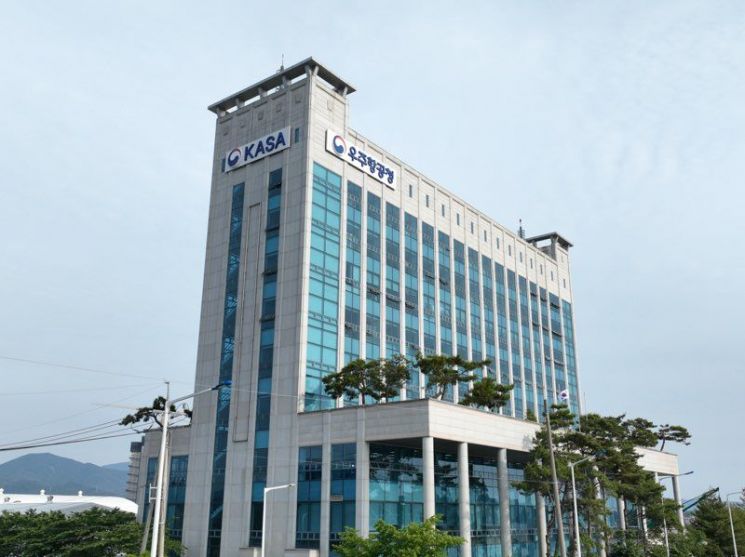
According to the Space Aviation Agency on the 28th, the 2025 budget will be concentrated on five areas: expanding space transportation capabilities and economic innovation (310.6 billion won), advanced satellite development (212.3 billion won), full-scale development of lunar landers and participation in the construction of the international giant radio telescope (54.3 billion won), securing leadership in the advanced aviation industry (40.5 billion won), and fostering a private-sector-centered industrial ecosystem (115.3 billion won).
The Space Aviation Agency's budget also includes the budgets of the Korea Aerospace Research Institute and the Korea Astronomy and Space Science Institute.
By sector, first, in the space transportation area, the budget has significantly increased as the Korean launch vehicle advancement project for repeated launches of Nuriho and the next-generation launch vehicle development project to send lunar landers are being intensified, and 5 billion won has been newly allocated for the preliminary technology development project for reusable launch vehicles aimed at economic launch vehicles.
The advanced satellite development sector increased by 36.3 billion won compared to this year. Along with expanded investment in satellite development for various missions, 11.3 billion won will be newly invested in next-generation communication satellites, and 5 billion won in satellite development projects for weather response purposes. The space exploration sector increased by 45 billion won compared to this year, with 45 billion won invested as the lunar lander development project is set to be fully launched next year, and 2 billion won allocated to the international giant radio telescope 'Square Kilometer Array Observatory' (SKAO) joint construction project.
The aviation industry sector has been allocated 40.5 billion won, which is 20.7 billion won less than this year, as many projects are ending this year. Seven projects, including the domestic production of lightweight materials for aviation, will conclude this year. The turbo fan aircraft engine Inconel superheat alloy forging development project has been allocated 10.7 billion won, an increase of 7.5 billion won compared to this year.
In addition, 115.3 billion won, an increase of 32.6 billion won compared to this year, will be invested in infrastructure acquisition projects such as the Space Triangle Cluster support project. The domestic space verification support project for domestic components and parts has been allocated 5.6 billion won, an increase of 4.2 billion won, and 2 billion won has been newly allocated to the Future Space Economy Cornerstone project supporting the localization of component-level parts.
The budget for next year did not include the newly expected additions in the space exploration sector, such as the Lagrange Point (L4) and Apophis asteroid exploration. L4 and Apophis have been anticipated as new milestones for Korea's space exploration with the establishment of the Space Aviation Agency, but it is understood that it was judged premature to allocate a budget at this time. The deep space exploration sector was expected to gain momentum with the appointment of John Lee, a former NASA mission director.
A Space Aviation Agency official explained, "In the case of L4, planning research has recently begun, so it is still impossible to estimate how much budget will be needed." The official added, "Regarding Apophis, it was previously rejected in a preliminary feasibility study, and since it is being pursued as an international cooperation project, it was not included in the budget."
Yoon Young-bin, head of the Space Aviation Agency, said, "For Korea to leap into the world's top five space aviation powers, bold research and development investment, creation of space aviation economy, and establishment of world-class research and industrial environments are important," adding, "With the increased budget scale, we will do our best to enable Korea to leap into the world's top five space aviation powers through bold research and development investment in the space aviation sector."
© The Asia Business Daily(www.asiae.co.kr). All rights reserved.

















