Lee Bok-hyun "Continued Disappointment Cases Among Merger and Tender Offer Investors"
Research Institute Calls for Commercial Act Revision... Also Suggests Individual System Improvements
Some Opinions Limit Scope to Listed Companies, Not General Corporations
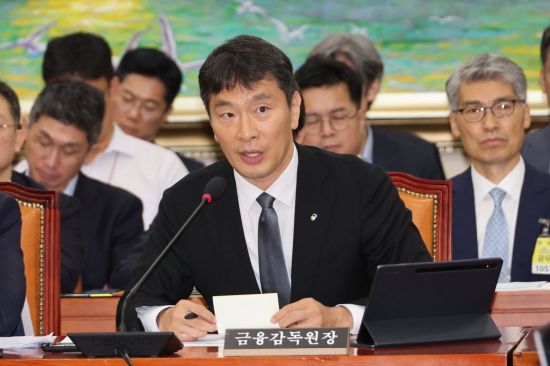 On the 28th, Lee Bok-hyun, Governor of the Financial Supervisory Service, criticized, "Cases where domestic and foreign investors are greatly disappointed due to decision-making solely for controlling shareholders in mergers or public offerings continue to occur." The photo shows Lee Bok-hyun, Governor of the Financial Supervisory Service, attending the National Assembly's Political Affairs Committee on the 25th. Photo by Yonhap News.
On the 28th, Lee Bok-hyun, Governor of the Financial Supervisory Service (FSS), criticized that "there continue to be cases where domestic and foreign investors are greatly disappointed due to decision-making solely for controlling shareholders in mergers or public tender offers." This remark is interpreted as referring to Doosan Group's corporate governance restructuring, which recently sparked controversy over the infringement of minority shareholders' rights during the calculation of merger ratios between subsidiaries.
Governor Lee held a 'Corporate Governance Improvement Research Institutions Meeting' at the FSS headquarters in Yeouido, Seoul, on the morning of the same day and made these remarks. Twelve participants from research institutions and business stakeholders attended the meeting, more than twice the size of the academic meeting held on the 21st, which had five attendees.
The core issue among capital market improvement tasks is the amendment of Article 382-3, Paragraph 3 of the Commercial Act (Duty of Loyalty of Directors). In Korea, the duty of loyalty of directors is specified as being to the 'company,' which has led to claims that when the interests of minority shareholders and controlling shareholders conflict, the board of directors tends to make decisions favorable to controlling shareholders, causing harm to minority shareholders. However, companies have opposed this, expressing concerns about managerial restraint due to excessive litigation.
Kim Woo-chan, Director of the Corporate Governance Research Institute at Korea University, who presented at the meeting, stated, "Currently, corporate governance in Korea is structured so that managers (heads) are loyal to their private interests rather than the company or shareholders' interests," and added, "There is a regulatory gap regarding capital transactions that do not directly harm the company, so an amendment to the Commercial Act concerning the duty of loyalty of directors is necessary." He also proposed establishing a separate provision to specify the duty of loyalty to the company, shifting the burden of proof for transaction fairness, and introducing exemption clauses such as a majority resolution requirement by minority shareholders.
Research institutions also suggested that, in addition to introducing a duty of loyalty to shareholders, individual institutional supplements are needed to address sensitive issues such as mergers or physical divisions. For example, they pointed out the need for deliberation and resolution through separate special committees within companies or the establishment of separate consent procedures for minority shareholders in major transactions. According to the FSS, there have been recent cases where special committees were formed during mergers between affiliates to separately collect opinions from minority shareholders.
On the other hand, the business community argued that rather than rushing to amend the Commercial Act, alternatives such as M&A guidelines to protect shareholders in mergers could be considered, similar to Japan. Kim Chun, Director of the Korea Listed Companies Association, said, "The duty of loyalty of directors to shareholders is difficult to recognize under the current legal system because there is no legal delegation relationship between directors and shareholders," and added, "Discussions should be based on clear standards of conduct or regulations according to specific cases."
There was also a suggestion that, assuming the current Commercial Act amendment discussions are an extension of the government's value-up policy, the scope should be limited to listed companies rather than all companies. In this case, the amendment could be made through the Capital Markets Act, under the jurisdiction of the Financial Services Commission, rather than the Commercial Act amendment led by the Ministry of Justice. This corresponds to Chapter 3-2 (Special Provisions for Listed Corporations) of the Capital Markets Act. Lee Jung-doo, Senior Research Fellow at the Korea Institute of Finance, pointed out, "Since the amendment of the duty of loyalty of directors mainly targets listed companies in line with value-up discussions, it is necessary to focus discussions on listed companies and consider introducing it in the special provisions for listed companies in the Commercial Act or the Capital Markets Act rather than the general provisions of the Commercial Act."
Governor Lee is the person who reignited the issue of amending the Commercial Act. Since June, he has been gathering opinions from academia, business, and finance sectors. A public hearing involving general investors is also planned for the second week of next month. It is expected to be similar to the 'open forum' held for discussions on short selling and financial investment income tax. The background for Governor Lee's focus on reigniting the Commercial Act amendment issue, which had been sidelined among the FSS's key matters for some time, is the controversy over Doosan's corporate governance restructuring.
In the National Assembly, discussions on amending the Commercial Act are active, mainly led by opposition parties. When Han Dong-hoon, leader of the People Power Party, argued for the abolition of the financial investment income tax on the 27th, Jin Sung-jun, Policy Committee Chair of the Democratic Party of Korea, immediately countered by stating, "The core of Korea discount is the backward corporate governance of our companies," advocating for the 'amendment of the Commercial Act.'
However, unlike the first half of the year when Governor Lee made radical proposals such as the abolition of the breach of trust crime, he now seems to be focusing more on gathering opinions regarding the amendment of the Commercial Act. Aware of criticism about whether it is appropriate for the FSS to take the lead in the Commercial Act amendment discussions, he said at the meeting on the 21st, "Although it is related to the Commercial Act, since it can have a significant impact on investors and the overall capital market, the Financial Supervisory Service, as the capital market supervisory agency, cannot help but take an interest."
© The Asia Business Daily(www.asiae.co.kr). All rights reserved.
![Clutching a Stolen Dior Bag, Saying "I Hate Being Poor but Real"... The Grotesque Con of a "Human Knockoff" [Slate]](https://cwcontent.asiae.co.kr/asiaresize/183/2026021902243444107_1771435474.jpg)
















