30 People's Livelihood Bills Submitted to the National Assembly Plenary Session
Nursing Act Expected to Reach Plenary After Judiciary Committee Approval
On the 28th, the ruling and opposition parties are scheduled to pass key livelihood bills in the National Assembly plenary session, including the so-called Goo Hara Act (Civil Code amendment) that strips inheritance rights from unparented or abusive parents, and the Special Act on Jeonse Fraud (Partial Amendment to the Special Act on Support for Jeonse Fraud Victims and Housing Stability) to ensure housing stability for victims of jeonse fraud. This marks the first bipartisan agreement in the 22nd National Assembly, just over three months after its opening.
The National Assembly will convene a plenary session at 2 p.m. that day to collectively approve 30 non-contentious and livelihood-related bills that passed the Legislation and Judiciary Committee the previous day. Until now, the leadership of both parties has discussed bills related to livelihood issues that can be agreed upon, responding to criticism that repeated partisan conflicts?such as bill proposals for political disputes, unlimited debates (filibusters), forced passage by the opposition, and presidential vetoes?have prevented timely handling of livelihood bills.
First, the Goo Hara Act, which was first proposed on June 2, 2020, shortly after the opening of the 21st National Assembly, was submitted to the plenary session after 1,548 days. Following Goo Hara's death in 2019, controversy arose when her biological mother, who had been out of contact for over 20 years and did not contribute to her upbringing, claimed inheritance rights. Both parties agreed on the need to amend the law, but the bill failed to pass the plenary session in May due to disagreements between the parties over contentious issues, resulting in its expiration without passage.
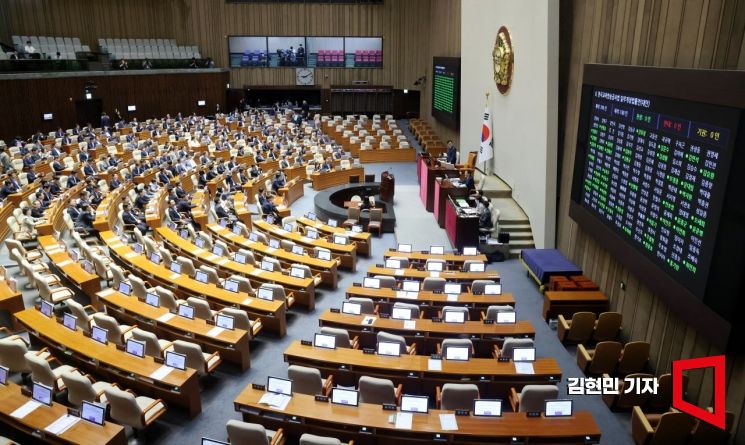 On the 30th, the amendment to the Educational Broadcasting Corporation Act (EBS Act), one of the four broadcasting laws, was passed in the plenary session of the National Assembly. Ruling party lawmakers abstained from the vote. Photo by Hyunmin Kim kimhyun81@
The Special Act on Jeonse Fraud to protect victims of jeonse fraud will also be processed this time. This law expands the scope of recognition for victims of jeonse fraud and includes provisions for the Korea Land and Housing Corporation (LH) to purchase jeonse fraud-affected properties through auctions and provide them as public rental housing to victims for up to 20 years or support the auction profit difference.
In addition, other livelihood bills such as the amendment to the Act on Promotion of Mutual Growth between Large and Small-Medium Enterprises, the amendment to the City Gas Business Act, the amendment to the Industrial Cluster Activation Act, the amendment to the Special Act on Public Housing, and the amendment to the Act on Protection of Crime Victims are also scheduled to be handled in the plenary session that day. The amendment to the Act on Promotion of Mutual Growth between Large and Small-Medium Enterprises includes provisions allowing courts to be petitioned to prevent unfair use of technical data when there is concern about damage to small and medium enterprises. The amendment to the City Gas Business Act allows local governments and others to apply on behalf of vulnerable groups to ensure they are not excluded from city gas fee reduction services. The amendment to the Industrial Cluster Activation Act guarantees the expansion of renewable energy use by companies located in industrial complexes.
The amendment to the Special Act on Public Housing aims to extend the special period for the Urban Public Housing Complex Project, which is currently set to expire on September 20, until December 31, 2026, to promote housing supply in aging areas. Furthermore, the amendment to the Act on Protection of Crime Victims, which allows compensation to be paid to the bereaved families when a crime victim dies, was also approved by the Legislation and Judiciary Committee the previous day.
Moreover, the Nursing Act bill, which had faced difficulties due to bipartisan disagreements, passed the Health and Welfare Committee's bill subcommittee the previous day and is expected to be approved in the plenary session after the Legislation and Judiciary Committee's approval that day. The Nursing Act primarily aims to legally protect the medical acts of Physician Assistant (PA) nurses. There had been disagreements over the scope of PA nurses' duties and the academic qualifications required for nursing assistants to take exams. However, as the medical service gap prolonged, there was consensus on the urgent need to establish legal grounds for PA nurses who partially perform doctors' duties, leading to agreement on the government's proposal to define the scope of PA nurses' duties "by the Ministry of Health and Welfare decree considering clinical experience, etc."
Meanwhile, it is reported that the ruling and opposition parties have agreed not to re-vote on bills such as the "Broadcasting Four Acts," the "Universal 250,000 Won Support Act," and the "Yellow Envelope Act," on which President Yoon Seok-yeol exercised his right to request reconsideration (veto) during the plenary session that day.
© The Asia Business Daily(www.asiae.co.kr). All rights reserved.

![User Who Sold Erroneously Deposited Bitcoins to Repay Debt and Fund Entertainment... What Did the Supreme Court Decide in 2021? [Legal Issue Check]](https://cwcontent.asiae.co.kr/asiaresize/183/2026020910431234020_1770601391.png)














