Surging Demand and Shrinking Supply Lead to Edible Rice Sellout
Ironically, Factory-Use Rice Also Being Discarded
Controversy is growing as 'rice' has reportedly sold out at Japanese retail stores ahead of the landfall of the large typhoon 'Sansan.' This is because citizens have been hoarding rice, and the recent influx of foreign tourists has caused rice demand to suddenly surge.
On the 28th (local time), photos of empty rice shelves in Japanese supermarkets have been continuously posted on social media platforms such as X (formerly Twitter). Local netizens also expressed concern. A user on X, who identified as a housewife, reported, "I went around several nearby supermarkets, but (rice) was sold out," adding, "There is nothing placed on the shelves where rice is usually sold."
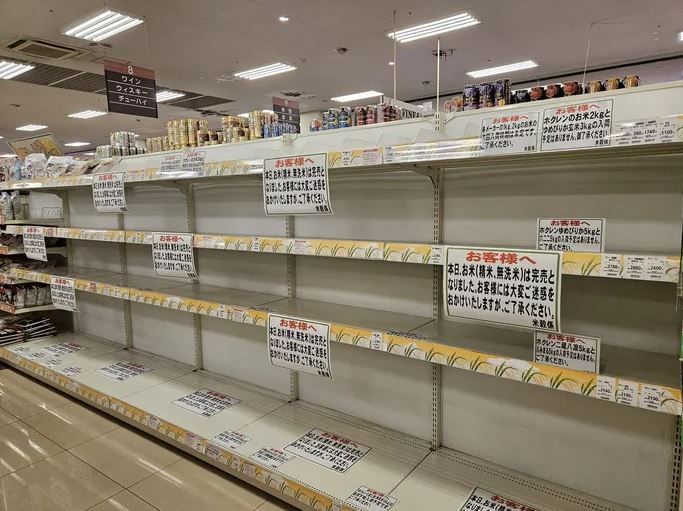
In fact, Japan is currently experiencing a rice supply shortage. The previous day, the Japanese daily newspaper Asahi Shimbun reported that as of the end of June, the private stockpile of rice was 1.56 million tons, marking a record low. The sudden disruption in rice supply has multiple causes. First, since May last year, the Japanese archipelago has experienced a significant lack of sunlight, and during the summer, abnormal heatwaves damaged crops. As a result, this year's rice harvest sharply declined.
Meanwhile, since last year, the number of foreign tourists has increased, and domestic consumers have engaged in 'revenge spending' by dining out after COVID-19, leading to a surge in rice demand. The Japanese government's control over edible rice supply has also been pointed out by media as a factor exacerbating the rice supply crisis. Additionally, due to concerns about the so-called 'Nankai Trough Earthquake' on the 8th, many households stocked up on rice early, which also contributed to the shortage.
The Osaka local government announced that rice was sold out in more than 80% of retail stores. Some have compared this situation to the so-called 'Heisei rice crisis' caused by poor harvests in 1993-1994, and the term 'Reiwa (post-2019 Japanese era) rice turmoil' has also been mentioned.
Ironically, while the supply of edible rice is disrupted, the amount of discarded rice is also reaching record highs every year. Asahi pointed out that Japanese rice companies supply food factories that produce rice balls, sushi, and lunch boxes, and the amount of unsold waste from these products is about 40 tons per day, with pure rice weight alone reaching 8 tons.
Regarding the reason why rice supply is cut off on one side while being oversupplied on the other, a local food expert remarked, "Companies order more rice than actual demand out of fear of losing sales opportunities, and consumers naturally expect to always obtain fresh food." He added, "(Because of this) products that are still edible are immediately discarded, which increases the amount of rice waste."
© The Asia Business Daily(www.asiae.co.kr). All rights reserved.

















