Confirmed Commitment to Fostering Three Major Game-Changer Technologies through Research Institutes
Promise to Accelerate Innovation at Research Institutes
Yoo Sang-im, Minister of Science and ICT, chose the Korea Institute of Science and Technology (KIST) as his first research site visit after taking office. Unlike his predecessor Minister Lee Jong-ho, who selected a semiconductor company as his first site visit, this choice is interpreted as a demonstration of his determination to secure global leadership in the three major game-changing technologies through government-funded research institutes. The innovation plan, which was to be promoted following the deregulation of government-funded research institutes as public institutions, will also be actively pursued.
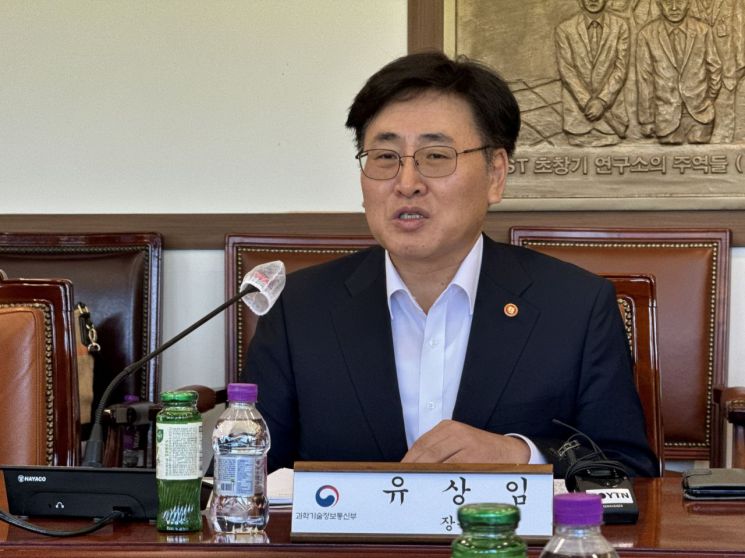 Minister Yoo Sang-im of the Ministry of Science and ICT is delivering a greeting during a visit to KIST on the 28th. Photo by Baek Jong-min
On the 28th, Minister Yoo held an on-site meeting at KIST headquarters in Seoul to listen to research trends in strategic technology fields and encourage related researchers. The Ministry of Science and ICT explained that Minister Yoo’s choice of KIST, the eldest among government-funded research institutes, as his first visit reflects his intention to innovate and nurture these institutes as leading organizations for national core projects.
From his inaugural speech, Minister Yoo emphasized the role of government-funded research institutes in fostering the three major game-changing technologies: artificial intelligence (AI) and semiconductors, advanced bio, and quantum technologies. He demanded that government-funded research institutes, which carry out national missions, must have capabilities befitting their status and be able to stand on equal footing with the world’s top research institutions to guarantee national competitiveness. The Ministry of Science and ICT’s budget proposal for next year, announced a day earlier, also significantly increased funding for these institutes, reflecting the intention to entrust them with the responsibility of nurturing strategic technologies.
Minister Yoo visited the Next-Generation Semiconductor Research Institute at KIST, which is leading the ultra-large-scale computing semiconductor project as part of the Global Top Strategy Research Group. He heard from the institute director that it is necessary to attract excellent talent both internally and externally beyond organizational boundaries and to flexibly adjust research goals and budget execution.
Under the leadership of Director Oh Sang-rok, who took office in May, KIST has introduced a ‘mission-oriented research institute’ system, where a research institute director with top research and management capabilities acts as a program manager (PM), setting specific performance goals and having full authority to manage research accordingly. Director Oh himself is an expert PM in the science and technology field.
Young and mid-career researchers at KIST collectively expressed in the meeting with Minister Yoo that if a stable policy environment is maintained while supporting various forms of joint and collaborative research and providing opportunities for researchers to grow independently, the preference for government-funded research institutes will increase.
Minister Yoo said, “The voluntary innovation efforts of government-funded research institutes, such as operating mission-oriented research institutes, are encouraging,” and emphasized, “To gain an advantage in the global technology hegemony competition, government-funded research institutes must serve as a hub that consolidates the capabilities of industry, academia, and research in strategic technology fields.”
He also stated, “I will soon hold candid discussions with institution heads and, through continuous communication with research sites, encourage innovation for government-funded research institutes to advance as leading organizations, while sparing no effort in government support and nurturing.”
The Ministry of Science and ICT plans to promptly establish operational regulations for government-funded research institutes to settle the innovation and operational directions proposed after their deregulation as public institutions, following Minister Yoo’s visit to KIST.
The operational regulations for government-funded research institutes will include specific measures to increase institutional autonomy, such as special recruitment of outstanding talents including scholars, allowance of separate compensation systems, and adjustment scopes and procedures for the execution of research funds.
The Ministry of Science and ICT plans to expand the scale of the Global Top Strategy Research Group, which aims to consolidate industry-academia-research capabilities centered on government-funded research institutes to produce major achievements, to support more challenging research next year. It will also promote new programs supporting joint research by young researchers at government-funded research institutes.
© The Asia Business Daily(www.asiae.co.kr). All rights reserved.
![Clutching a Stolen Dior Bag, Saying "I Hate Being Poor but Real"... The Grotesque Con of a "Human Knockoff" [Slate]](https://cwcontent.asiae.co.kr/asiaresize/183/2026021902243444107_1771435474.jpg)
















