WSJ "Dup (Affordable Alternative) Threatens Lululemon"
Despite its high prices, the American sportswear brand Lululemon, once dubbed the "Chanel of yoga wear," has recently been reported to face consumer neglect. More young consumers are opting for affordable brands with better cost-effectiveness instead of premium leggings priced around 200,000 won.
On the 25th (local time), The Wall Street Journal (WSJ) reported that 'dupes,' cheaper versions of premium brands like Lululemon, are gaining popularity among young consumers as alternatives. It noted that some counterfeit products are even preferred over the originals, forecasting that premium sportswear brands' growth may be hindered by these 'dupes.' 'Dupe' is short for 'duplication,' referring to low-cost products that imitate the style and quality of premium items.
 Actor Jeon Jong-seo is throwing the ceremonial first pitch at the Los Angeles (LA) Dodgers and Kiwoom Heroes Major League Baseball (MLB) Seoul Series practice game held last March at Gocheok Sky Dome in Seoul.
 [Photo by Joint Coverage]
Founded in Canada in 1998, Lululemon led the premium athleisure market by selling products such as leggings at high prices reaching 200,000 won. During the COVID-19 pandemic, as athleisure looks gained popularity and many clothing brands struggled, Lululemon became one of the 'invincible brands' that survived.
In South Korea, it was also known as the "Herm?s of leggings" and the "Chanel of leggings," recognized as a strong player in the premium athleisure market. Actress Jeon Jong-seo also drew attention by wearing Lululemon's khaki leggings during a ceremonial first pitch.
Lululemon's sales increased by more than 15% for 14 consecutive quarters. In the recent fiscal year (ended January 28), the company's annual sales reached $9.6 billion (approximately 12.7 trillion won), up 19% from the previous year. In the first quarter of this year, sales exceeded expectations with $2.21 billion (about 3.03 trillion won), an increase of around 10% compared to the same period last year.
However, there is analysis that this growth momentum has stalled. In March, Lululemon experienced a sharp decline in sales within the U.S. The securities industry also forecasted a slowdown in performance starting from the second quarter.
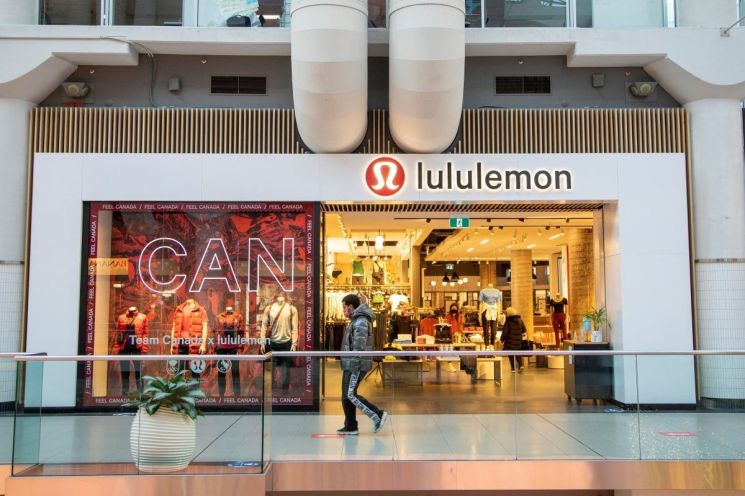
The trend shift toward consumers seeking 'cost-effectiveness' (performance relative to price) is interpreted as the reason for the halt in Lululemon's growth. Micaela Kichopoulos (22), a college student, told WSJ, "Wearing clothes with premium brand logos doesn't hold as much meaning as before," adding, "It's better to look for discounted or cost-effective products."
A survey conducted by research firm Morning Consult in October last year, targeting 2,200 American adults, found that about one-third had purchased 'dupes.' Among the respondents, 50% of Generation Z and 44% of Millennials preferred dupes. Consequently, affordable brands like Gymshark, AYBL, and Halara are seen as pioneering new markets within the athleisure sector.
Lululemon's loyal consumers are also turning away. According to WSJ, when customers recently complained that new leggings "accentuate the stomach and hips too much," Lululemon stopped selling those products both online and offline.
© The Asia Business Daily(www.asiae.co.kr). All rights reserved.
![Clutching a Stolen Dior Bag, Saying "I Hate Being Poor but Real"... The Grotesque Con of a "Human Knockoff" [Slate]](https://cwcontent.asiae.co.kr/asiaresize/183/2026021902243444107_1771435474.jpg)

















