US Presidential Election Bipartisan Candidates
Alternative Approaches to Poverty Alleviation
U.S. Democratic presidential candidate Vice President Kamala Harris and Republican candidate former President Donald Trump are fiercely clashing over methodologies to address 'poverty.' Vice President Harris's camp views subsidy payments as an effective way to solve poverty, while former President Trump's side expresses concerns that it could lead to a decline in work motivation.
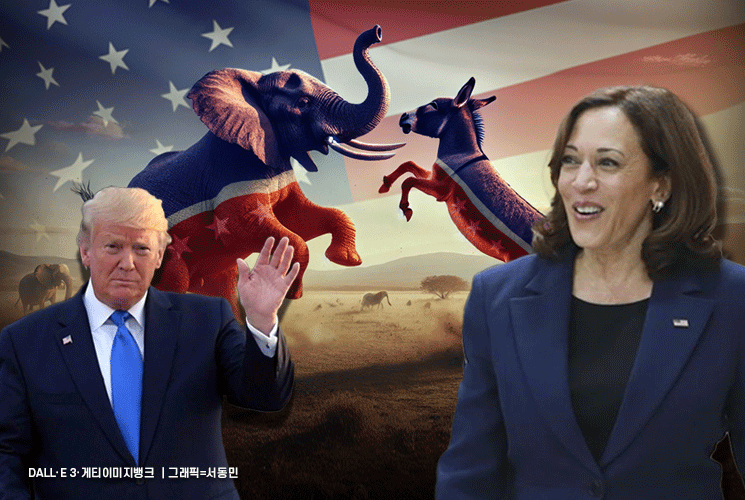
According to the New York Times (NYT) on the 26th (local time), Vice President Harris plans to maintain or expand food, medical, and housing subsidies that significantly benefit low-income groups if elected. She also intends to provide a Child Tax Credit (CTC) guaranteeing $3,000 income per child regardless of income level. This comes from an analysis that the CTC, which former President Trump implemented during his tenure with a $2,000 payment per child, was not considered an effective poverty measure because it provided greater tax deductions as income increased.
Former President Trump holds the position that direct subsidy payments to low-income groups will ultimately be insufficient to solve poverty. The reason is that it could reduce the incentive to work.
The difference in positions on subsidy payments is well illustrated by the Affordable Care Act (ACA), known as 'Obamacare.' The core of the ACA is that the government provides subsidies to insurance companies so that the poor can also receive medical benefits. Vice President Harris has announced that she will focus on strengthening the ACA if re-elected.
Former President Trump does not seem to advocate for repealing Obamacare, likely aware of the possibility of 'losing support' since it has become popular. However, the NYT reported that the possibility of subsidy cuts is being mentioned. This is in light of the recent proposal by the Republican Study Committee, a pro-Trump faction in the U.S. House of Representatives, to cut Medicaid and the Children's Health Insurance Program subsidies by more than half over ten years, amounting to $4.2 trillion.
Regarding food stamps, which provide free food to low-income groups, Vice President Harris argues for a significant budget increase to ensure children benefit. Former President Trump, who tightened eligibility criteria during his tenure, may view this as budget waste and plan to cut support.
On housing policy, Vice President Harris's camp is expected to continue housing support for low-income groups, similar to the Biden administration. However, in her economic initiative speech during the first 100 days after taking office on the 16th, Vice President Harris emphasized support for first-time homebuyers and large-scale housing supply rather than housing subsidies for the poor. Meanwhile, former President Trump has emphasized plans to cut 10% (about 250,000 units) of housing vouchers provided to low-income families.
Former President Trump claims that the personal income tax cuts for all income brackets implemented in 2017 during his administration were a turning point that reduced poverty to pre-COVID-19 pandemic levels and has stated that he will make these permanent if re-elected, as they are set to expire next year. The personal income tax cuts, which varied by income bracket, lowered the top tax rate from 39.6% to 37%, sparking controversy over tax cuts for the wealthy. The NYT explained, "Most of the direct benefits of these cuts went to corporations and the wealthy."
© The Asia Business Daily(www.asiae.co.kr). All rights reserved.
![Clutching a Stolen Dior Bag, Saying "I Hate Being Poor but Real"... The Grotesque Con of a "Human Knockoff" [Slate]](https://cwcontent.asiae.co.kr/asiaresize/183/2026021902243444107_1771435474.jpg)
















