Focused Investment in 3 Major Game-Changer Technologies
Upgrading Future Technology Competitiveness through Preliminary Feasibility Study Exemption and Abolition
Expanding Budget for Research Institutes and Increasing Scholarships and Cash Support for STEM Students
Restoring Scientists' Pride Amid Budget Cut Controversies
The national research and development (R&D) budget for next year has been set at 29.7 trillion won. Compared to the 2023 budget before the budget cuts occurred, this represents an increase of 400 billion won, or 1.3%. It is an 11.8% increase compared to this year, when budget cuts were implemented. As this budget is a recovery from the wounds left by budget cuts in the science and technology sector, efforts for future progress are now necessary.
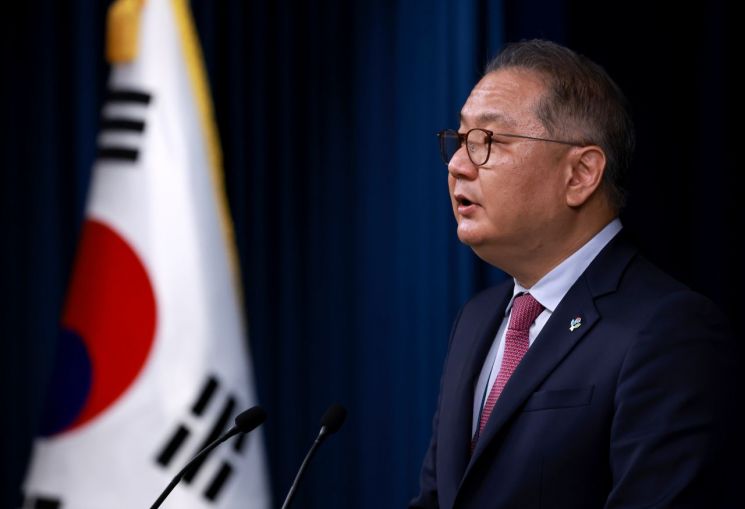 Park Sang-wook, Chief of Science and Technology at the Presidential Office, is giving a briefing on the results of the 2025 research and development (R&D) funding allocation on the 27th at the Presidential Office building in Yongsan, Seoul.
 [Image source=Yonhap News]
According to the 2025 budget plan released by the government on the 27th, next year’s R&D budget will focus on national strategic technologies centered on three major game-changer technologies: artificial intelligence (AI), semiconductors, advanced bio, and quantum technologies. It will also concentrate on creating a research environment for young scientists through the introduction of the Korean-style Staipend, and on transitioning to leading-edge R&D such as global and innovative challenge R&D.
The budget size confirmed by the government increased by 5.2 trillion won compared to the 24.5 trillion won national R&D budget allocation plan announced by the Ministry of Science and ICT in June. This includes the general R&D budget finalized by the Ministry of Economy and Finance.
The government’s R&D budget in 2023 was 31.1 trillion won, but after applying international standards and classifying education and other sector R&D as general fiscal projects, it is now calculated as 29.3 trillion won.
The Ministry of Science and ICT previously expressed optimism that if the general R&D budget under the jurisdiction of the Ministry of Economy and Finance is maintained at this year’s level of 4.6 trillion won, the total government R&D budget for next year would reach 29.4 trillion won, surpassing the record 29.3 trillion won in 2023.
The Ministry of Science and ICT also stated that an additional 300 billion won would be reflected for projects expected to pass preliminary feasibility studies and multi-ministerial collaborative budgets, suggesting that even more budget could be secured. Park Sang-wook, the science and technology chief at the Presidential Office, also repeatedly assured that next year’s R&D budget would be the largest ever.
This has become a reality. On the 26th, a day before the budget announcement, six R&D preliminary feasibility study exemptions were announced. Areas such as quantum science technology and the Korean-style Staipend (research living allowance for graduate students in science and engineering) were immediately reflected in next year’s budget.
Minister Yoo Sang-im of the Ministry of Science and ICT also responded at the full meeting of the National Assembly’s Science, Technology, Information and Broadcasting Committee a day earlier when Democratic Party lawmaker Hwang Jeong-ah inquired about next year’s R&D budget level, saying, "Initially, it was said to increase by about 100 billion won from the 2023 level, but it seems to be a bit more," and added, "The budget is expected to be decided at around 29.7 trillion won." A senior official from the Ministry of Science and ICT said, "Thanks to the support from policy stakeholders in the science field, it seems that more budget than expected has been secured."
A director of a government-funded research institute said about this budget plan, "Although there was an increase announced in June, this scale definitely conveys a strong will to support R&D," and expressed determination to accelerate research.
Professor Lee Deok-hwan, emeritus professor at Sogang University, welcomed the increase itself but pointed out that the honor of scientists has not yet been restored. He emphasized, "The honor of scientists, which fell due to the hasty R&D budget cuts last year, has not yet been restored," and stressed that the government should implement policies that can restore the pride of scientists.
There is also opposition. Opposition lawmakers, including Democratic Party lawmaker Hwang Jeong-ah and Justice Innovation Party lawmaker Lee Hae-min, pointed out that "the real R&D budget adjusted for inflation is reduced by 4.2%, or 1 trillion won, compared to 2023," and criticized that "the Yoon Seok-yeol administration is not following the ‘2022-2026 Medium-Term Fiscal Management Plan’ announced in 2022." At the Science, Technology, Information and Broadcasting Committee meeting held that day, lawmakers also reminded Minister Yoo Sang-im of the research project she was in charge of as a Seoul National University professor that was discontinued. The Ministry of Science and ICT responded that adjustments to inefficient research projects are inevitable.
◆ Investing in the three major game-changers to become a global top 3 power = Next year’s R&D budget by sector will invest 3.5 trillion won in the three major game-changer fields, an increase of 700 billion won compared to this year. The budget increase was made to achieve the goal of becoming one of the global top 3 powers (G3) by 2030.
1.2 trillion won will be invested in next-generation AI ecosystems and the development of artificial general intelligence (AGI) technologies. In the bio sector, 2.1 trillion won will be invested focusing on advanced regenerative medicine, data and AI convergence, and messenger ribonucleic acid (mRNA) vaccine development. To accelerate catching up in quantum science technology, which is significantly behind advanced countries, 200 billion won will be invested in flagship projects such as the development of 1,000-qubit-class leading technologies.
In strategic technology fields, 7.1 trillion won will be invested, an increase of 1.7 trillion won compared to this year. This includes the development of low-power, high-efficiency domestic AI semiconductors, next-generation small modular reactors (SMR), reusable launch vehicle technology development, and securing autonomy in 6th generation mobile communication (6G) technology. Living allowances, research incentives, and presidential science scholarships will be provided for young researchers.
Basic research will receive 2.9 trillion won, an increase of 300 billion won compared to this year, to expand excellence-focused programs by establishing follow-up research for excellent projects, policy agenda research, and new and high-difficulty pioneering research programs.
To expand international research, 2.2 trillion won will be invested in global R&D, an increase of 400 billion won compared to this year, and 1 trillion won will be invested in innovative challenge-type R&D, an increase of 300 billion won.
Overseas joint research will participate in Boston Korea and Horizon Europe, and innovative challenge research will foster a research system that grants principal investigators (PM) full authority over research management.
Public R&D will develop new disaster technologies such as lithium fire battery technology with a new investment of 5 billion won, and conduct research to prepare for 2050 carbon neutrality, including clean hydrogen technology.
Government-funded research institutes have been allocated 3.6 trillion won, an increase of 300 billion won compared to this year, to reorganize and expand around open autonomous research. This includes all facility costs of the research institutes. In particular, the budget for global top strategic research groups involving government-funded research institutes increased from 100 billion won this year to 183.3 billion won, and the number of projects increased from 5 to 15.
© The Asia Business Daily(www.asiae.co.kr). All rights reserved.
![Clutching a Stolen Dior Bag, Saying "I Hate Being Poor but Real"... The Grotesque Con of a "Human Knockoff" [Slate]](https://cwcontent.asiae.co.kr/asiaresize/183/2026021902243444107_1771435474.jpg)
















