Korea Consumer Agency Survey on 30 Products
17 Products Raise Concerns of Sudden Infant Death Syndrome
Products Not Allowed for Infant Sleep Use in the US
A significant number of cradles, pillows, and cushions advertised and distributed for infant sleep have been found to pose a risk of suffocation accidents.
On the 27th, the Korea Consumer Agency announced that out of 30 products (10 each of cradles, cushions, and pillows) advertised and sold for infant sleep, 17 products (56.7%) were found to have levels of risk associated with Sudden Infant Death Syndrome (SIDS). SIDS refers to the sudden death of an infant under one year old, usually occurring during sleep without a clear cause, and is also known as crib death.
 A significant number of cradles, pillows, and cushions advertised for infant sleep and distributed on the market have been found to pose a risk of suffocation accidents. [Image source=Getty Images]
In South Korea, over five years (2018?2022), a total of 275 infants died from SIDS, occurring at a rate of about 0.2 per 1,000 live births annually. Countries like the United States and Australia consider unsafe sleep environments as one of the causes of SIDS and have strengthened safety standards for infant sleep products such as beds, cradles, and cushions.
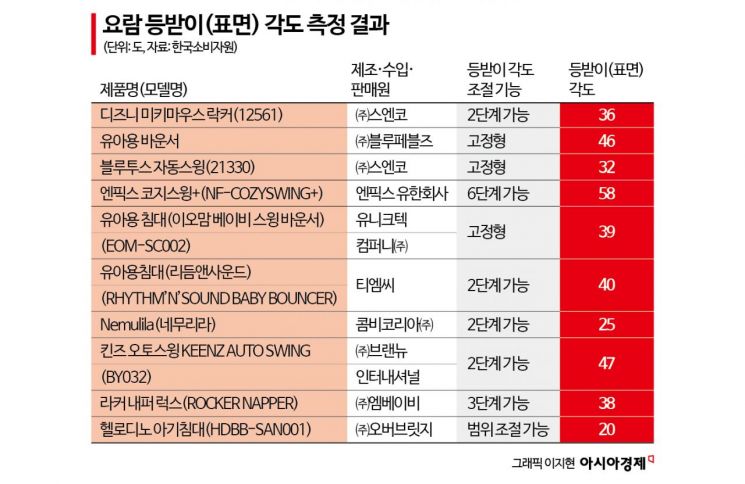
In particular, all products designed or advertised for infant sleep are regulated to have a backrest (surface) angle of 10 degrees or less, and products exceeding this angle are prohibited from being sold as sleep products. However, when the Consumer Agency tested the backrest surface angles of the 30 products surveyed, 17 products exceeded the U.S. standard applied (10 degrees or less), ranging from 11 to 58 degrees, confirming that these products cannot be sold as sleep products in the U.S.
A Consumer Agency official explained, "Infants with immature growth and development have unstable breathing during sleep and relatively underdeveloped neck muscles and narrow airways, making them more susceptible to suffocation accidents compared to other age groups. When infants who cannot support their necks are placed on inclined sleep products, the weight of their heads causes their necks to bend forward, compressing the airway, or they can easily roll over, blocking their mouth and nose with bedding, increasing the risk of suffocation."
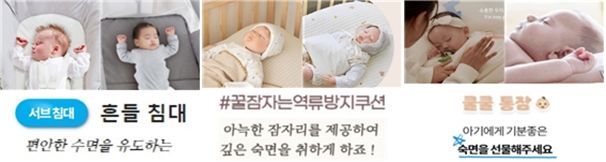
Despite this, all surveyed products were found to be advertised using expressions related to sleep or inducing sleep, such as 'bed,' 'deep sleep,' and 'sound sleep.' Additionally, many products failed to properly display caution or warning labels for SIDS prevention. Only 8 out of the 30 products included caution or warning labels regarding suffocation risks.
Based on this investigation, the Consumer Agency recommended that all surveyed businesses display caution and warning labels related to suffocation risks and SIDS, remove advertising content that suggests the products are for sleep if the backrest (surface) angle exceeds 10 degrees, and include warnings that the products are not for sleep use. A Consumer Agency official urged, "For safe infant sleep and SIDS prevention, infants should be placed on firm and flat surfaces, and nothing except a fitted sheet that matches the mattress should be placed in the sleep space."
Meanwhile, the National Institute of Technology and Standards is conducting research and development projects to establish safety management measures to ensure the safety of infants and young children. By the second half of this year, they plan to prepare a revision of safety standards for infant sleep products and revise the standards after gathering opinions from industry, consumers, and other stakeholders.
© The Asia Business Daily(www.asiae.co.kr). All rights reserved.



















