Korea University Advocates Regional Proportional Selection System
"Wealthy and Seoul Residents Enter Prestigious Universities...Inheritance of Wealth"
"Excessive Entrance Exam Competition Causes Structural Social Crisis"
Excessive competition for college entrance exams causes various social problems such as the inheritance of wealth, population concentration in the metropolitan area, rising housing prices, and low birth rates. Therefore, it has been argued that major universities like Seoul National University should proportionally select talented students based on the regional school-age population to alleviate inequality.
On the 27th, the Bank of Korea released a report titled "Social Problems Caused by Overheated Entrance Exam Competition and Countermeasures," pointing out that the overheated competition for college entrance exams causes various social problems including the burden of private education, inequality in educational opportunities, reduced social mobility, low birth rates and population concentration in the metropolitan area, students' emotional instability, and low educational outcomes.
Entrance Exam Competition Deepens Socioeconomic Status Inheritance
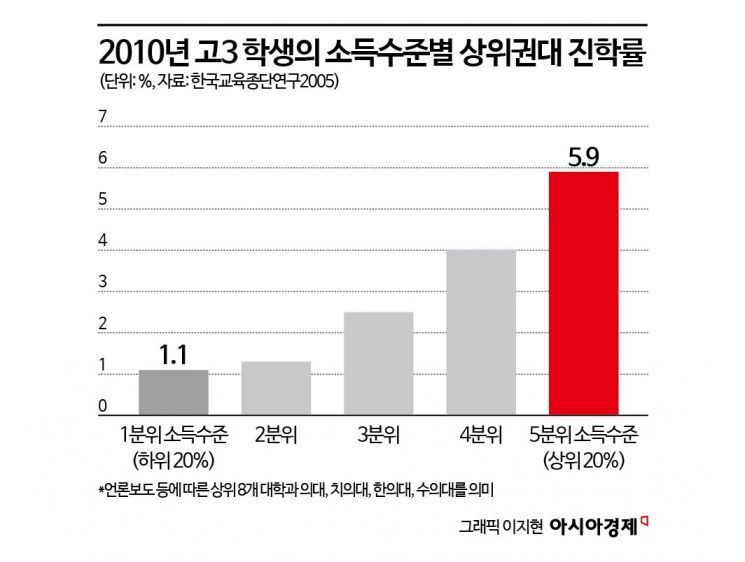
The Bank of Korea especially emphasized that entrance exam competition deepens the inheritance of socioeconomic status. The competition has increased private education expenses, placing a heavy burden on households and causing inequality in educational opportunities depending on income level and residential area.
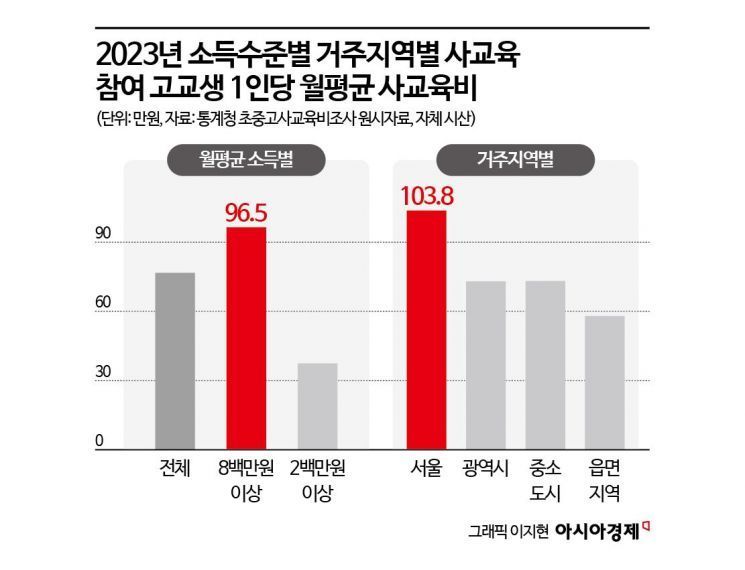
Last year, the average monthly private education expense per high school student was 970,000 KRW for high-income households with a monthly income of over 8 million KRW, whereas it was only 380,000 KRW for low-income households with a monthly income below 2 million KRW. In Seoul, the per capita private education expense was 1,040,000 KRW, compared to about 580,000 KRW in rural areas.
The gap in private education expenses by income level and residential area leads to differences in admission rates to top-tier universities and particularly causes a concentration of Seoul-born students among those admitted to top universities.
Based on 2018 general high school graduates, students from Seoul accounted for only 16% of all graduates but made up 32% of those admitted to Seoul National University. Students from the Gangnam 3 districts accounted for only 4% of all graduates but 12% of Seoul National University entrants.
Lee Dong-won, head of the Micro-Institution Research Division at the Bank of Korea Economic Research Institute and author of the report, said, "Empirical analysis confirmed the phenomenon of socioeconomic status inheritance, where high-income students achieve better results than their potential in top-tier university entrance exams through their parents' economic power and residence in private education hubs."
Entrance exam competition also causes population concentration in the metropolitan area and rising housing prices in Seoul. The report analyzed that the educational enthusiasm toward top universities leads to a preference for living in areas with superior private education environments, which in turn causes population concentration in the metropolitan area and rising housing prices in Seoul. It also increases education and child-rearing costs, acting as a major reason for young generations delaying childbirth and marriage.
Prestigious Universities Should Actively Recruit Regional Talents
The report argued that bold approaches are necessary to mitigate the negative effects of such entrance exam competition. It proposed that major top-tier universities introduce a "regional proportional selection system" when selecting talents.
The regional proportional selection system is a system where universities voluntarily select most of their admission quotas reflecting the regional school-age population ratio, while allowing universities to autonomously choose selection criteria and methods.
Currently, some universities, including Seoul National University, operate similar systems such as regional balance admissions, but the regional proportional selection system expands this to most of the admission quotas. This system differs from existing Seoul National University regional balance admissions and special opportunity balance admissions in that it applies to most admission quotas, reducing stigma effects, and allows universities to freely choose freshman selection criteria.
The government will actively accept university plans, provide incentives such as financial support if necessary, and play a role in retrospectively checking whether universities comply with entrance exam plans and whether any admission fraud occurs.
The report expected that introducing the regional proportional selection system would reduce the impact of socioeconomic background on entrance exams and effectively discover talented local students with potential. The potential here refers to the pure academic ability of talents, excluding external variables such as parents' economic power and residence in private education hubs.
To verify this, a hypothetical scenario was analyzed where some admission quotas in the 2018 Seoul National University entrance exam were selected according to the regional school-age population ratio by city/province units, and the remaining quotas were selected by the existing method. The result showed that applying this system to most admission quotas adjusted the Seoul National University admission rate closer to students' potential.
When applying a rule that the acceptance rate for a specific region is between 0.7 and 1.3 times the proportion of third-year high school students, the gap between the Seoul National University admission rate and the potential admission rate decreased by 64% compared to the current situation.
The report acknowledged that the system's introduction might somewhat disadvantage marginalized groups in Seoul and benefit high-income groups in local areas, but considering the advantages such as reducing the impact of socioeconomic background on entrance exams, these drawbacks are deemed tolerable.
Also, considering that students admitted through existing Seoul National University regional balance admissions and special opportunity balance admissions do not show significant differences in academic performance compared to other students, it is expected that talents selected through the regional proportional selection system will also have satisfactory academic performance.
Regional Proportional Selection System Will Reduce Metropolitan Population Concentration and Other Problems
The report expected that the regional proportional selection system would geographically disperse the entrance exam competition concentrated in Seoul, thereby alleviating problems such as population concentration in the metropolitan area, rising housing prices in Seoul, low birth rates, and late marriages.
When the admission rate to top universities in Seoul is significantly high as it is now, local students have incentives to move to Seoul despite relocation costs. This leads to concentrated demand for limited resources such as schools, academies, and housing in Seoul, increasing social costs such as education expenses and housing prices.
Lee said, "This system allows major top-tier universities to voluntarily select most of their admission quotas reflecting the regional school-age population ratio, while freely choosing selection criteria and methods. It is a highly effective measure that can quickly help our society escape from the 'bad equilibrium' without government policy intervention."
© The Asia Business Daily(www.asiae.co.kr). All rights reserved.



















