Approved as Original Proposal with 85.76% Approval from Attending Shareholders
The merger proposal between SK Innovation and SK E&S passed at the extraordinary general meeting of shareholders held on the 27th. Although the major shareholder, the National Pension Service, opposed it citing concerns about 'potential damage to shareholder value,' it did not affect the outcome.
On the day, SK Innovation held an extraordinary general meeting at the SK Seorin Building in Jongno-gu, Seoul, and approved the merger contract with SK E&S. The National Pension Service, the second-largest shareholder of SK Innovation, exercised its expected voting rights against the merger at the meeting, but the merger was approved as originally planned with 85.76% of the attending shareholders voting in favor.
The merger, a special resolution item at the general meeting, passes if two-thirds or more of the attending shareholders and one-third or more of the total issued shares approve it. 62.76% of all shareholders attended the meeting. The major shareholders of SK Innovation are SK Group holding company SK Inc. with 36.22%, the National Pension Service with 6.28%, individuals with 24.9%, foreigners with 20.9%, and other institutions with 8.9%. Since SK Inc. holds more than one-third of the total issued shares, only the requirement of two-thirds or more of the attending shareholders needed to be met. SK E&S is an unlisted company, so the schedule of the general meeting is not publicly disclosed, but since SK Inc. holds 90% of the shares, the merger approval is expected to pass smoothly.
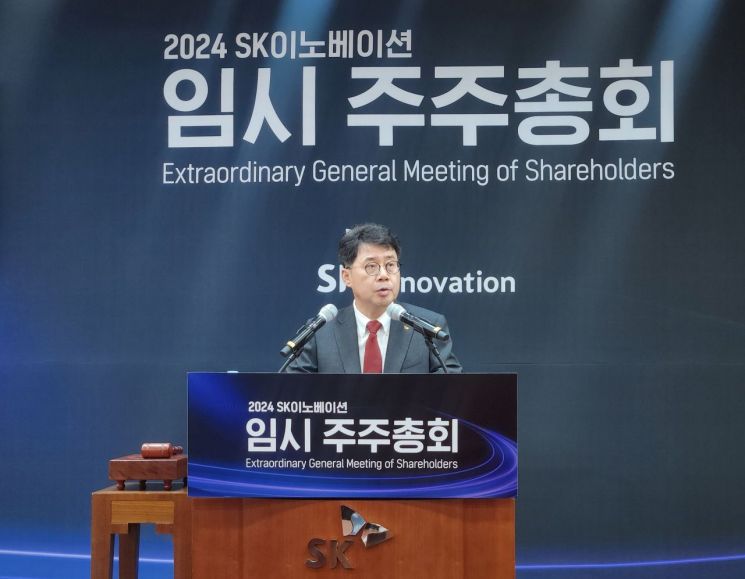 Park Sang-gyu, President of SK Innovation, is speaking at the SK Innovation Extraordinary General Meeting of Shareholders held on the 27th at the SK Seorin Building in Jongno-gu, Seoul. Photo by Choi Seoyoon
The National Pension Service did not raise any particular objections at the meeting but may exercise the right to request stock purchase later. If the National Pension Service exercises the right to request stock purchase in full, SK will have to buy shares worth 681.7 billion KRW. This amount is close to the 800 billion KRW prepared by SK Innovation. Shareholders opposing the merger, including the National Pension Service, can exercise the right to request stock purchase from that day until the 19th of next month. The expected purchase price is 111,943 KRW per share. SK Innovation’s stock price was 106,500 KRW at the previous day’s closing, which is below the exercise price of the purchase right, potentially leading to a flood of shares for profit realization.
SK Innovation announced when deciding on the merger that "if the amount exceeds 800 billion KRW, the contract may be canceled or the merger conditions changed." Regarding this, SK Innovation President Park Sang-gyu said at the meeting, "We set the limit sufficiently by referring to past cases," and "We expect that the right to request stock purchase will not exceed the range anticipated by the company." He added, "If it does exceed, we will decide whether to proceed after consulting with the board of directors," and "Since the company holds more than 1.4 trillion KRW in cash, it is not at a level that cannot be handled."
An industry insider said, "Since stock transaction costs amount to several hundred billion KRW and funds are frozen for about a month according to related regulations, the likelihood of the National Pension Service exercising the right to request stock purchase is low," adding, "The difference between the expected purchase price and the current stock price is only about 5,000 KRW."
With SK Innovation absorbing SK E&S through the merger, a large energy company with assets worth 100 trillion KRW will be created. It will rise to first place in the Asia-Pacific region’s private energy companies, surpassing Japan’s ENEOS Holdings (95 trillion KRW), which was previously second. The merged entity will officially launch on November 1. To maximize merger synergies and maintain the competitiveness of both companies, the merged entity will operate as a Company-in-Company (CIC). The goal is to become a comprehensive energy company with an EBITDA of 20 trillion KRW by 2030. SK Group has been promoting the merger as part of rebalancing (business restructuring). While SK claims the merger aims for external growth to become a comprehensive energy company, the market views it as part of the effort to 'save SK On,' which has posted losses for ten consecutive quarters.
Regarding shareholder questions about share buybacks, President Park said, "After the merger is completed, we will consider various financial matters and implement shareholder-friendly policies," adding, "The government is also discussing value-up plans, and we will create mid- to long-term plans accordingly to reward our shareholders." On the expected timing for SK On to turn profitable, he said, "(SK On’s performance) is greatly affected by external factors. Internally, SK On needs to make two efforts simultaneously," explaining, "We must consistently work on creating an environment where profits can be made even if growth is slow through internal cost reduction," and "If we build a balanced business beyond the existing petrochemical business, we believe we can operate a stable business in the mid- to long-term."
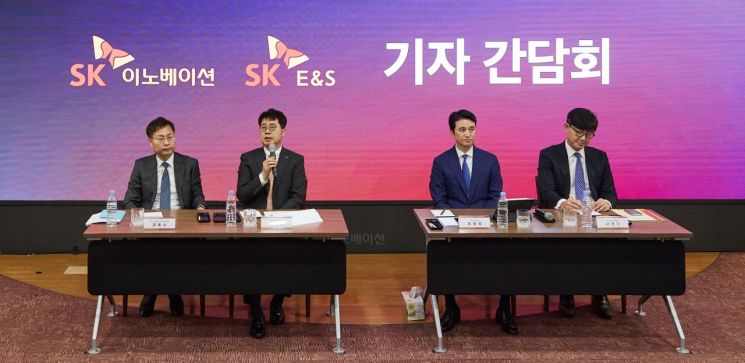 At the 'SK Innovation-SK E&S Merger' press conference held on the 18th of last month at the SK Seorin Building in Jongno-gu, Seoul, from the left, Kang Dongsu, Head of Strategy and Finance at SK Innovation, Park Sanggyu, President of SK Innovation, Chu Hyungwook, President of SK E&S, and Seo Geonki, Head of Finance at SK E&S, are engaging in a Q&A session.
 [Photo by SK Innovation]
Earlier, on the 22nd, the National Pension Service’s Stewardship Responsibility Committee decided to oppose the merger ratio of 1 to 1.1917417 between listed SK Innovation and unlisted SK E&S, citing that it was inappropriate and posed a significant risk of damaging the value of SK Innovation’s common shareholders. Even though the merger ratio calculation did not violate the Capital Markets Act, they judged that SK Innovation’s stock price was undervalued at about half of its asset value and did not properly reflect the company’s stock value.
SK Innovation’s new shares will be listed on November 20. After the merger, SK Inc.’s shareholding ratio is expected to increase from 36.22% to 55.9%.
© The Asia Business Daily(www.asiae.co.kr). All rights reserved.


















