The government has set a goal to increase the number of leading fields from the current semiconductor, display, and secondary battery sectors to six by investing more than 30 trillion won over five years in 12 national strategic technology areas.
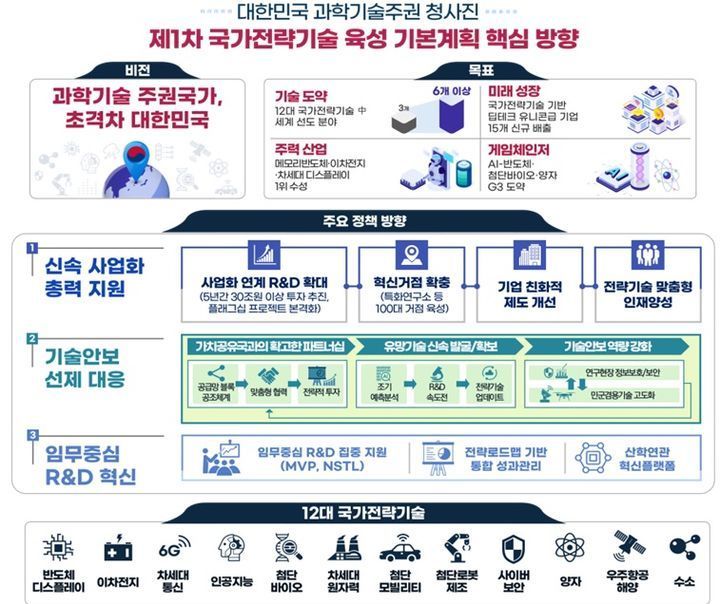
On the 26th, the Ministry of Science and ICT announced that it had approved the "1st Basic Plan for Fostering National Strategic Technologies" at the National Science and Technology Advisory Council's deliberation meeting. The basic plan is a five-year inter-ministerial plan that presents a mid- to long-term vision and policy directions in accordance with the Special Act on Fostering National Strategic Technologies.
This plan includes the government's vision of a "Blueprint for South Korea's Science and Technology Sovereignty," outlining three major policy tasks to be carried out by 2028 and key policy directions for each of the 12 national strategic technology fields.
First, the government decided to support R&D in the 12 fields with more than 30 trillion won over five years, focusing on private sector demand. Investments will be expanded in three game-changing fields: artificial intelligence (AI) and semiconductors, advanced bio, and quantum. The government will also actively promote 10 flagship projects in strategic technologies, with a cumulative investment of over 3 trillion won planned by 2033. New projects will be additionally identified in fields such as advanced robotics and manufacturing, and hydrogen, where flagship projects have not yet been established.
For small and medium-sized venture R&D, more than 50% of new projects will be allocated to the 12 strategic technology fields, and public-private cooperative R&D and financial support for startups and growth will be strengthened.
The national strategic technology system will be renewed every two years through deliberation by the Science and Technology Advisory Council, similar to the U.S. White House's Emerging and Critical Technologies (CET) system.
The government-funded research institutes will introduce the National Science and Technology Laboratory (NSTL), an open cooperative system that transcends institutional boundaries for strategic technology development. Additionally, a performance management system will be established for the main tasks and deadline-based goal achievements of the strategic technology roadmap, and the national R&D survey analysis and future forecasting system will be linked with the 12 fields to strengthen policies.
Cooperation systems will be established between top-level policy bodies for major fields, such as the National Artificial Intelligence Committee, and the Science and Technology Advisory Council. A Strategic Technology Innovation Forum will be launched and operated, and the establishment of a "Korean-style Technology Security Think Tank" leading the 12 national strategic technology issues will also be pursued.
The 12 national strategic technologies will be subdivided and supported into leading fields, catching-up and competitive fields, and future challenge fields.
Leading fields, including semiconductors and secondary batteries, will focus on securing ultra-gap technologies and maintaining supply chain dominance, while catching-up fields such as AI, advanced bio, and next-generation nuclear power will promote early commercialization of strategic technologies.

Future challenge fields such as quantum, aerospace, and hydrogen will concentrate on public-led innovative challenge projects to catch up with technological gaps, and aim to cooperate with value-sharing countries and participate in multilateral cooperation systems.
Through these policies, the government aims to increase the number of world-leading technologies to six fields and produce 15 unicorn-level companies (unlisted startups valued at over 1 trillion won) based on strategic technologies.
Lee Joo-heon, Director of Strategic Technology Development at the Ministry of Science and ICT, said, "The investment of more than 30 trillion won over five years is a relatively conservative level, and we will strive to invest much more."
Yoo Sang-im, Minister of Science and ICT, stated, "By consolidating the capabilities of ministries, industry, academia, and research institutes, we will faithfully implement the policy tasks included in the basic plan so that South Korea can take a step forward not only in survival amid global technological hegemony competition but also in future growth engines and technology security capabilities."
© The Asia Business Daily(www.asiae.co.kr). All rights reserved.


















