China: "Philippine Ship Deliberately Rammed"
Philippines: "Chinese Fighter Jet Fired Flare"
Chinese and Philippine vessels involved in the South China Sea territorial dispute clashed again near the Spratly Islands (called Nansha Qundao in Chinese and Kalayaan Islands in Filipino) after six days.
China stated that the collision occurred because the Philippines deliberately rammed its coast guard vessel. Earlier, the Philippines claimed that China threatened them by firing flares, escalating tensions between China and the Philippines over the South China Sea.
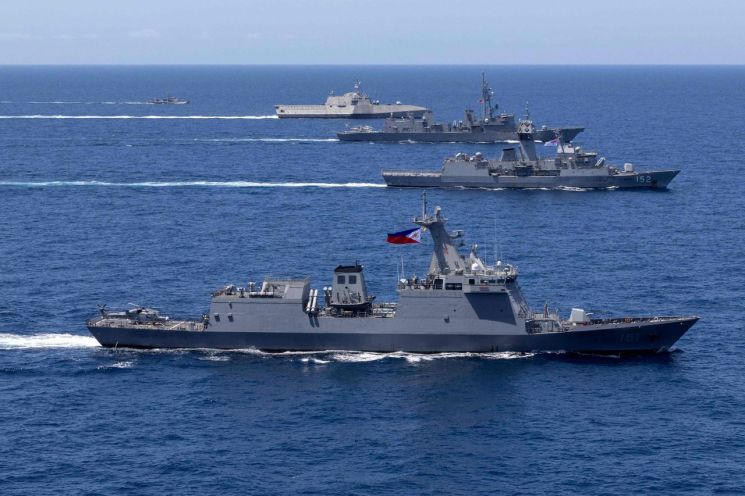
According to Chinese state broadcaster CCTV and local media such as the Philippine Star on the 25th, Gan Wei, spokesperson for the China Coast Guard, said on official social media that "Philippine vessel 3002 insisted on transporting supplies to Philippine coast guard vessel 9701, which was illegally staying in the waters near China's Nansha Qundao (Spratly Islands) 'Xianbinjiao' (the Chinese name for Sabina Reef, known as Escoda Reef in the Philippines), despite repeated advice and warnings from the China Coast Guard."
He added, "At around 2:12 PM (China time) that day, Philippine vessel 3002 refused to comply with control and deliberately rammed China Coast Guard ship 21551, which was lawfully conducting enforcement, causing the collision. The responsibility lies entirely with the Philippines."
Earlier, the Philippine Department of National Defense and the 'West Philippine Sea Task Force,' a coalition of Philippine government agencies, stated in a release the previous day that Chinese fighter jets fired flares at Philippine Bureau of Fisheries and Aquatic Resources (BFAR) patrol planes patrolling the South China Sea on the 19th and 22nd.
According to the Philippine government, on the 19th, a BFAR patrol plane was conducting surveillance over the Scarborough Shoal (called Huangyan Dao in Chinese) in the South China Sea when a Chinese fighter jet dangerously approached at close range and fired flares. Then, on the 22nd, flares were also fired at a patrol plane surveying the Subi Reef (called Zhubi Jiao in Chinese) area.
The Philippines stated that the BFAR patrol planes were on routine patrol and said, "China must immediately cease all provocative and dangerous actions that threaten the safety of Philippine vessels and aircraft legitimately operating within Philippine territorial waters and EEZ (Exclusive Economic Zone)."
This is the first collision between China and the Philippines near Sabina Reef in six days since the incident on the 19th.
Meanwhile, China claims sovereignty over about 90% of the South China Sea, causing friction not only with Vietnam, Taiwan, Malaysia, and Brunei but also with the international community, including the United States.
© The Asia Business Daily(www.asiae.co.kr). All rights reserved.
![Clutching a Stolen Dior Bag, Saying "I Hate Being Poor but Real"... The Grotesque Con of a "Human Knockoff" [Slate]](https://cwcontent.asiae.co.kr/asiaresize/183/2026021902243444107_1771435474.jpg)
















